


 Francais
 Deutsch
 Italiano
Refine Your Search
Japanese-martial-arts stock footage and images
- Showing 1615 to 1620 of 4328 results more
more Hide
Hide
Japanese Imperial Navy warships in Aleutian waters in wintertime, during World War II
Japanese Imperial Navy ships encounter severe icing conditions in Aleutian waters during winter, World War 2. Thick layer of ice covering everything on the deck of a Japanese light cruiser. Sailors chop ice from a container on deck and shake ice loose from guy lines. Ice sculpted by wind and wave on the foredeck. Two forward turrets and their single 5.5 inch guns covered in ice. Looking from starboard, towards the stern, a Mitsubishi F1M2 (Pete) scout observation plane can be seen mounted on the ship. Another light cruiser seen well astern. More views of ice covering a ship and of sailors chopping it away.
Japanese Kamikaze planes are shot down during the Battle of Okinawa (WW2)
Japanese planes attack United States fleet off Okinawa Island, Japan. A barrage of United States Navy fire shoots down the Kamikaze planes. Views of fire and smoke-filled sea and air. Curtain of anti-aircraft flak fired at Japanese aircraft. Many attacking aircraft seen streaking across the sky and some falling into the ocean after being hit by fire form U.S. Navy ships. (World War II period).
Representatives of nations sign Japanese surrender and peace treaty ending World War II, on the deck of USS Missouri, Tokyo Bay
Officials of various countries arrive. Sailors standing at attention. General Douglas MacArthur arrives on deck and stands in front of a microphone. Japanese officials, military and civilians standing in groups. Japanese General signing the surrender document then the Russian General Derevyanko, General Sir Thomas Blamey from Australia, Colonel Moore Cosgrave General Jacques P. Leclerc of France and Admiral Cel Helfrich from Netherlands signs the peace treaty.
U.S. troops take key Japanese bases in the Makin Islands during the World War II.
Allied Forces advance during the World War II. U.S. troops fight on the Makin Islands in the Pacific. Animated map of Makin Islands. The U.S. soldiers waddle in water to reach the shore. They move through jungle terrain. A soldier talks on the radio. More troops and tanks come in. U.S. planes bomb and strafe the Japanese positions. Captured Korean laborers sit. Dead Japanese soldiers. Lieutenant Colonel James Roosevelt drinks from a cup. Tanks and infantry move forward.
U.S. invasion fleet sails towards Tarawa and destroys Japanese emplacements during the World War II.
U.S. turns offensive in the Pacific theater and captures Tarawa from Japan during the World War II. The U.S. invasion fleet moves toward Tarawa. Sailors on the ship discuss the strategy. A globe showing the Pacific Ocean. Marines on the fleet ships pray. The U.S. Navy opens fire. Explosions on the surface of water. Marines land and fight after a naval bombardment. More reinforcements arrive. Destroyed Japanese emplacements due to the American offensive. Wrecked Japanese weapons on the island. Korean laborers. American construction battalions repair the damaged airfield.
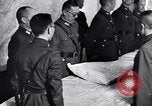
Chinese men, women and children mass migrate to the West in China, as they flee the invading Japanese.
Chinese emigrate to the West as they flee the invading Japanese. Chinese military officers and officials in a meeting. They develop strategies to fight the Japanese invasion. Maps and charts on the table. They confer on territory yield, military strategy and industrial power for production of rifles and guns. An officer talks as he points to a wall map. They decide to move West into the mountains. Chinese men blow up roads, scorch fields, and blow up factories before proceeding westward. Factories in flames. People begin to move towards the West. Men, women and children walk, ride in hand rickshaws. They cross bridges and cities in the process of mass migration. People carry their belongings and machinery. Libraries, schools and houses are dismantled and carted away. Machinery moved in trucks and carts. People wait for a train near a railroad. They board a train bound westward. men dismantle railway tracks to leave no route for the enemy. People seated on railway carriages. Overcrowded boats and barges in a river. Elderly people and children in the boats. People cross a river running through a mountain gorge. People walk on the banks and pull load and boats with ropes. People climb hills and move further into the mountains. (World War II period).
CRITICALPAST.COM: About Us | Contact Us | FAQs - How to Order | License Agreement | My Account | My Lightboxes | Shopping Cart | Advanced Search | Featured Collections | Website Terms & Conditions | Privacy Policy ©2026 CriticalPast LLC.
License Agreement |
Terms & Conditions |
Privacy Policy
©2026 CriticalPast LLC.