


 Francais
 Deutsch
 Italiano

Refine Your Search
Japanese-martial-arts stock footage and images
- Showing 2557 to 2562 of 4337 results more
 Hide

Contrast between the lifestyle of hectic workdays and quiet Sundays in New York City in the late 1940's after World War 2.
"City Pastorale" shows citizens of New York City hurrying about their business during workday on a street in New York City. Vehicular traffic and pedestrians. People riding on the subway. Views of workaday foot traffic along New York sidewalk in midtown Manhattan. Macy's department store. Racks of clothes being wheeled along the streets and sidewalks. Scenes of New Yorkers in hectic activity. In contrast, are shown peaceful scenic views of New York City. Penthouse gardens. Clothes drying on a rooftop line. People entering a number of different churches in Manhattan, New York. A woman in a garden. A man and a boy sit and read newspapers in the garden. The young boy looks at the "funny papers" (comic strips). A man walks with a child on a sidewalk. Cars parked. People chatting on the sidewalk of a New York city street. The Chrysler Building and nearby skyscrapers. People taking pictures with handheld cameras at a playground. Families with babies. Children playing in a park. Quiet streets. Car drives beneath an elevated train. Men walk on a ramp. People relax on beaches. Older women gathered together on the beach talking, while boys play in the sand at the edge of the surf. A huge crowd seated in a baseball stadium and watching a game between the New York Giants and the Brooklyn Dodgers, including a shot of Giants pitcher, #36 ( Mickey McGowan ?), throwing from the mound and, in another scene, Giants #23 (Clint Hartung ?) batting and striking out. Views of the fans watching the baseball game, including some men in suits and boys sitting together in the bleachers watching the game and eating ice cream on a stick. Visitors stroll through the Metropolitan Museum of Art.

Views of New York City and environs, especially Manhattan, in the United States.
Film begins showing location of New York City on a world globe, at the mouth of the Hudson River on the East Coast of the United States. It transitions to an aerial view of the Southern tip of Manhattan Island at the junction of the Hudson and East Rivers and slowly shows views moving Northward along the Hudson River. Piers along the Hudson are visible. Scene shifts to above those piers, looking South at the cluster of Manhattan skyscraper buildings, and beyond to New York Harbor, the borough of Queens, and Brooklyn, and beyond to Long Island in the misty distance. Next the skyscrapers are seen from Queens,across the East River. A large ocean liner is seen underway in New York Harbor, among ferry boats, barges, and tugboats. The Statue of Liberty is seen in the background. An animated map shows regions around New York and traces the Hudson and Mohawk valleys into the Great Lakes. The map is then overlaid with numerous lines representing transportation routes by lend, water, and air. View of Brooklyn Bridge, wharfs, and Manhattan skyline in hazy background. Seagoing freighters loading and unloading at New York's piers. A truck and other cargoes being moved by cranes. Passenger trains moving in the New York city area. View of the famous Beaux-Arts style Penn Station by architects McKim, Mead, and White, at West 34th Street and Eighth Avenue, in Manhattan. Train station interior crowded with travelers and commuters. Commercial aircraft taxiing at a New York area airport. Closeup of two young children watching the planes. Passengers deplaning from a large aircraft. Sign for Peruvian International Airways atop an airport building. A Swissair passenger plane being serviced. Passengers boarding a TWA Lockheed Constellation airplane. A family watching airplanes from an airport observation deck. The Lockheed Constellation starting its engines. A Douglas DC-4 aircraft taxis out and takes off, as several boys watch from the observation deck. Closeup of another group of boys watching planes from the observation deck. Aerial view of Manhattan skyscraper buildings from an overflying airplane. Traffic on streets at Times Square. The Astor Hotel at the left and the Times building straight ahead. Several other street scenes in Manhattan, crowded with pedestrians. A view residential apartment houses along Park Avenue. Views of African Americans crowding the sidewalks in Harlem. Views of "Little Italy" in the lower East side of Manhattan, where Italian restaurants and other businesses are seen. Chinatown is seen with some of the business signs in Chinese. A man of Chinese heritage reading a letter. Asian American children playing together in a neighborhood. New high rise apartment buildings are seen replacing older homes in parts of Manhattan. Mothers wheeling their children on sidewalks in one of the new neighborhoods.

Pan American Union Building; South America Statue; Gardens; Washington Monument, in Washington DC.
The Pan American Union Headquarters Building in Washington DC, United States. A garden around the Beaux Arts-style building. A circular drive at the Pan American Union Building (Organization of American States Building, 200 17th St NW, Washington, DC 20006). People arrive by automobile and climb up the steps at the entrance. The vehicle drives away. A statue of a woman with a child at the building with the words 'South America' inscribed on the base. The garden from where part of the Washington Monument is visible. Another small building. A garden with walkways in front of the building. The United States flag sways, the flag of Panama hoisted on a pole and another flag.
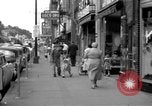
Views of a typical small town in the midwestern United States in the 1950s, Ottumwa, Iowa.
In a U.S. Army documentary, an Army Sergeant walks on sidewalks of a typical 1950 small town in the rural United States -- Ottumwa, Iowa. Civilians on streets of the city. Various shops and 1940s and 1950s era automobiles. People from various walks of life talk to the Sergeant. The Sergeant recalls the town's ancestors entering America. The Des Moines river is shown with a small boat anchored at the end of a dock and men and boys fishing. Statue of Native American Indian Chief atop the Courthouse Building, Chief Wapello, whose tribe camped in the spot of the town years prior. The entrance of the library. Still images and drawings from the library depicting the town. Pictures of houses, shops and other buildings. People on the streets of Ottumwa. The Ottumwa Daily Courier newspaper headline announcing U.S. participation in World War I, "War Becomes Actuality." Images of members from Ottumwa's own Company G, 42nd Rainbow Division in WWI, including soldiers Arthur Menge, Charles Orman, Marlow Work. Views of WWI battle scenes. Oscar Nelson is remembered for heroism. WWI soldiers returning to American towns. Private Charles Orman 40 years later in Ottumwa. He enters a barber shop. Art Menge is also seen in the Barber shop. Aerial view of the city with many bridges, plants, factories, and homes visible. Cars and pedestrians on streets, The Ottumwa Bank, the Airport with a plane parked in front of the terminal, the Railroad train station with people waiting as a large sleek silver passenger train pulls up and arrives. The Hoffmann Drug store, the Ottumwa Hotel, The Ottumwa Daily Courier newspaper building, the Glover Motor Company, the Union Bank, and the Sunnyslope Sanitorium. Various homes and neighborhoods and 1950s automobiles. Governor Herschel Loveless, an Ottumwa native, at home with his wife. The home on Davis Street of the Miss Universe contest winner Carol Morris, and views of Ms. Morris in the pageant and receiving the winners crown in 1956.

Conservators and workers sent to Florence after heavy floods damage great artistic works.
Heavy floods inundate the city of Florence, Italy, caused by flooding of the Arno River on November 4, 1966. A man views immense erosion on the side of the Arno River caused by floodwaters. Trucks parked outside the Florence National Central Library. Piles of books and manuscripts destroyed by floods. Conservators flip through pages of a book. Workers try to clean and restore famous art works by Italian Renaissance artists.
President Nixon works to improve social conditions of minorities under his entrepreneurship program in the United States.
U.S. President Richard Nixon's administration works to improve the conditions of minorities in American society. President Nixon shakes hands with African American dignitary. View of factory machines working at a cardboard box, packaging, and furniture business owned by an African American business man named Al Hollingsworth. Mr. Hollingsworth demonstrates some box packaging pieces and speaks in favor of Nixon's support for minority business owners. Three parked 18 wheeler trucks owned by Latino business man JJ Corasco. Corasco speaks in favor of Nixon's work with the Small Business Administration (SBA) supporting Mexican American business owners like himself. One truck begins to drive. View of a man using a drill press in a Toy Company that grew out of a small arts and crafts business. A man who is the Native American Indian business owner of the toy shop speaks in favor of Nixon's minority small business support. Scenes of the Native American man and his workers in the toy factory. From a pro-Nixon "documentary" called "The Nixon Years: Change Without Chaos" covering President Richard Nixon's first four years in office. Released during his 1972 reelection campaign.