


 Francais
 Deutsch
 Italiano
Refine Your Search
Japanese-martial-arts stock footage and images
- Showing 3025 to 3030 of 4328 results more
more Hide
Hide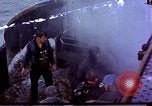
Crewmen throw bombs off USS Enterprise (CV-6) after it was attacked by a kamikaze aircraft while underway in the Pacific Ocean
Japanese air attack on U.S. ships underway in the Pacific Ocean during World War II. Crewmen throw bombs in ocean from USS Enterprise (CV-6) after it was attacked by a Japanese suicide kamikaze aircraft. Debris on the deck. Ships in the far background and explosions in sky and water are seen in the distance as battle against Japanese aircraft continues.
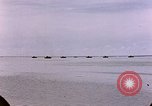
U.S. Marines examine damaged structures and Knocked out tanks on Saipan, Mariana Islands during World War II.
A line of landing craft silhouetted on the horizon. An explosion on the shore behind them. Camera pans from beach, across a bay to a beached landing craft, and then back past some damaged huts, to a destroyed Japanese motorcycle that an American marine examines. A marine climbs through a damaged Japanese wooden structure. A marine examines a knocked out Japanese 1st Yokosuka SNLF Type 2 Ka Mi Amphibious tank
U.S. aviators are welcomed at different places during their journey around the world.
A flight around the world. A globe rotates. U.S. President Calvin Coolidge bids goodbye to army airmen. The President and Major General Mason Patrick and the fliers on a lawn of the White House, Washington DC. The journey starts from Seattle, Washington. Douglas World Cruisers ( DWC ) in flight. The DWCs parked in a bay. A forest in the background. They arrive at Chignik Bay, Alaska. The aircraft in flight. An iceberg. Lieutenant Lowell Smith stands on one of the pontoons and works with propellers on his DWC. The DWCs in flight from America to Asia. The aviators are welcomed by Japanese officials in Yetorufu, Japan. Japanese children playing in a school yard. A child has a Japanese and a U.S. flag, one in each hand. They reach Hong Kong, China. A fleet of native junks to welcome them. In Calcutta, India , a DWC taxis on water. A large number of people gather around a DWC. A crane lifts a DWC out of water. The aviators land in Constantinople. People around the aircraft. They reach Paris, France.. Aerial views of the city. Mrs. Maclaren congratulates the airmen in London, England. The crew of USS Richmond cheers the aviators. The aviators board their aircraft from a small boat. People watch as the aircraft land in Labrador, Canada. The DWCs are anchored in a bay and the aviators are brought to the shore in a boat. Naval officers greet them. The aircraft in flight over the Boston skyline. A motor launch in Boston Harbor. The DWCs land on water. The aviators arrive at the dock in the motor launch and are greeted by officials. They fly over New York. A large crowd greets the aviators at Mitchel Field, Long Island. They arrive at Bolling Field in Washington and are congratulated by President Coolidge and U.S. Secretary of War John Wingate Weeks. The three DWCs are followed by an XNBL-1 Barling bomber in flight in Dayton. Lt. Jack Harding is welcomed home. The world flight ends in Seattle, Washington. Photographers click pictures as a DWC lands. Major Martin greets aviators standing beside a DWC.
British Prime Minister Winston Churchill in many meetings before and after America's entry into World War II
Opening slate reads: "Quebec Conference August 1943." The English battleship, Prince of Wales, is seen in fog off the Coast of Newfoundland, in August 1941. View of sailor on fore-deck of the British ship. View inside engine room of the ship where sailor manipulates her power. Closeup of engine crankshaft stopping as she drops anchor in Placentia Bay. View of Prime Minister Winston Churchill, greeting U.S. President Franklin D. Roosevelt aboard the Prince of Wales. He proffers a letter to the President, from the King of England. View of Roosevelt and Churchill seated on deck with their respective military leaders standing behind them. Admiral Ernest King, U.S. Chief of Naval Operations converses with U.S. Army Chief of Staff, George Marshall, as they stand behind Churchill and Roosevelt. Wider camera view shows the larger military entourage accompanying the Prime Minister and the President. Glimpse of prisoners and enslaved workers taken by Nazi Germans in Europe. Glimpse of bombs falling from an airplane. Classic film views of the Japanese attack on Pearl Harbor in December 7, 1941. Bombs exploding along "Battleship Row." Heavy smoke rising from the bombed ships. The USS Arizona tilted heavily and burning. Camera pans along the path of destruction, as the voice of President Roosevelt is heard in the background, asking the Congress to declare that the Japanese attack created a state of War between the United States and the Japanese Empire. View of President Roosevelt speaking to the U.S. Congress. Seated behind him are Vice-President Henry Wallace and Speaker of the House, Sam Rayburn. Glimpse of Congress members applauding. Change of scene shows President Roosevelt and Winston Churchill meeting in Washington, DC, in December of 1941, during World War 2. Views of war preparations in the United States, including the building of new war production plants and facilities. A large steel ingot being forged into an artillery gun barrel. Machinist at work turning a gun barrel on a lathe in a munitions factory. Views of manufacturing plants in operation and steel being made. A railroad train carrying new Army trucks. Another meeting of Churchill and Roosevelt in Washington, D.C. June, 1942. Standing behind them is President Roosevelt's special assistant, Harry Hopkins, a British naval officer, and an American navy Captain. American soldiers boarding a troop ship, and closeups of them as they enter the ship, looking out of portholes, and waving from the ship's deck. Glimpse of Washington Monument and its image in the reflecting pool in Washington DC. Closeup of a book entitled, "Time Table for Invasion." General George Marshall with several of his generals doing preliminary planning. Series of scenes involving senior military officers engaged in war planning. A convoy of warships is seen at sea during the Operation Torch Allied invasion of French North Africa during 8–16 November, 1942. Views of Allied Navy ship guns firing. Allied troops riding in landing craft, and advancing from beached craft on shore of Algiers. Aerial view of a flight of Douglas Dauntless bombers in formation. "Bombs away" view from Allied airplane dropping bombs. Allied troops firing camouflaged antiaircraft guns from sandy positions near shore. Enemy shells or bombs exploding nearby. Two U.S. Army soldiers holding a document in French entitled, "Message from the President of the United States.
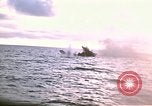
Sailors manning battle stations and fire guns aboard USS Barb submarine in Pacific Ocean.
Attack on Japanese shipping by American submarine around Palau Island in Pacific. Japanese motor sampan underway is fired on by submarine deck gun of USS Barb (SS-220). Japanese sampan burning and smoking during the attack as it tries to get away. View of bow of submarine as seen from elevated position of conning tower. Next scene shows U.S. sailors on American submarine manning battle stations, and readying guns for an attack. Deck gun crew fires, showing muzzle blast and recoil. Crew also operates smaller gun located part way up conning tower area. (World War II period).
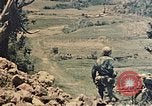
United States 1st Battalion 1st Marines attempt to put off a fire in an overturned tank after hitting a land mine in Naha.
U.S. 1st Battalion 1st Marines fight Japanese troops in Naha during their advance to Shuri in Okinawa Island. Marines examine cave (Japanese fortification) blasted by demolition charge. Marines carry wounded man on stretcher. Marine stand on top of hill in foreground. Marines advance up a hill with casualties. U.S. tank overturns after hitting a land mine, it is on fire. Marines attempt to extinguish the fire. Marines dig around tank in an attempt to rescue men inside. Turret of tank burns. Marine with wounded arm, blown clear when tank hit Japanese mine. Marines talk to the man who was hit. Tank burns. Marines with mine detector in foreground. Ammunition in tank explodes. Tanks burns after explosion. Pellets of hot steel fly from tank which is burning. Smoldering tank. (World War II period).