


 Francais
 Deutsch
 Italiano
Refine Your Search
Japanese-martial-arts stock footage and images
- Showing 319 to 324 of 4336 results more
more Hide
Hide
Japanese invasion of Manchuria (Mukden Incident), forming Manchukuo, as part of the Second Sino-Japanese War.
A Japanese militaristic propaganda film about the material and spiritual strength of Japan. Narration by General of the Imperial Japanese Army Baron Sadao Araki. Map of Asia. Image of an artillery shell followed by animation of large blotch marks covering large sections of Asia. Scenes of Japanese troops marching in countryside and on railway beds. Sign in English 'Soochow'. Troops loaded into open rail cars and a steam engine pulling the train out of a station. Troops resting along a roadway, with civilians walking by among them. Some of the soldiers water and care for the horses. Many signs in Japanese in an urban center. Some depict warfare and conquering of territory. It appears to depict the 1931 Japanese invasion of Manchuria known as the Mukden Incident or the Manchurian Incident, part of the Second Sino-Japanese War. A parade on a city boulevard, with leaflets dropped everywhere blowing on the ground. A dragon costume controlled by many people. Children marching in a group. A regiment of Japanese soldiers marching in formation. An entrance way covered by the angled, draped flags of Japan and Manchukuo.
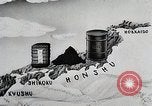
Japanese natural resources related to Second Sino-Japanese war and World War II
Animated map illustrating shortage of indigenous raw materials in Japan. As stockpiles vanish during Second Sino-Japanese war, Japan's domestic sources supply only 10% of the nation's needs for war. Animated sequence shows lack of steel, aluminum, copper, and power generation for the conduct of war. But one of the nation's greatest resources is the population of skilled Japanese workers, who are shown at various high tech jobs, as well as on the farms and in the fishing industry. Japanese workers are seen who work for the Zaibatsu (four ruling families of Japan). Banks of Japanese women typists and women in a factory. Young women painting faces on a "Kewpie doll." A Japanese family at dinner time. Women engaged in fabric spinning. Animated graphic illustrates Japan's war-related resources for World War 2, by showing a Japanese soldier standing astride map of Japan with lines extending to sources of needed raw materials from Japanese possessions in Korea, Manchuria,Formosa, China,Indochina,Malaya, and its network of Pacific Islands. Final scene displays copy of Los Angeles Times newspaper with headline reading: "Jap Supply Lines Blasted." It also features a story that appears to refer to the U.S. 6th Army invasion of Leyte in the Philippines, in October, 1944 (when General MacArthur waded ashore and stated,"I have returned"). (Note: Although produced during World War 2, this film shows prewar scenes of Japan. The animated illustrations and maps and, of course, the newspaper shown at the end, date from World War II.)
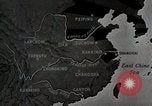
Chungking (Chongqing) city life, and bombing by Japanese forces during Second Sino-Japanese war
The Republic of China establishes its wartime capital at Chungking (Chongqing), China during the Second Sino-Japanese War. Animated map depicts areas of Japanese occupation and highlights cities including Lanchow (Lanzhou), Chengtu (Chengdu), and Kunming. It highlights Chungking (Chongqing) as the new capital of Nationalist China. Generalissimo Chiang Kai-shek is seen leading a group of Chinese leaders as they walk through an arched gate in Chungking (Chongqing). A busy street with shops and apartment houses, in the commercial district. It is filled with pedestrians, cart traffic along the curbs, and automobiles in the road center. Boatmen on the Yangtze River are seen below long steep steps leading up to the streets above. Views of houses clustered along the cliffs, and workmen digging bomb shelters into the cliffs. View from inside a shelter being hollowed out of the rock. Back in the Japanese occupied area, a car brings a Japanese Air Force leader who addresses a large group of fliers at an airbase. Next, Japanese air crews are seen running to their airplanes from their camp on the airfield and taking off in their Mitsubishi G3M bombers, to attack Chungking (Chongqing). Nakajima Ki-27 airplanes take off from the field and join in large formations overhead. A formation of Chinese World War 1 era is seen inflight, ostensibly to engage incoming Japanese bombers. Japanese crew member in a bomber sees the Chinese fighters and gunners in the bombers get ready to fire on them. The Chinese fighter planes dive at the bombers but are intercepted by Nakajima Ki-27 airplanes flying cover. Aerial dogfights ensue with Chinese planes being shot down, and the bombers continuing their way. Air raid sirens sound in Chungking and people run to their shelters, including many school children. Views of bomber crews at their stations and then of bombs falling with the Yangtze River below. Bombs exploding along the riverfront and inland, along the cliffs. View of machinery operating, and Chinese workers occupied in underground factories in Chungking (Chongqing). Fires burning throughout the city, from the bombing, and Chinese fire fighters working to extinguish them.
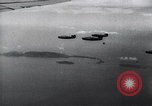
American and Japanese aircraft attack each others airfields in World War II. B-24 and B-29 heavy bombers strike Japanese targets
Formation of U.S Army Air Forces B-24 Liberator bombers, flying over Iwo Jima during World War 2. View from one of the aircraft of Japanese air field below. Nightime view of American anti-aircraft fire directed at Japanese bombers attacking Saipan. Explosions and fire silhouetting American aircraft on Saipan's Isely field during Japanese air raid. Burning U.S. B-29 bombers. Scene changes to Japanese aircraft destroyed on the ground at the air base on Iwo Jima. Bodies of dead Japanese airmen on the air field. Later view of P-51Ds from the 21st Fighter Group at Central Field on Iwo Jima, in the summer of 1945,after the field had been substantially upgraded to allow B-29 operations. A B-29 is seen displaying an "F" tail code. A formation of B-24 Liberator bombers in flight on a bombing raid. Waist gunner inside a B-24 firing at attacking Japanese fighter aircraft. A Japanese fighter going down in flames at night. View from a B-24 of another, off its left wing, flying in formation with its number 3 engine shutdown and propeller feathered. View from B-24 bombing oil facilities at Balikpapan, Borneo. Bombs bursting on the ground. Glimpse of B-24s in formation. Aerial views of bomb bursts carpeting target areas below. Aerial view of B-24s flying above smoke rising rapidly from bombs bursting below. View of bomb craters left below (probably from later reconnaissance flight).
Japanese women and a man interviewed by a worker woman at Japanese Registration Control Station building at San Francisco.
Japanese men and women walk in to Japanese Registration Control Station building at San Francisco. Japanese people at the office interviewed by social workers. A woman worker talks to a Japanese woman. Japanese woman smiles. Medic checks an old Japanese woman escorted by a young woman. A Japanese man appears before the worker woman and she talks to him.
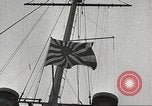
Japanese troops land in China and advance along the Burma Road during the Second Sino-Japanese War.
Japanese Army advances in China during the Second Sino-Japanese War. The Prime Minister of Japan Fumimaro Konoe, Japanese Army General Hideki Tojo and other Japanese officials pose. Japanese troops disembark from a ship into landing boats which make their way towards the Chinese shore. Troops advance along the Burma Road. Barricaded Burma Road with Japanese troops standing around. A Japanese soldier stands behind a sandbagged position on a hill.