


 Francais
 Deutsch
 Italiano
Refine Your Search
Japanese-martial-arts stock footage and images
- Showing 3235 to 3240 of 4328 results more
more Hide
Hide
Signing of Peace treaty in San Francisco, California brings an end to war with Japan.
Major events of the year 1951. War with Japan comes to an end with the signing of the Peace Treaty in San Francisco, California. Delegates of various nations gather to sign the treaty. Soviet Deputy Foreign Minister Andrei Gromyko walks out to express his opposition. Japanese delegate and Allied delegate Dean Acheson sign the treaty. Japanese delegates shake hands with Dean Acheson, an Allied delegate and the United States Secretary of State.
Allied aircraft lay mines in Pacific Theater during World War II.
'Aerial mine laying blockades Japanese shipping' depicts Allied preparations and Operations of the 21st Bomber Command, for aerial dropping of mines in the Pacific ocean to thwart Japanese shipping in World War 2. . Rows of stacked bombs are shown in a munitions dump at Tinian Air Base in the Mariana Islands. Camera focuses on a 2000 pound MK25 mine. Men demonstrate hydrostatic safety devices on the mine, including an extender that holds the detonator away from the booster charge until sufficiently immersed, and a clock delay mechanism. MK 25 transported to B-29 aircraft named Flak Alley Sally. (This is B-29 Number 42-24878 of the 40th Bomb Squadron, 6th Bomb Group, 313th Bomb Wing.) Airmen attach a parachute to the end of the mine. Another inserts the detonator and its extender plus the timer device into the side of the mine. Soluble washers are then placed in arming device ports. Scene shifts to Army and Navy planners working with maps, dividers, and a Weems plotter to mark the target location and mine laying pattern. 313th Bombardment Wing Group Commanders are seen being briefed in a war room. Next, engines are seen starting on a B-29, that then takes off and is seen in flight.(Narrator notes that missions are flown at night, but this one is photographed in the day to show how it is done. View of B-29 cruising above clouds. View from inside the aircraft, of bomb bay slowly opening. View of the target area below. The parachute of a mine opens by a static line as it falls from the bomb bay. Scene shifts to water level closeup of a mine striking the water. ('Presumably a demonstration inserted here.) Final scene shows a Navy Grumman TBF/TBM Avenger torpedo bomber dropping a parachute equipped mine. in the same location.
Ships destroyed during Pearl Harbor attack salvaged in Hawaii.
Aftermath of Pearl Harbor attack. An animation shows a map of Japan as a fictional character Tojo makes a call from Tokyo to Nagasaki and other cities disseminating the news of Japanese attack on Pearl Harbor. He rejoices at the attack. The United States Navy ship Arizona capsized. Wreckage of damaged ships like Nevada, West Virginia, California. Navy personnel along with civil technicians start the salvage of United States ships. Men work on the ships. Ships like California, Nevada and West Virginia underway after repair. Sailors and supplies aboard the ships. Military preparations in United States to counter the Japanese attack. (World War II period).
A U.S. Naval Fleet bombards the coast of Japan during World War II.
A U.S. Naval fleet attacks a Japanese coast during World War II. The naval fleet underway at sea. Explosions occur at sea. U.S. Navy Admiral William Halsey and others confer at a map. U.S. Navy aircraft in flight. A Japanese ship being strafed at sea. A man in the engine room of a ship. Naval guns fire at the coast. Explosions occur at sea. A man and a dog in the foreground and the naval fleet underway in the background.
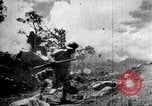
A Filipino soldier is ordered to join the C Company, 1st Battalion in Manila, Philippines during World War II.
A Japanese propaganda film on mistreatment of Filipinos by the United States. Filipino soldiers join the U.S. in battle against the Japanese in Manila, Philippines during World War II. Fighting at a battlefield. Explosions and smoke on the battlefield. A soldier sitting and another standing near him. They talk. The soldier who is standing walks away and talks to the one sitting. He comes back and sits down. Another soldier approaches and says something. The two soldiers smile. He gives them a news. They become sad. They salute. One of the soldiers is ordered to join the C Company, 1st Battalion. He bids goodbye and leaves. Soldiers in prone position. The soldier standing near them. A white flag is raised by the enemy. Soldiers crouch forward. An explosion occurs. The soldiers run.
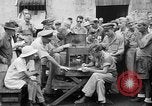
U.S. soldiers listen to a radio broadcast at the Santo Tomas concentration camp in Manila, Philippine Islands.
The Santo Tomas concentration camp in Manila, Philippine Islands near the end of World War II. Liberated Allied Soldiers and officers gather outside a prison camp building. They listen to a radio broadcast. An officer tunes the radio. The progress of soldiers is followed by a pencil on a map. Officers and repatriated prisoners listen to the radio. The radio set is made from stolen parts from a Japanese radio set. The soliders demonstrate how the radio equipment is packed up and was kept in the bottom of a stool to keep it hidden from discovery by Japanese guards. The maker of the radio, Lieutenant Hutchinson, is seated on the stool and chats with a soldier.
CRITICALPAST.COM: About Us | Contact Us | FAQs - How to Order | License Agreement | My Account | My Lightboxes | Shopping Cart | Advanced Search | Featured Collections | Website Terms & Conditions | Privacy Policy ©2026 CriticalPast LLC.
License Agreement |
Terms & Conditions |
Privacy Policy
©2026 CriticalPast LLC.