


 Francais
 Deutsch
 Italiano
Refine Your Search
Japanese-martial-arts stock footage and images
- Showing 3403 to 3408 of 4328 results more
more Hide
Hide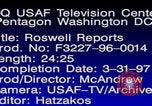
United States Air Force propaganda film about the Roswell Incident and Project Mogul weather balloon experiments.
The Roswell incident according to the United States Air Force. Roswell Daily Record newspaper shows article about flying saucers. Popular books on the Roswell incident such as “Roswell Ufo Crash Update: Exposing the Military Cover-Up of the Century” and “A History of UFO Crashes” by Kevin D. Randle and “The Roswell Incident” by Charles Berlitz. Magazines People and Omni featuring UFO stories. The International UFO Museum (114 N Main St, Roswell, NM 88203, United States) in Roswell, New Mexico. An “EYES ONLY” document prepared for President-Elect Dwight D. Eisenhower. Forensic experts examine a strange body believed to be alien remains. Foreign books on the Roswell incident written in French and Japanese. A New Mexico magazine shows a UFO flying saucer and the words “UFO The Roswell Incident” on its cover. The sliding door of the United States Air Force archives closing. New Mexico Congressman Steven Schiff on a newspaper article about UFO. View of the United States Capitol in Washington DC. The Washington Post January 14, 1994 article with title “GAO Turns to Alien Turf in Probe”. An accompanying photo depicts a flying saucer and alien remains. View of the Pentagon. A man and a woman uncover records and files from a United States Air Force archives. Archive shelving inside the United States Air Force. Archivists pushing a trolley. Map shows the location of Roswell in New Mexico. Pages of a report being flipped. Page of a report reads “WHAT THE ROSWELL INCIDENT WAS NOT”. Another page reads “An Extraterrestrial Craft”. Page of a report reads “to project “Mogul” be classified “TOP SECRET”. An atomic bomb explosion with red skies in the United States. The Japanese bombing of Pearl Harbor on December 14, 1941, during World War 2. Debris and fire from surprise attack. An acoustic sensor used in Project Mogul. A radar reflecting target being carried by a white weather balloon during Project Mogul. Weather balloons on the beach. A scientist holds a radar target tied to a weather balloon. Scientist lets go of the weather balloon with radar target. A man standing on top of a United States Army bus with satellite dish observe the weather balloon flying upwards. Photographs of “flying disk” fragments from Roswell in 1947. A man holds a fragment claimed to be from a “UFO”. “Flying Disk” debris that are debris made of aluminum foil, rubber, paper, and sticks. Army Air Force officials identifying debris from radar targets and weather balloons found in Roswell. Brigadier General Roger M. Ramey, Commanding Officer of the Eighth Air Force, inspects the remains of a weather balloon and Rawin radar target on July 8, 1947. Colonel Thomas J. DuBose, the Chief of Staff of the Eighth Air Force, sits on the right. Roswell Daily Record front page reads “Gen. Ramey Empties Roswell Saucer”. Brigadier General Roger M. Ramey with weather balloon debris.
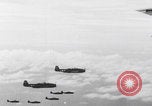
United States 322nd regiment 81st Infantry Division troops land at Red Beach, Angaur Island after aerial bombardment. (WW2)
Grumman TBF Avenger torpedo bombers flying in formation during the Battle of Angaur in World War II. Aerial view of United States landing circling near Angaur. Fighters strafe Japanese positions on Angaur Island. Officer gives orders for first wave to deploy over the telephone. An officer wearing a T-45 lip microphone responds . First wave of 322nd regiment landing craft head to Angaur Island Red Beach. U.S. Army troops inside landing craft underway. Animated map shows arrow pointing at Red Beach, Angaur. United States troops on armored tracked vehicles landing on shore. Soldiers advance to the beach after the Higgins boat door opens. Armored vehicles fire at Japanese positions from the beachhead. Soldiers in prone position as smoke envelopes the scorched coastal jungle. Close ups of soldiers under fire and digging in.
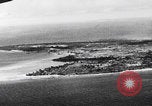
81st Infantry Division “Wildcats” troops advance through Bloody Gulch to Suicide Hill during the Battle of Angaur (WW2)
Aerial view of Peleliu Island during the Battle of Angaur in World War II. Map pointing to the location of Suicide Hill on Angaur Island. 81st Infantry Division “Wildcats” troops moving up a narrow gauge railway leading away from phosphate works into a narrow gorge called “Bloody Gulch”. Smoke from Japanese artillery is seen above the gorge. United States infantry soldiers advance along with tanks through Bloody Gulch. Tank operator talking through a radio microphone. Dramatized audio simulates tank communications while in Bloody Gulch. Infantry soldiers trail behind tanks. A tank is hit by Japanese artillery. Soldier runs past moving tanks. Wounded soldiers crawl and lay down in Bloody Gulch. Medics remove a casualty, running to avoid snipers. Infantry troops taking cover. Soldiers assemble a satchel charge. Soldiers run as explosion in front of tanks to clear the gulch. The second battalion resumes their advance. The second battalion splits up to start an encircling maneuver. Soldiers climbs while wearing flame thrower on his back. Machine gun fire towards Suicide Hill.
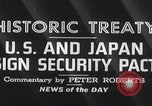
The United States and Japan sign the 1960 U.S. – Japan Security Treaty in Washington DC.
The U.S. – Japan Security Treaty (Treaty of Mutual Cooperation and Security between the United States and Japan) is signed in Washington DC, United States. View of the White House in Washington DC. President Dwight D. Eisenhower escorts Japanese Prime Minister Nobusuke Kishi to the East Room of the White House. Photographers taking photos of Eisenhower and Kishi. President Eisenhower speaks to the media. “This treaty represents the fulfillment of the goal set by Prime Minister Kishi and myself in June of 1957 to establish an indestructible partnership between our two countries in which our relations would be based on complete equality and mutual understanding. The treaty likewise reflects the closeness and breadth of our relations in the political and economic as well as security fields.” President Eisenhower said. Prime Minister Kishi signs the Treaty of Mutual Cooperation and Security Between Japan and the United States. Japanese official stands behind Prime Minister Kishi. United States Secretary of State Christian Herter signs the same treaty. President Eisenhower and Prime Minister Kishi shake hands after the signing of the 1960 U.S. – Japan Security Treaty.
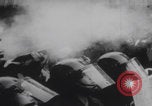
Zenkyoto students protest at Waseda University in Tokyo.
Tokyo Metropolitan Police clash with students at Waseda University during a protest on campus. A Japanese man speaks through a megaphone. Police use water cannons and physical force against protesters in the University of Tokyo's Hongō campus. Aerial view of Okuma Auditorium and Waseda University with water cannon spray. Police chase after college students and tackle and brutally arrest them. Japanese college students wearing helmets emblazoned with the word "Zenkyōtō" (All-Campus Joint Struggle Committees) board a police bus after their arrest.
U.S. military cemeteries on recaptured islands in the Pacific; aerial bombing of Japan in WW2
Brief views of Allied bombing raids in Japan during World War II. A group of United States Army Air Force aircraft flying over Japan. An army cemetery in front of a building in the Pacific. United States Army Air Force aerial machine gun strafe Japanese positions on the Aleutian Islands. A chaplain praying over a coffin with the American flag draped over it. Aerial view of bombs falling and exploding into Japanese positions in China. Consolidated B-24 Liberator dropping bombs over Wake Island. View of Wake Island. Graves of U.S. troops on Wake Island, Burma, and other recaptured Pacific islands. Allied Airborne Infantry on the jungles of Burma (Myanmar). Gunshots are heard on the background. Two United States Consolidated B-24 Liberator aircraft flying to the Philippines. Allied bombardment of Hollandia (present day Jayapura, Papua, Indonesia). Grave of an unidentified soldier. United States troops land on a beach. A Howitzer is towed across a river. Soldiers rolling a barrel of oil. Snowplow truck clearing snow in front of a bomber. United States troops unload supplies at a snow-covered airbase.