


 Francais
 Deutsch
 Italiano
Refine Your Search
Japanese-martial-arts stock footage and images
- Showing 3547 to 3552 of 4328 results more
more Hide
Hide
Places in New Mexico, familiar to Ernie Pyle
Views of Ernie Pyle’s familiar places in New Mexico. Opening shot shows a man stepping from the porch of Ernie Pyle’s house, with great expanse of desert landscape in the background. A car driving along a quiet mountain road. People picnicking at a roadside table. Views of mountains and sky and a man leading a horse walking slowly up a sandy hillside. Horse-drawn wagon in the Pueblo of Isleta. A farmer plowing a field with a team of horses. Pueblo women placing rugs on a line and baking bread in an ancient clay outdoor oven. Pueblo residents celebrating Corpus Christi Day. They walk slowly carrying banners and flags. The local Priest says prayers for American soldiers away in World War 2. Inside the church, a Pueblo mother lights candles for her son, overseas, against a backdrop of stars representing each local man away in the war. Car is seen driving across a low bridge over the Rio Grande River. It drives slowly into the town of Sandoval, where a man leads a cow across the road in front of the car. Farmers cultivating rows of crops by hand. A woman sings accompanied by a guitar. A sheep ranch where shepherds on horseback move a flock. Sheep being herded into pens. View of sheep being sheared by team of men. Wool being piled into a truck. Mailman delivering mail to a country mailbox on a street in Albuquerque, New Mexico. Two girls in jeans walking in town. A girl comes out of a building and embraces a young soldier in uniform, who was waiting for her. Pedestrians on the sidewalks in the commercial district. Women with cut roses; playing cards; baking a cake; and cutting a lawn with a manual reel mower. A wedding party walking along the sidewalk. Two girls reading. People in various settings reading the Albuquerque Tribune (or the Journal) newspaper. Movie houses that show films in Spanish and English. Students walking on the grounds of the New Mexico State University in Las Cruces. More views of ordinary people in towns including people of Hispanic descent or Mexican Americans. Sheriff Harold Hubbell of Bernalillo County, who served with the 200 Coast Artillery on Bataan, in 1942, is seen mailing a letter. Former Governor, Clyde Tingley, now Mayor of Albuquerque, comes down steps of a building. A Navajo indian reading a newspaper. A rancher rolling his own cigarette. A young Spanish American boy (Muchacho). Girl (Muchacha) rides a bicycle. A Navajo man followed by his family. Sign reading “Bataan Relief” announcing a talk by a Bataan veteran of World War 2. View of the speaker, in uniform, speaking to a group of mostly women. (Narrator states they lost a whole National Guard Regiment to the Japanese after the Pearl Harbor attack in 1941.) Another glimpse of students at the State University. Another repeat glimpse of Pueblo women baking bread in outdoor oven. Views of girls and women. Various Views of Ernie Pyle with American troops overseas during the war.
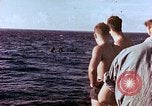
Australian prisoners of war rescued and helped aboard submarine by U.S. Navy rescue team near the Philippines (WW2)
Australian prisoners of war rescued after sinking of the Rakuyo Maru, a Japanese prison ship carrying them at sea near the Philippines, during World War II. Survivors afloat on parts of wreckage. Crew members on USS Sealion (SS-315) and USS Pampanito (SS-383) helped the survivors to deck of their submarines. Survivors adrift with life belt. They are pulled aboard the ship with the help of a rope.

Australian prisoners of war at sea rescued and U.S. Navy submarine crew members help them aboard submarine near Philippines (WW2)
Australian prisoners of war rescued by USS Sealion (SS-315) and USS Pampanito (SS-383) after sinking of the Rakuyo Maru, a Japanese prison ship carrying them at sea near the Philippines, during World War II. Rescue team members on the deck of the submarine. They help the survivors aboard the ship. Crew members remove the fuel oil from the body of survivor.
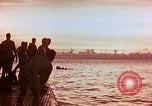
Australian prisoners of war at sea rescued and the survivors helped aboard by U.S. submarine crew members in Philippines (WW2)
Rescue team members on the deck of a U.S. submarine (both USS Sealion (SS-315) and USS Pampanito (SS-383) participated in the rescue) . Crew members carry Australian survivors found clinging to wrecked parts of the Rakuyo Maru, a Japanese prison ship, that had been carrying the prisoners, during World War II. The Rakuyo Maru had been torpedoed by U.S. submarines including these same rescue ships, days earlier. Exhausted survivors pulled on deck with the help of rescue line. They are covered with fuel oil. Men help the survivors aboard. Crew members with other survivors on the submarine.

People gather to watch the Army Day celebration in New York, prior to the U.S. entry into World War II in December 1941.
Celebration of Army Day in Manhattan, New York City, United States, in 1941, prior to the Japanese attack on Pearl Harbor causing the U.S. to enter World War 2.. View from high on a building overlooking 5th Avenue and Central Park, of U.S. Army units parading on Army Day. Street-level view shows color guard followed by marchers. Central Park is seen at left, and spectators line sidewalks on both sides of Fifth Avenue. The street is wet and many spectators carry umbrellas. A reviewing stand, on the Central park side of the Avenue, contains military officers and political leaders. Among those seen are: Lieutenant General Hugh A. Drum, who is flanked in the front row by New York Governor, Herbert Lehman, and New York City Mayor Fiorello LaGuardia. Next to the Mayor, A Fire Chief represents the NYFD ( the Commissioner was being replaced) and next to him is NYPD Commissioner Lewis Valentine. They are seen saluting. In the line of march members of the 44th Division Ski Patrol are seen carrying their skis. People sit with umbrellas to watch the parade. Some bleachers set up have few spectators, because of the rain. A child watches the soldiers. Troops of the U.S. 157th Field Artillery Regiment ride in trucks, pulling 37mm antitank field pieces and 105mm howitzers. More views from a high building overlooking the parade.

International Battalions of Shanghai Volunteer Corps parade during Annual Review in Shanghai, China.
Film opens showing British Shanghai Light Horse 'A' Company parading along Bubbling Well Road in Shanghai, China, past crowds who have turned out in numbers to cheer for the International battalions of the Shanghai Volunteer Corps (SVC). Visible, in the background, is the clock tower on the clubhouse of the Shanghai Racing Club. View shifts to the reviewing stand, where Mr. Cornell Franklin, Civil Commandant and Chairman of the Shanghai Municipal Council, stands in front of military officers, Vice-Admiral Sir Percy Noble, Major General Telfer-Smollett, Colonel Price, Colonel Andreini, Lieutenant-Colonel Perretier, and Commander Takeda. Next, a contingent from 1st Battalion, Seaforth Highlanders, shouldering rifles with fixed bayonets, execute eyes left as they march past the reviewing stand. A large crowd of spectators watches the parade from a stands set up near the reviewing stand. Next, Armored cars of the SVC Armoured Car Company, drive past in a column. Photographers take pictures. Japanese naval officers are seen in full dress uniforms, watching the parade. Led by a mounted officer, another formation of SVC soldiers march past, shouldering rifles with fixed bayonets.