


 Francais
 Deutsch
 Italiano
Refine Your Search
Japanese-martial-arts stock footage and images
- Showing 3883 to 3888 of 4336 results more
more Hide
Hide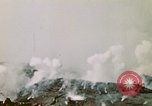
Heavy smoke protects United States Marines in open fields, Okinawa, Pacific Theater.
Okinawa Operations in Pacific Theater. United States Marine units and 24th Army Corps advance the island. Japanese aircraft bomb the island. U.S. Marines in open fields. Heavy smoke protects the marines on open slopes. Tank guns are fired. Marines fire guns in wooded area. Fire and smoke. Soldiers crawl on the island. (World War II period).
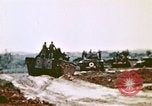
Transport through tanks, trucks and jeeps slowed down in Okinawa, Pacific Theater.
Okinawa Operations in Pacific Theater. United States Marine units and 24th Army Corps advance the island. Roads muddy due to water. Trucks, jeeps and tanks move along the water flooded roads with difficulty. Advancing troops and supplies slowed down. Tank and infantry units in fields. Phosphorous and small arms fired on camouflaged Japanese positions. Heavy smoke rises up. Fire and smoke. Tanks and soldiers advance. Army corps relieved by Marines in South Naha. (World War II period).
Views of U.S. Forces in the Pacific and European theaters of operation during World War II
U.S. Troops in the Solomon Islands during World War II, load munitions and supplies aboard landing craft to be carried to the troopship, USS Frederick Funston (APA-89), sitting offshore. The equipment and troops are bound for Bougainville, New Guinea, to reinforce marines there. Next, the troops themselves, in full battle gear, enter Higgins boats, to be ferried to the troopship. Closeup of troops boarding one of the landing craft. View from a landing craft heading to the Frederick Funston, seen ahead. View from the Higgins boat approaching the troopship, and then of troops climbing aboard via a rope net. Closeup of soldiers climbing the net. Change of scene shows U.S. Field Artillery unit changing position on New Georgia. They employ caterpillar tractors to move the guns. One is seen bogging down in the soft earth, so another tractor assists by pushing on the gun (possibly damaging its barrel). After arriving at the new position, they are ordered to move again, because of movements of the Japanese forces. This time, the troops pitch in and use sheer manpower to move a howitzer. Scene shifts again, to Italy, where U.S. troops attempt to ford a river on the road from, Benevento, to Caserta, after German forces destroyed all bridges along it. A truck is seen successfully crossing after combat engineers created a path for it. Trucks and jeeps move through muddy paths. The last image shows a jeep equipped with a tall bumper-mounted wire cutter.
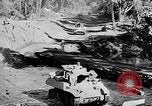
United States troops and Chinese troops advance in Burma (WW2)
United States tanks advance in Burma during World War II. Soldiers on tanks. United States troops and Chinese troops advance in Burma. U.S. troops walk through a wooded area. Soldiers and war dogs patrol in the forest area for retreating Japanese troops. Soldiers feed dogs with food. Dogs eating from soldiers' helmets serving as makeshift bowls. Troops near a Buddhist temple and a river. Troops with donkeys cross a flimsy makeshift bridge over water.
United States Navy ships and carrier planes bombard Kwajalein, Marshall Islands (WW2)
United States amphibious invasion and capture of Kwajalein, Marshall Islands during World War II. Supplies for the departure of ships. Goods, war material and vehicles loaded. Supplies loaded manually and by cranes. Boxes of supplies checked. Ships underway. Animation depicts the movement of ships. Aircraft on flight deck of the aircraft carrier. Aircraft takes off and in flight. Ships and carrier planes bombard the island. Explosions and smoke rises up. Kamikaze suicide planes attack ships. 4th Marine Division troops board landing craft. Marines land on the island. Marines and tanks advance on the island. Troops fire artillery. Dead bodies of Japanese soldiers. Landing craft beached. Marine troops on the beach.
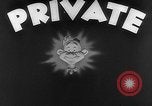
Animation character 'Private Snafu' learns the importance of education, United States.
Animation character 'Private Snafu' disturbs all other people when they are studying. He scoffs at education. Technical Fairy, First Class comes and makes him Snafuperman. He flies in the sky to work against the enemy. He makes many mistakes as he does not refer to any reading material. He does not take a navigation guide when he goes to drop the bomb on Adolf Hitler and drops the bomb in United States. Technical Fairy recovers it. He lands on a Japanese tank which actually is a U.S. tank. He sees aircraft in flight. He collects them and becomes a victim of a blast. He is admitted in hospital. He learns later that education is important. (World War II period).
CRITICALPAST.COM: About Us | Contact Us | FAQs - How to Order | License Agreement | My Account | My Lightboxes | Shopping Cart | Advanced Search | Featured Collections | Website Terms & Conditions | Privacy Policy ©2026 CriticalPast LLC.
License Agreement |
Terms & Conditions |
Privacy Policy
©2026 CriticalPast LLC.