


 Francais
 Deutsch
 Italiano
Refine Your Search
Japanese-martial-arts stock footage and images
- Showing 4159 to 4164 of 4336 results more
more Hide
Hide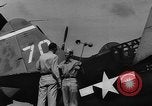
U.S. Navy aircraft making use of new airstrip at Ulithi Atoll in World War II
Three crew members stand on deck of a U.S. aircraft carrier, anchored off Ulithi Atoll during World War 2. One holds an anemometer, with its buckets spinning. A TBF avenger aircraft on deck ready to be catapulted. It launches and is seen flying away above a variety of naval vessels at anchor. View from an aircraft flying fast and low, past Ulithi Atoll. A TBF avenger landing on the Ulithi airstrip. (Note: At TC 00:28 through 00:36, the Destroyer Tender, USS Prairie AD15, is seen with several destroyers tied to it. She rescued survivors from the sinking of the Oiler, USS Mississinewa, AO-59, by a Japanese Kaiten suicide submarine, on November 20, 1944.)
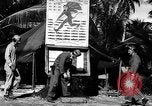
U.S. air operations at newly built airstrip on Ulithi Atoll in World War II
During World War 2, three pilots of Marine Torpedo Bombing Squadron 232 (VMTB-232) stand in front of Billboard displaying their squadron symbol of a red devil with spear and cape. It also displays silhouettes of Japanese ships they had struck. View of the newly constructed airstrip at Ulithi, as an F6F aircraft takes off. It is followed, in turn, by a C-47 (R4D),a PBY, and another F6F. Aerial view of Ulithi and the new broad runway running across the atoll.
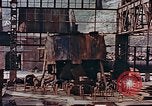
A damaged Chenzei School building and fallen concrete wall in the sawmill after the attack in Nagasaki, Japan.
Physical damage caused by the atomic bombings in Nagasaki, Japan during the end of World War II. An unidentified wrecked object underneath galvanized tin which was placed by the Japanese to keep out the elements. A damaged building. iron heaps, small castings and several different types of debris. A main roof member of a sawmill shows the total collapse of the roof. The collapsed roof. A damaged wall. A fallen concrete wall in the sawmill. The steel tie rods and their placements. The damaged concrete reinforced wall with the tie supports. The damaged Chenzei School building.
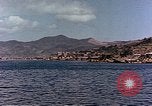
A harbor shows small buildings and homes situated on the side of the hill and Landing craft construction in Nagasaki, Japan.
Physical damage caused by the atomic bombings in Nagasaki, Japan during the end of World War II. A harbor shows small buildings and homes situated on the side of the hill. Boats on the shoreline with a building area of wooden ships. A Japanese lighthouse located at the end of a small island. A view of the harbor. Ships with gantry crane and sheet metal shop is viewed from the harbor. Two ships, a barge crane at the harbor. Minage Saki outfitting works located at the center of the harbor. Landing craft construction on a pier located on a dry dock at Nishi-Kotohiramchi on side of the harbor. A boat underway in the background.
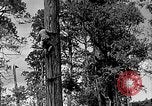
Lumberjacks work at a forest in Taiwan
A film shows the lumber industry in Taiwan during Japanese colonial period. Taiwanese lumberjacks at work in mahogany forest. One is silhouetted against the sky as he climbs a tall mahogany tree trunk devoid of branches. He descends using ropes. A supervisor watches as a lumberjack uses a long saw to cut on a tree trunk that has already been cut from the other side. Camera pans up the tree.and back down again as he completes his cut and the tree falls to the ground. The base of the fallen tree trunk is seen to be hollow. Views of other trees as they are felled by lumberjacks. Closeup of the stump remaining from one. A log cut from a tree is lowered by ropes. Glimpse of valley across from the forest. Closeup off a steam whistle blowing. Closeup of a steam engine driver and arm in motion. A long log being lowered by a cable. Other cables seen strung across a rustic work building from which steam is venting. The log is deposited on a pile of others. A steam driven cable pulls logs on a small rail car atop a small gauge track. A very large log is lowered atop those a;ready on the rail car. Men with long pikes help position the log. Smoke blows out of a narrow metal chimney. A train carrying logs on rail cars moves through the forest. Views of a steam locomotive pulling a train of cars carrying logs.

The Nauzan mountainous range and a train passes a railroad station and proceeds onward past mountainous area in Taiwan.
A film shows the geographical features of Taiwan during Japanese colonial period. A lamp hanging in the foreground. The Nauzan mountainous range. Clouds over the mountains. A railroad train passes a railroad station and proceeds onward past mountainous area. The train climbing the mountain. A conductor stands on a track in the foreground.
CRITICALPAST.COM: About Us | Contact Us | FAQs - How to Order | License Agreement | My Account | My Lightboxes | Shopping Cart | Advanced Search | Featured Collections | Website Terms & Conditions | Privacy Policy ©2026 CriticalPast LLC.
License Agreement |
Terms & Conditions |
Privacy Policy
©2026 CriticalPast LLC.