


 Francais
 Deutsch
 Italiano
Refine Your Search
Japanese-martial-arts stock footage and images
- Showing 4207 to 4212 of 4336 results more
more Hide
Hide
United States Army Air Force tracers strafe an installation in Kyushu, Japan (WW2)
An air raid by the United States Army Air Force on Kyushu, Japan during "Operation Downfall" of World War II. Aerial view of Kyushu as seen from aircraft cockpit view. United States Army Air Force tracers strafe installation on the peninsula. Fire burns at an installation. The tracers strafe Japanese barracks. Hits around buildings. An ocean in the background.
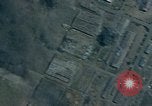
Explosions around buildings after an air raid by the United States Army Air Force in Kyushu, Japan (WW2)
An air raid by the United States Army Air Force on Kyushu, Japan during "Operation Downfall" of World War II. Aerial view of Kyushu air raid as seen from aircraft cockpit view. Explosions around Japanese buildings. Smoke rises from the buildings.
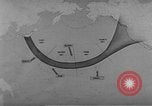
U.S. Navy personnel demonstrates balancing mechanism of fire balloon used to attack North America during World War II.
Diagram shows pattern of air currents that carried Japanese paper balloon fire bombs from Japan to America's West Coast, during World War II. The paper bomb balloon or fire balloon unit consists of the paper gas sac and an automatic balancing and firing control device. United States Navy personnel inspects the balloon as it descends to the ground. He looks at the paper bags filled with sand which provide balance and the central payload,incendiary and bombs. He holds paper material and inspects its strength. The balloon is filled with hydrogen gas. Pressure is exerted by a rubber ring. United States Navy personnel demonstrates the various parts: demolition block,aneroid switches,jacks,blow out plugs,incendiaries and central payload. He demonstrates the balancing mechanism: Balance bags,payloads and incendiaries are suspended by T-hooks switched between the blow out plugs on the balancing ring. A man unhooks the T-hook and releases balance bags.
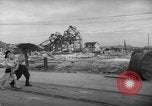
Crowd of civilians wait for the a streetcar in Hiroshima, Japan after World War II; view of marketplace.
Activities of civilians in Hiroshima, Japan after World War II. View of the buildings damaged by atomic bomb. Japanese citizens wait for a streetcar. In a market area women pass a sign that reads "Hiroshima Bazaar Bargain Sale". Huts seen in the background. A wounded child walks on a road. Camera pans down from rubble to a young toddler sitting among rubble on th road, looking sad or upset. Crowd wait for streetcar. Market buildings in background. Mountains seen in the background. Man comes out of the "Hiroshima Station Front Restaurant". View of the "Hiroshima Station" railroad station. Civilians enter the station.
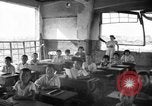
School children in classroom in Hiroshima, Japan after World War II; scenes of destruction outside school house.
Activities of civilians in Hiroshima, Japan, post-war, including those affected by the atomic bomb blast. Children seated in a classroom. Damaged windows seen in the background. Teacher at a class with children. She writes on a chalk board. Children take down notes on school pads. Japanese children walk in a damaged area. Injuries show burned arms and injured hands of boy due to bomb blast. Face of boy badly scarred from wounds of war. View of the damaged school building. Children exercise in the school yard. Civilians clear the debris on streets. Damaged buildings seen in the background. A damaged church leaning sideways behind a crew of men digging to clear rubble and reclaim building materials for reconstruction.
U.S. President Dwight D Eisenhower receives and greets Japan's Prime Minster Shigeru Yoshida at the White House in Washington DC
President Eisenhower receives Japanese Prime Minister Shigeru Yoshida at the White House (1600 Pennsylvania Avenue NW, Washington, DC 20500, United States) in Washington DC. U.S. President Dwight D. Eisenhower welcomes and greets citizens at the White House. They all pose for photographers. Japan's Prime Minster Shigeru Yoshida arrives at the White House. President Eisenhower receives and greets him. Photographers click photographs as they walk.
CRITICALPAST.COM: About Us | Contact Us | FAQs - How to Order | License Agreement | My Account | My Lightboxes | Shopping Cart | Advanced Search | Featured Collections | Website Terms & Conditions | Privacy Policy ©2026 CriticalPast LLC.
License Agreement |
Terms & Conditions |
Privacy Policy
©2026 CriticalPast LLC.