


 Francais
 Deutsch
 Italiano
Refine Your Search
Japanese-martial-arts stock footage and images
- Showing 4291 to 4296 of 4336 results more
more Hide
Hide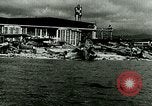
New recruits, including African Americans, commence training in the U.S. Army during World War II
Views of damage in the aftermath of the Japanese attack on Pearl Harbor, December 7, 1941. Scene shifts to African American pastor in pulpit of a church speaking about U.S. armed forces. A woman in the congregation whose son is serving in the Infantry, points to a flag filled with blue stars for service members from the church. She reads letter from her son telling her he has been selected for Officer Candidates School. View of new recruits in a railroad depot. African American recruit pauses to say goodbye to his mother, but is moved along by a uniformed Army officer. Closeup of locomotive wheels turning. Glimpse of barracks in an Army base. Recruits leaving railroad train and entering a snow-covered building. Army sergeants organizing the new recruits inside the building. An army spokesman welcomes them to the training camp. Recruits being interviewed about their past training and experiences. Closeup of a Sergeant inquiring about the kind of machine tools a recruit had worked with. Recruits assembled in a base auditorium where they hear from a Chaplain and an officer who demonstrates how to salute. (World War II; WW II; World War 2; World War Two)
105 mm Howitzer carriage M-7 tank backs up in Okinawa, Japan during World War II.
United States Marines advance on Okinawa, Japan during World War II. A 105 mm Howitzer carriage M-7 tank backs down a hill. M-7 tank moves across a field. Dead body of a Japanese soldier in a Marine uniform.
U.S. Marines cross a creek as they advance in Okinawa, Japan during World War II.
United States Marines advance on Okinawa, Japan during World War II. A dead Japanese soldier lying on ground. Marines kneeled down by the side of a creek. Marines cross the creek on the double, one man at a time. Marines climb up a ridge.
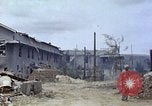
Injured Marines being treated at a division and a civilian hospital in Saipan during World War II.
A U.S. Navy training film about the treatment and recovery of soldier wounded in Saipan during World War II. Division hospital building. Marines pile up sand bags. Tori at the entrance of a Shinto temple as military vehicles move through the gate. A Japanese civilian hospital in a town. Debris being piled up. Marines enter the hospital. A litter patient being carried inside the hospital. Plasma and blood being administered to the wounded Marines. A doctor cleans a wound and administers penicillin. A doctor washes his hands. Patients at the hospital as an ambulance arrives. A sprinkler sprays water on ground to prevent dust from puffing up. A technician works on a microscope and looks into it. A man washes clothes.
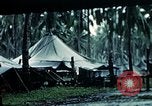
A U.S. Navy training film about controlling malaria among United States soldiers in the Pacific during World War II
At start, this film shows a U.S. Military tent camp somewhere in the South Pacific during World War II. Heavy rains create breeding grounds for Anopheles mosquitos as seen when a Navy technician holds up a sample of water containing mosquito larvae. A jeep rides through mud, creating road ruts that become mosquito breeding grounds, which are seen swarming around them. Two scenes of bulldozers is being used to destroy soft surface, rutted roads. One employs a disc harrow. Closeup of the discs. Two men step under barbed wire and look at sign reading: "Use Authorized roads only." Scene shifts to American infantry moving cautiously through the jungles and engaging Japanese with hand grenades and small arms. A field clinic where a malaria patient is being treated. A soldier uses a sprayer inside his tent quarters to kill mosquitos. Troops marching back to a field headquarters, benefitting from taking precautions against malaria.
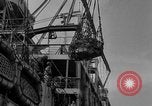
Food supplies and bombs being unloaded in the Solomon Islands during World War II.
U.S. Marines in the Solomon Islands during World War II. Food crates in a sling being lowered . The Marines unload food crates from landing crafts on a beach. Signs on the crates read 'Spinach', 'Tomato juice'. The Marines load supply crates onto a Japanese truck. A bomb being taken off a landing barge.
CRITICALPAST.COM: About Us | Contact Us | FAQs - How to Order | License Agreement | My Account | My Lightboxes | Shopping Cart | Advanced Search | Featured Collections | Website Terms & Conditions | Privacy Policy ©2026 CriticalPast LLC.
License Agreement |
Terms & Conditions |
Privacy Policy
©2026 CriticalPast LLC.