


 Francais
 Deutsch
 Italiano
Refine Your Search
Korea stock footage and images
- Showing 673 to 678 of 999 results more
more Hide
Hide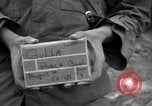
U.S. Air Force H-13D Siox helicopter takes off with a wounded U.S. soldier from Kachil-Bong, Korea during Korean War.
Aerial tramway for transportation in Kachil-Bong, Punchbowl during Korean War. U.S. medic and soldier examine a wounded soldiers alongside a jeep. Medic throws a smoke bomb to attract attention of U.S. Air Force H-13D Siox helicopter. H-13D approaches and lands. Casualty is loaded aboard H-13D. H-13D takes off and flies towards mountains in the background. Sign reads 'Mobile Army Surgical Hospital'.
President Harry S Truman awards Congressional Medals of Honor at the White House to Carl Sitter and Reginald Myers
President Harry S Truman awards Congressional Medals of Honor at the White House in Washington DC. A gathering at the White House. Officials and awardees with their families. The recipients are Marine Captain Carl Sitter (standing left of the President when all three men are together) and Reginald Myers (standing right of the President). The President awards the Medal of Honor to each of the two officers. The officers shake hands and pose with the President. Officers with their families after receiving the Medals. Sitter holding his son and pictured with his wife. Myers' wife, Margaret, and daughter, Susan, and son, Scott. Myers holding his son, Scott. Major Myers was awarded the Congressional Medal of Honor while serving as Executive Officer, 3rd Battalion, 1st Marines, in the vicinity of HAGARU-RI, KOREA, November 29, 1950, while commanding a group of 80 men who were stragglers and missing from other units during the Korean War. Major Myers' makeshift unit successfully denied the Chinese Communists the possession of EAST HILL, which dominated the key crossroads in the withdrawal -- attack in another direction -- by U.S. Marines and Army units from the Chosin Reservoir. Captain Sitter's unit relieved Major Myers' unit in the same battle. Sitter received e medal for his actions as a commanding officer during a two-day battle at Hagaru-Ki, Korea in November 1950. The fighting lasted 36 hours, and Sitter endured grenade burns to his face, arms and chest. He refused to evacuate as the fight continued. More than half of his company was killed, wounded or captured, but a successful defense of the area was mounted by U.S. soldiers.
Retired famous Marine Corps horse, Sergeant Reckless, decorated for combat service during the Korean War.
Camera from hilltop, pans over an outdoor corral and collection of buildings (some quonset style) at U.S. Marine Corps Camp Pendleton, California. In the middle background, what appears to be a firing range, can be seen. Other buildings sit atop hills in the far background. Scene shifts to close view of a chestnut mare, in a private stable. A sign on the gate reads "Reckless." The mare wears a blanket displaying a staff sergeant's stripes and service ribbons. The words "Sgt. Reckless 1st Mar. Div." also appear on it. Sgt. Reckless is contentedly eating from a trough of hay set up in the pen. Closeup of her horse blanket. (Note: Sgt. Reckless is seen here in retirement. She was bought by U.S. Marines in Korea, in 1952, during the Korean war, and trained to be a pack horse for the Recoilless Rifle Platoon, Anti-Tank Company, 5th Marine Regiment, 1st Marine Division. Her decorations include: Purple Heart w/ 1 award star; Navy Presidential Unit Citation w/ 1 service star; Navy Unit Commendation; Marine Corps Good Conduct Medal; National Defense Service Medal; Korean Service Medal w/ 3 bronze service stars; Korean Presidential Unit Citation; United Nations Korea Medal; and French Fourragère. Sergeant Reckless died in 1968.)
Director Streibert speaks on the purposes of the USIA and Soviet influence; scenes from a Soviet anti-American propaganda film
Theodore Cuyler Streibert , Director of the U.S. Information Agency, speaks on the purposes of the Agency (USIS). The Director seated at a table. He states that there is much misunderstanding about the United States, throughout the world, and Communist entities wish to take advantage of this to spread misinformation about the U.S. As the leading world power for peace, he says the U.S. must tell the world the truth about America. This is the mission of the USIA. A map portrays Soviet dominated areas within the so-called "iron curtain,"encompassing 800 million people. Another map illustrates targets of Communist propaganda employed to facilitate North Korea's aggression against South Korea. A graph illustrates propaganda spending by the Soviet Union and Communist China, primarily to spread misinformation about America. Segments of a Soviet propaganda film about the U.S. are shown. It begins with a map of the U.S. and then shows the Statue of Liberty. Camera pans over Manhattan, showing skyscrapers. A narrator disparages American commercialism, materialism and sensationalism. A lion is seen sitting in a convertible car, looking over a young woman's head. Next are scenes of an American beauty contest, and of women performing precision water skiing. Then an airplane is seen crashing on landing and a car is seen burning. View from trolley car moving along Broadway, from Times Square, in Manhattan, New York City, at night. A follies-style Broadway show. Show girls in bathing suits, walking past the camera. Show girls performing on stage. Another nighttime view of Times Square. Dogs being manicured by groomers. Outdoor soup kitchen scene from the Great Depression in the 1930s with unemployed men receiving food. Hobos or homeless men at a railroad siding. Milk and grain being spilled from containers during a labor and pricing dispute. Scenes of slum area tenement houses with wash drying on lines strung between the buildings. Men playing bocce ball in the yard of an apartment house. Camera pans up the Empire State Building from street level view. African American drummer with other band musicians performing in a civilian band, and scenes of African American musicians in a U.S. Army band. Poor African Americans in the South, at home and doing wash outdoors. Mounted police maintaining order in scenes of a fire and public protest or labor strife (circa 1935) interposed with views of the Statue of Liberty. A Soviet propaganda poster about the Korean War, shows an American soldier walking away from a dead Korean woman whose small child clings to her. Fires burn and a burning airplane falls from the sky in the background. A propaganda cartoon shows "warmongers of the west" being counterbalanced by a Soviet fist on a pair of scales.
World tensions after World War II. The Baruch Plan. The Berlin Airlift. The Korean War. The Cold War. The Atomic age. Ballistic Missiles
Speaking before United Nations Atomic Energy Commission (UNAEC) in its first meeting in June 1946, Bernard Baruch proposes international control of all atomic energy -- the so-called Baruch Plan. Low level aerial view of ruined post World War 2 European city. Goods including heavy equipment, locomotives, being loaded aboard ships to aid in the postwar recovery of Europe (The Marshall Plan). Workers in Western Europe making use of Marshall Plan materials to rebuild their national infrastructures. West European farmers restoring agriculture. View from overflying light airplane of parts of postwar Berlin in 1948. Blocked roads and empty railroad tracks leading from East Germany to West Germany, blocked by the Soviet Union. Barge traffic at standstill due to Soviet actions. U.S. C-54 transport aircraft flying supplies into West Berlin (The Berlin Airlift) during the Soviet blockade of that city. West Berlin citizens watching U.S. transport aircraft bringing fuel, food and other essentials into the isolated city. A C-54 flying low over empty railroad lines, as it prepares to land in West Berlin. Supplies offloaded from a DC-3 ( AKA C-47 or British Dakota) equipped with unusual set of rear cargo doors. Supplies being moved on Tegel Airport with many C-54 aircraft in the background. Numerous C-47 aircraft operating at Tempelhof airport. An East German official opening a barricade as Soviet blockade of West Berlin ends on May 12, 1949, and supply trucks begin to move over roads again. Flags of Western nations flying on high flagpoles. Glimpse of Allied warships underway during the Cold War. Formation of P-38 Lightning aircraft in flight overhead. NATO troops marching and NATO armor on parade. Flashes of heavy artillery firing at night. Korean refugees moving South in 1950 with the outbreak of the Korean War. View of UN Security Council meeting in the absence of Soviet representative. U.S. tanks firing guns and American infantrymen in conflict with North Korea in Korean War. American wounded on stretchers.Delegates of both North and South Korea signing the Korean Armistice Agreement in P'anmunjŏm, on July 27, 1953. A rocket is launched. Images of earth from inside a space craft in orbit. Narrator mentions the first satellite to circle the earth, the soviet Sputnik 1 in 1957. View of Soviet pilots in low pressure altitude chamber. A test subject in an aircraft making a maneuver that allows him to experience "weightlessness." Objects in his cockpit float about. A military rocket launch monitored by arrays of radar. An object being retrieved from space by means of a parachute. A nuclear powered submarine. Rockets on display during a military parade in Red Square, Moscow, the Soviet Union. A U.S. Air Force B-52 bomber taxiing. More views of rockets seen during a Soviet military parade in Red Square, Moscow.
Yakov Malik walks out of a meeting of the Security Council in New York, United States.
The United Nations Security Council meeting in New York, United States. Delegates discuss the issue of invasion of South Korea by North Korea (Korean War period). Soviet representative Yakov Malik boycotts the presence of Nationalist Chinese representative and walks out of the meeting.