


 Francais
 Deutsch
 Italiano
Refine Your Search
Richmond-viginia stock footage and images
- Showing 49 to 54 of 101 results more
more Hide
Hide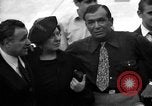
Pilot Henry (Dick) Merrill and Copilot, Harry Richmond, take off from New York in their Vultee V1A for transatlantic flight
First roundup trans-Atlantic flight to be attempted from the United States.. Pilot, Henry (Dick) Merill, Chief Test Pilot of Eastern Airlines and Co-Pilot, Harry Richman, millionaire singer, songwriter and part time pilot, prepare to depart on round-trip trans-Atlantic flight. They bid goodbye to friends and family. They board their Vultee V-1A named 'Lady Peace', start the engine, taxi out and takeoff. Crowd watches.
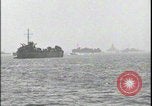
United States Navy Invasion fleet under Admiral Richmond K. Turner sailing near Okinawa coast, green beach, during Battle of Okinawa in WW2
Whole invasion fleet of the United States Navy in Operation Iceberg, or more famously known as the Battle of Okinawa, during World War 2. Invasion fleet includes amphibious ships such as patrol craft coastals, submarine chasers, battleships, LST (or Tank Landing ships), LCI (Landing Craft Infantry), Landing Ship Medium (LSM), and landing craft such as the LCVP (landing craft vehicle personnel boat or also known as the Higgins boat). A Tank Landing ship sails towards Okinawa, showing military equipment and with sectional pontoons attached to its side. Landed amphibious LVT tanks and Higgins boats on the Green Beach in Okinawa’s coast. Invasion fleet in Green Beach in Okinawa during Battle of Okinawa. Okinawa Island in smoke from Battle of Okinawa off green beach.
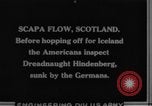
Americans inspect Dreadnought Hindenberg in Scotland as Douglas World Cruisers aviators prepare to hop off to Iceland.
U.S. Army Air Service Douglas World Cruisers (DWC) in Scotland during their first around the world flight. The DWC in Scapa Flow, Scotland, before hopping off for Iceland. The Americans inspect Dreadnought Hindenberg sunk by the Germans. Several views of this ship. Two of the fliers on gun barrels. Crew of USS Richmond cheer for American aviators preparing to hop off to Iceland. Mixed personnel as they raise their hats and give three cheers. Crew members being escorted out to the airplanes. A world cruiser. The aircraft being refueled. Birds in the water. The world cruiser in flight. World Cruiser No. 3, piloted by Lieutenant Leigh Wade, afloat. World Cruiser No. 3 afloat near a ship. USS Richmond attempts to pull the world cruiser aboard. The world cruiser being towed in very rough waters. Italian flier Locatelli, also attempting a world flight, is forced down and is picked up by a U.S. cruiser. An Italian airplane afloat. The aircraft burning. Locatelli is taken aboard USS Richmond. Locatelli being greeted by the captain of the ship.
Rolling of shell plates and burning radius holes in Liberty ship construction at shipyards in California during World War II
Constructing Liberty ship at shipyards in California during World War 2. Shell plates are put through shaping rollers. Torch burns radius holes into shell plates. Parallel burning of shell plates. (Note: May include scenes from Kaiser Shipyard in Richmond, California as well as Hunters Point Naval Shipyard in San Francisco.)
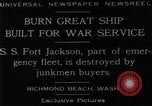
The S.S. Fort Jackson is burned by junk salvagers.
The ship S.S. Fort Jackson, part of the U.S. emergency fleet in 1929, is destroyed by salvage buyers at Richmond Beach in Washington. Flames and smoke rising as the S.S. Fort Jackson falls to pieces.
Allies demand the unconditional surrender of Japan in World War II. Entry of Soviets and use of atomic bomb ends the war.
Representatives of three nations, seated around table at Potsdam Conference held at Cecilienhof in Potsdam, Germany. British prime minister, Clement Attlee; President of United States, Harry Truman; and representative of Soviet Union, Joseph Stalin at the Potsdam Conference, July 1945. They deliver an ultimatum of unconditional surrender to Japan. Swarms of B-29 bombers and Aircraft Carrier Task Forces destroy Japanese homeland. Planes on carrier decks.Navy Grumman carrier-based TBF aircraft dropping bombs.. Destruction of ships at sea. Mushroom cloud due to atomic bombing. Chart depicts the power of one atomic bomb. Britain's 'grand slam' bomb, most destructive conventional bomb ever produced. Doctor Ernest Orlando Lawrence, inventor of the cyclotron (atom smashing machine). A man works at the Cyclotron at the University of California, Berkeley. General Leslie Groves, head of the project speaks. He is seated with Dr Vannevar Bush, government director of science and research, and Dr Richard Tolman, technical expert. Quantities of uranium shipped from Alberta, Canada are used in bombs. The atomic bomb process (Manhattan Project) is developed in widely separated areas; scenes from Hanford Project plant in Richmond, Washington. Project personnel exit cars and enter into the search area before starting their work day. Lieutenant colonel Franklin T Matthias with the army corps of engineers, appointed to the Hanford Project. Sign of 'Oak Ridge' in Tennessee. Largest of the three atomic bomb plants located near the Tennessee Valley Authority (TVA) dam. Employed personnel in atomic bomb plants are seen going to work. Man and woman employees at the plan read and smile at a Knoxville Journal newspaper in August 1945 with news headline "Power of Oak Ridge Atomic Bomb hits Japs" after the atomic bomb was dropped in Hiroshima. View of dense prefabricated home communities to house large number of Oak Ridge plant workers. View of families setting up their houses in trailer towns after the prefabricated homes were full. People come out from the Henebry's Jewelers and supermarket, among stores setup to meet the needs of the quickly built city. Scenes changes to show view of Soviet leader Joseph Stalin at conference. Russian artillery and troops in a parade at Red Square in Moscow, Russia (these parade scenes are from the May 1, 1945 May Day parade, just days before Germany's surrender). President Harry Truman reports on the latest developments regarding the war with Japan. He states that the United States is prepared to destroy every productive enterprise in Japan and the U.S. shall completely destroy its power to make war. He warns of an attack by the U.S. due to the rejection of the July 26th ultimatum at Potsdam. He warns that Japan "should expect a rain of ruin from the air; the like of which has never been seen on this earth." Truman notes that it will be followed by an unprecedented sea and land invasion of Japan.