


 Francais
 Deutsch
 Italiano
Refine Your Search
Saint-raphael stock footage and images
- Showing 475 to 480 of 704 results more
more Hide
Hide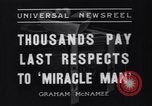
Thousands of people pay last respects to 'Miracle Man', Brother Andre, of the St Joseph's Oratory, Montreal ,Canada.
Flags at half staff in mourning on roof of College of Notre Dame in Montreal, Canada (Collège Notre-Dame, in Côte-des-Neiges, Montreal). Thousands of people (a total of about 1 million in one week) pay last respects to the 'Miracle Man' of Montreal, who died January 6th, 1937. Brother Andre, the former Alfred Bessette, was a revered 20th century disciple of St. Joseph associated with St. Joseph's Oratory, a major Roman Catholic religious sanctuary in Montreal, Canada (l'Oratoire Saint-Joseph du Mont-Royal). On Saturday, January 9, the coffin is taken from the Oratory to the Montreal cathedral Marie-Reine du Monde (Mary Queen of the World), for a first funeral Mass. Six Firemen Officers carry it inside. Later, back into the sanctuary (St Joseph's Oratory) it would lie in state until January 12 for a second funeral ceremony. View of the open coffin. Views of the St. Joseph's Oratory. Brother Andre poses for picture a few years before his death.
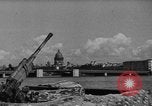
Russian people struggling and rationing during the Siege of Leningrad by German forces (WW2)
Snow covered grounds in Leningrad, Russia (present day Saint Petersburg, Russia). Soviet artillery in front of the Neva River and a road with moving streetcar. Ships stuck on frozen river. A man stands beside a Howitzer in front of St. Isaac's Cathedral. Soviet soldiers bring a tank and a barrage balloon. People on the frozen streets of Leningrad, Russia. A destroyed bus covered in deep snow on the street. A Soviet soldier’s moustache is covered with snow. Soviet soldiers in prone position to defend Leningrad from the German forces. German tanks and soldiers on the streets of Leningrad during World War II. No electricity and water supply. Russian civilians walk as streetcars remained out of service and covered in deep snow. People dig holes in frozen streets to gather water. A woman washing clothes on the street. Food is rationed during Leningrad blockade. A baker cuts bread into slices for rationing. A woman receives rationed bread. Women clean the rubble on streets. Aerial bombing of Leningrad by the Luftwaffe. A German Karl-Gerät “Thor” supermortar. German soldiers load and fire supermortar. A mortar fire hits a house, destroying it entirely. A building falls to the ground. German bombardment of Leningrad. Machines and Soviet war production workers build supplies weapons and ordnance in Leningrad. Women workers assemble mortars. Animated maps show Leningrad mostly surrounded by German territory. Shell manufacture. Supplies are brought in by truck, tracked vehicles, tractors, and railroad on ice across Lake Ladoga. German planes bomb trucks. Russians laying railroad tracks across frozen Lake Ladoga. Infirm and sick civilians, women, children board train out of Leningrad for medical treatment. A traffic enforcer waves flag on Lake Ladoga. Red Army soldiers in white suits advance in the battlefield. A tank advances. The arrival of spring. Melting snow in springtime. A wooden cross from a German grave is being washed away in a stream. Soviet trucks moving in convoy across flooded Lake Ladoga in spring. Russian children playing on the streets. People indulge in recreational activities. Civilians riding bicycles and taking streetcars. A woman cleans window. Russians crowd the streetcars of Leningrad. Soviet sailors clapping on deck. Russian dancers dancing traditional folk dances to celebrate. Soviet Navy sailors play music for the dancers. The sailors clap and applaud the performance. German prisoners of war enter Leningrad. A Soviet woman spits on the captured German soldiers. Russians marching in Leningrad.

Venerated relic shown at the ancient city of Trier in Germany
Venerated Seamless Robe of Jesus relic shown at the ancient city of Trier in Germany. Crowd outside the Trier Cathedral (Trier Saint Peter's Cathedral, Liebfrauenstraße 12, 54290 Trier, Germany). A vestment purported to have been worn by Christ is displayed. It is the Seamless Robe of Jesus (also known as the Holy Robe, or the Holy Tunic, Honorable Robe, or Chiton of the Lord). United States Air Force personnel among the privileged viewing the robe. The relic is publicly shown only three times in over a century.

Gertrude Stein, American writer, speaks and reads from her libretto for Opera
Writer Gertrude Stein speaks briefly and then reads part of libretto from her opera "From Four Saints in Three Acts" the famous lines "Pigeons on the grass, alas,...." (Sound is poor)
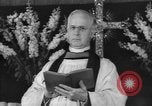
Reverend Roelif Brooks, Rector of St. Thomas Episcopal Church, New York, conducts "Bundles for Britain" service (WW2)
Reverend Roelif Brooks, Rector of St. Thomas Episcopal Church (Saint Thomas Church 1 West 53rd Street New York, NY 10019) in New York City, United States, blesses "bundles for Britain" contributed by his parishioners. He asks people to help war-stricken people in Britain. He asks for non- military aid for war relief which will reach Britain through 'Bundles For Britain Service'. A Cross and flowers in the background. He talks about the Nazi German bombing in Britain, its victims, and World War II during church service at St. Thomas Episcopal Church.
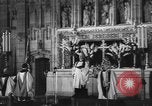
Parishioners of St. Thomas Episcopal Church, New York City, contribute "Bundles for Britain" during Sunday Worship Service (WW2)
Reverend Roelif Brooks leading a Sunday Worship Service at St. Thomas Episcopal Church (Saint Thomas Church 1 West 53rd Street New York, NY 10019) in New York City during World War II. Reverend Brooks prays to God to bless the offerings of the people which will reach Britain through 'Bundles For Britain Service'. Crowd of parishioners come forward and place their offerings of parcels before the altar. Reverend Roelif Brooks blessing the Bundles for Britain. Pile of bundles seen placed before the altar.