


 Francais
 Deutsch
 Italiano
Refine Your Search
Samurai stock footage and images
- Showing 7 to 12 of 21 results more
more Hide
Hide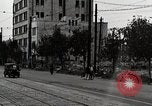
Gutted War Department building in Tokyo
Bombing damage in Tokyo soon after the end of World War 2. Samurai district showing remains of small shops and Geisha houses. Square block destroyed. Gutted war department building and retaining prison. Damage to navy building. Entrance to imperial palace and surrounding area. U.S. sailors stand at entrance to imperial palace.
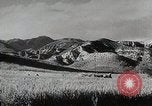
Contrast between Chinese and Japanese national aspirations before Second Sino-Japanese War and WW2
Film reviews China's four thousand years of history. Scenes showing mountains, woods, and a farmer plowing with oxen in rural China. A mass of Chinese people tightly packed together as they walk along a narrow alleyway in a town. Fleeting glimpses of two Chinese soldiers; a child; a woman; a woman and child; and numerous other Chinese people in a montage splayed across a background of moving crowds. An open book of Chinese characters. Mariners compass superimposed on an moving image of an ocean liner. Views of several large-scale astrolabes and world globes. A Chinese worker placing porcelainware in an oven for glazing. A man spooning gunpowder into a dish, followed by glimpse of a Chinese firework igniting. Chinese paper Dragon and street celebrations. A book entitled: "Analects of Confucius," in which, on page 105, is found the admonition: "What you do not want done to yourself, do not do to others." Ancient statues of two men and of two riderless horses behind them. Tall Chinese pagodas. Chinese artillery field pieces firing. Chinese troops advancing in several situations during conflict with Japan. Map of China and illustration of Japanese samurai warrior emblazoned across it. A book entitled: "The Tanaka Memorial, (Japan's Dream of World Empire)." A still photograph of Japanese Foreign Minister Baron Tanaka Giichi in military uniform, with other Japanese officers. Excerpts shown, ostensibly from this book. Emperor Hirohito is seen with Baron Tanaka, and other officers, all in military uniforms, in front of a tent, circa 1928. Automated map ostensibly illustrates the elements of a Japanese plan of conquest, starting with Manchuria for raw materials; the absorption of China for manpower; followed by a sweep South for riches of the Indies and Australia; and lastly a sweep eastward to crush the United States. More views of crowds of Chinese people are followed by an. animated map illustrating early World War II events, including Nazi Operation Barbarossa against Russia, approved by German leader Adolf Hitler in 1940, and the Nazi German occupation of Denmark, Norway, and other European countries. (Note: Actual existence of the so-called "Tanaka Memorial Imperialist Conquest Plan" is a subject of debate among historians.)
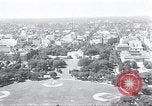
"Fuji Art Shoppe" in Washington D C
View of Washington D C city. Proprietor of "Fuji art shoppe" in Washington DC, is interviewed by a Japanese man. Proprietor shows around the shop. Articles like plates,vase and other China crockery can be seen. Small gift houses and other gift items made by wood can also be seen. Movies like Gates of Hell,The Magnificent Seven,Ugetsu, Samurai, Rasho-Mon can be viewed in the cinema hall.1964-65
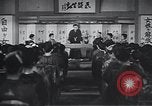
Documentary on status of women in Japan. Contrasts progressive efforts to past practices affecting lives of women.
Documentary on the status of women in Japan. It begins with a group of "progressive" women working to improve women's lot. Images of Meiji statesmen Fukuzawa Yukichi and Mori Arinori are shown with comment that they recognized the importance of women and worked towards their equality. The narrator states that in spite of their efforts, attitudes towards women were slow to change. The narrator cites centuries of repression of women as a reason for this. (In the Nara period, however, songs from the anthology called the Manyoshu, indicate men and women had a more equal relationship, which is illustrated by a couple relaxing in a park, while girls dance in the background.) With that exception, women are shown to have had generally difficult lives in the past. scenes of women being supressed are reenacted, such as one where a man eats dinner while his wife sits quietly behind him. Another shows a woman being scolded by her husband. A woman pulling a heavily laden cart up a hill. Women bowing low while a Samurai passes them.
Modernization of Japan in 20th Century leading to World War 2
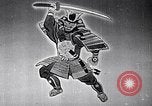
Opening scene shows cartoon depiction of a samurai and a Meiji-era soldier. A cartoon depicts the Bakufu opening Japan to the Western world. A Japanese communications worker is seen climbing a pole to install communications lines. A steam locomotive moves along railroad tracks being installed in the country. Glimpse of European style Japanese calendar (October 1856) being adopted. A Japanese photographer using flash powder and hooded camera. Men walking on a sidewalk in European style fashions. Cartoon showing Japanese inviting outsiders to help them build up their military power. View of three Japanese officials posing for camera. View of a British sailing vessel displaying the British Red Navy Ensign. Japanese troops on maneuvers with realistic smoke and battlefield conditions, supervised by French military advisors. Reenactment of French fighting Prussians in the 1870 Franco-Prussian war. Impressed by the German victory, the Japanese solicited German advisors for their army. View of German troops goosestepping and then of Japanese troops also goosestepping. National Diet building in Chiyoda City (1-7-1 Nagatacho, Chiyoda-ku, Tokyo 100-0014, Japan). View of Japanese legislators and then of the entire legislature (Diet) in session. Views of Japanese military leaders, including General Hideki Tojo, who also served as Prime Minister of Japan. Views of several such military leaders in uniform, exiting automobiles. Japanese soldiers marching through Torii gates.
Japanese Kawasaki Ki-32 (Mary) aircraft operating early in World War II
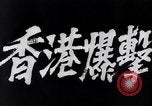
Japanese armorers carry a large bomb on their shoulders and place it on the ground next to a line of other bombs at a Japanese airfield in the Pacific region, early in World War 2. A Japanese pilot, carrying a katana (samurai) sword, climbs on the wing of a Kawasaki Ki-32 (Mary) light bomber and into its cockpit. Another crew member seen getting into rear cockpit. A flight of two Kawasaki Ki-32s airborne on takeoff from an established airfield. Both aircraft display wheel pants and white stripes and star-shaped images on their tails. View of pilot in forward cockpit. Six Kawasaki Ki-32s flying in loose formation.