


 Francais
 Deutsch
 Italiano

Refine Your Search
Santo-tomas stock footage and images
- Showing 7 to 12 of 68 results more
 Hide

Civilian internees work in a vegetable garden at a Civilian internment camp in University of Santo Tomas, Manila
Civilian internees from Allied countries including Americans, work in a vegetable garden at a Civilian internment camp operated by occupying Japan, at the University of Santo Tomas, Manila, Philippines, during World War 2. Sign says “Vegetable garden”. Various vegetables growing in a garden. A female internee planting seeds on soil. A woman picking from vines. Two men sitting in front of crops. A man and a woman walking together. Men and women use shovels to dig up soil. A man waters trays of seedlings. Several internees buy vegetables in market. Vegetables such as turnips, radishes, potatoes and other root crops on sale. Internees selling vegetables inside camp market. Children looking at vegetables for sale. Women picking leaves. A man distributes packages.

Civilian internees play games and use playground at a Japanese internment camp at the University of Santo Tomas, Manila.
Civilian internees including Americans play volleyball and basketball at a Japanese internment camp at the University of Santo Tomas, Manila, Philippines during World War 2. Several women internees sit on chairs while they watch other internees play. Children play in groups. A group of boys playing American football. Children playing on slides and swings and playground equipment.

Civilian internees at a Christmas party at the University of Santo Tomas internment camp in Manila (WW2)
Civilian internees (prisoners) in Japanese-occupied Philippines at a Christmas party at University of Santo Tomas, Manila civilian internment camp during World War II. View of the university’s main building. Christmas tree visible. A man dressed as Santa Claus distributes gifts to children. Children playing with toys.

Band of the Thirty Seventh Division play for the Santo Tomas internees in Philippine Islands
Band of the Thirty Seventh Division play for the Santo Tomas internees in Manila in Philippine Islands. Civilian internees applaud the performers. Several internee children dance and perform on stage.

Released U.S. prisoners and Filipino civilians line up for food at the Santo Tomas Concentration Camp in Manila, Philippines.
The Santo Tomas concentration camp in Manila, Philippines during World War II. Americans ( released prisoners ) and Filipino civilians line up for food. American citizens eating. Undernourished repatriates eat in a group. Food in trays. The repatriates eat.
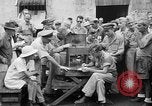
U.S. soldiers listen to a radio broadcast at the Santo Tomas concentration camp in Manila, Philippine Islands.
The Santo Tomas concentration camp in Manila, Philippine Islands near the end of World War II. Liberated Allied Soldiers and officers gather outside a prison camp building. They listen to a radio broadcast. An officer tunes the radio. The progress of soldiers is followed by a pencil on a map. Officers and repatriated prisoners listen to the radio. The radio set is made from stolen parts from a Japanese radio set. The soliders demonstrate how the radio equipment is packed up and was kept in the bottom of a stool to keep it hidden from discovery by Japanese guards. The maker of the radio, Lieutenant Hutchinson, is seated on the stool and chats with a soldier.