


 Francais
 Deutsch
 Italiano

Refine Your Search
Santo-tomas stock footage and images
- Showing 49 to 54 of 68 results more
 Hide
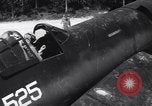
U.S. Marine Corps F4U aircraft returning from missions in Pacific theater in World War II
Location is probably Espiritu Santo in the New Hebrides Islands, during World War 2.The day is clear and sunny and palm trees are seen in background. Pilot sits in cockpit of Marine Aircraft Group 11 F4U Corsair airplane number 525 after returning from a mission. Plane captain, in shorts, climbs up to cockpit and gives the pilot a booklet in which he makes notes regarding any aircraft problems.He hands the booklet back to the plane captain and climbs out of the cockpit. He unfastens the chute leg straps and carries the chute in his arms. Scene shifts to another F4U that has just parked and is shutting down it's engine. Plane captain climbs up to the cockpit. A crew truck pulls up and a ground crewman picks up a parachute and places it on the truck fender.
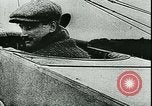
Various famous French flyers and flights
Pilot Roland Garros first man to cross the Mediterranean 1913. Pegoud taking off--first man to make successful loop in a bi-plane, shown making loops. Landing of bi-plane. View of flyer Clement Ader. Scenes of famous flyers superimposed atop take offs, landings, and aerials to show the progress from 1890 to 1945. View of Alberto Santos-Dumont. View of Bleriot. Views of aircraft flown in WW I. French aces Capt. Georges Guynemer, Lt. Charles Nungesser, Capt. Rene' Fonck. Views of practice bombing. Views of formation flying and two flights super-imposed over each other. World War 2 era bomber shown at end.
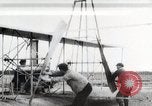
First joint flight by Wright Brothers in 1910 near Dayton Ohio. Also scenes from other "firsts" in early aviation history up until 1919.
Wright brothers' first aircraft flight together near Dayton Ohio in 1910. Wilbur Wright is in the pilot's seat with Orville Wright as passenger to his right. (Until this flight, the Wrights had never flown together so that if one of them was killed, the other could continue their work.) Next, a view of Alberto Santos-Dumont, and the first European flight made by him on 13 September 1909. Following segment shows crowds gathered at Washington DC Polo field as truck arrives carrying mail to be loaded on the first U.S. Air mail flight, May 15, 1918. Army pilot, Lieutenant Webb, in his JN-4H airplane, on Southbound flight from New York, takes off from Philadelphia, where he stopped to pick up more mail. He flies over the Washington Polo Field upon arrival. We see his airplane being unloaded as he jumps down from cockpit and crowds watch. Views of first transatlantic flight begins with takeoff of three out of four existing United States Navy Curtiss flying boat aircraft from Newfoundland, on May 16, 1919. Curtiss flying boats NC-1, NC-3, NC-4 are seen at takeoff from Newfoundland on first leg of the transatlantic journey. Flying Boat NC-4 is also seen at one of its foreign ports, though which is unclear (Azores, Lisbon, or England).

Aviation History in France; early airplane history and notable French aviation pioneers.
Scene of a symbol which demonstrates man's desire for flight. Painting of Leonardo da Vinci. Drawing of Leonardo da Vinci's flying machine. Views of drawings of the attempts of man to fly. Photo of Clement Ader. Drawing of Ader's plane. Still photo of the first powered Wright Brother's plane. Still photo of one of Ader's planes. Photo of Louis Blériot. Gabriel Voisin's photo. Picture of Robert Esnault-Pelterie. Two French designers. Robert Esnault-Pelterie making a test by mounting a glider atop a truck. Gabriel Voisin towing a glider with boats on the Seine River. He stayed airborne for several seconds. Photo of Alberto Santos-Dumont. The plane in which he made several flights. A plane made by Gabriel Voisin "La Bagatelle" which was flown by his brother Charles Voisin. Scene of this flight. Henry Farman seated in plane. Several views depicting the first attempt to fly the English Channel. Three competitors were Count Lambert in a Wright Plane at Wissant, Hubert Lathan in Antionette IV at Sangatte and Louis Bleriot (winner) flying a monoplane of his own design from Los Baraques to Dover. Single of Bleriot's plane. Observers of the flight. The English Channel. The wreckage being salvaged by French boat. Wreckage of plane as it is lifted out of the channel. Wreckage being pulled down streets. Louis Bleriot walking on crutches. Bleriot standing in cockpit of plane prior to, attempting to fly the English Channel at Les Baraques. The takeoff. Observers watching the landing at Dover, England. Two men standing on roof top waving a flag. Field, tent and personnel at Dover, England where the landing was made. English people examining plane after landing. Ship on which Bleriot returned to France. Reception committee greeting him. Street scenes of his reception in Paris.
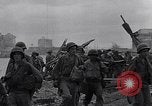
Chinese and Filipinos Red Cross workers carry away wounded civilians for treatment in Manila, Philippines (WW2)
Medical troops arrive at the South bank of Pasig River to help the wounded Filipino victims of the Battle of Manila during World War II. Chinese and Filipino Red Cross workers carry away wounded natives in boats with Red Cross flag across the Pasig River. Dead bodies of murdered Filipino civilians in the rubble. A weakened Augustinian priest receives, and eats food given by Santa Clara monastery nuns. Red Cross workers carry Allied and Filipino wounded from Santo Domingo Church. Filipino refugees travel by small banca boats on the Pasig River.

Four engine float plane Bleriot 5190 takes off from water and seen in flight.
The four engine seaplane Blériot 5190 (possibly the first one, called ‘Santos-Dumont’, named in memory of a friend of Blériot) descends a ramp into the water and takes off in Dakar, French West Africa. The Bleriot 5190 floatplane in flight. Views of the amphibious aircraft as it flies.