


 Francais
 Deutsch
 Italiano
Refine Your Search
Vietnam-security-police stock footage and images
- Showing 889 to 894 of 6186 results more
more Hide
Hide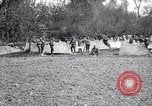
U.S. troops having their clothing deloused by steam, during World War I
U.S. Army Pup tents set up at bivouc area in Bonvillers, France during World War 1. A soldier, stripped to the waist, examines his clothing for louses. Soldiers place clothing,to be deloused,into large steam cylinders,mounted on a truck. The operators close and secure latches on one cylinder that has been filled with clothes. Soldiers standing around wearing only their overcoats, as they wait to retrieve their clothes. The operators remove baskets of clothing from the steam cylinders, and soldiers retrieve their belongings. Soldiers in a yard, waving their steamy clothes to cool them. One soldier takes a sponge bath in a small container of water. soldier in protective clothing examines clothes laid out in the yard.Red Cross ambulances and trucks in the background. (WWI. WW1)
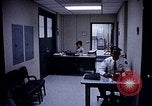
Apollo 204 review board discusses at National Aeronautics and Space Administration (NASA) in United States.
Engineer at entrance to secure facility. Shows badge to guard and is admitted. Another person is admitted after being identified. Guards station and file of persons allowed access is shown. Within the restricted area, teams of investigators are seen conferring and writing on white boards. Tables are spread with documents and drawings. Engineers examine vibration graphs (like seismic data) and plot timelines related to the investigation.
Navy training film about proper handling of jet airplanes on U.S. aircraft carriers
Training film about handling of jet aircraft aboard U.S. aircraft carriers. Introductory scenes show a U.S. Navy F9F-2 jet, of Squadron VF-51, landing on the aircraft carrier, USS Essex (CV-9). Scene shifts to U.S. Marine Corps McDonnell F2H Banshee jets, with tail codes LC, and folded wings, on carrier deck. A flight of four F9F panther jets flies past a carrier. They peel off to land. (They have no tip tanks.) Jet aircraft being moved about on carrier deck. Scene shifts to Vought F4U Corsair aircrafton a carrier. Then a Douglas A-1 Skyraider, tail code M, takes off. Carrier flight deck diagram is shown with typical layouts for positioning jet and conventional aircraft. Jets are then shown being catapulted in pairs. A diagram compares Jet and conventional landing patterns. A skyraider aircraft takes a wave-off without delay. An F9F lands forced to commit earlier than the conventional aircraft. A series of jet landings are shown. An F2H Banshee jet receives a wave-off and must go around. It runs out of fuel and crashes into water, just short of the carrier. Next, helicopter with rescued pilot seen on deck. More views of jets being moved toward elevator on carrier. An F2H coming up on elevator. Blue shirt plane handlers moving, securing, and guiding a taxiing jet. A yellow shirt signalling to catapult a jet. Jets landing closer to one another. Purple shirts refueling a jet on carrier deck.
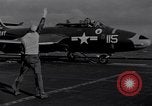
Training film explains techniques for catapulting jet aircraft from U.S. Navy aircraft carriers.
Film illustrating proper technique for catapulting jet aircraft from U.S. Navy aircraft carrier. Yellow shirt officer signals for catapult launch of a U.S. Navy F2H Banshee airplane, aboard an aircraft carrier. The aircraft is catapulted. Film recounts sequence of actions leading up to catapulting of a jet airplane from a carrier. A yellow shirt catapult officer guides the pilot as green shirt catapult gear crewmen adjust the bridle. Others secure the hold-back cable. View of hold-back cable and its slip catch with metal ring that breaks when the catapult is fired. A cover is installed to prevent parts of the ring from being flying loose and injuring someone or being ingested by a jet engine. View of an F2H being catapulted. Pilot given brakes off signal and catapult bridle is tensioned. Catapult officer coordinates with deck-edge crewman who monitoring catapult situation lights controlled by crew in catapult ready room below deck. When they signal "final ready," pilot applies full power and signals when at 100%. After final check, catapult officer on deck gives signal and the plane is launched. Views of jet aircraft being catapulted in pairs. Film illustrates procedures for handling "duds," when pilot signals a problem on the catapult. Pilot and deck officers hand signals are shown. Deck crewmen swarm over the aircraft and rapidly push it off and away from the catapult. Focus shifts safety regarding use of deck elevator. Views of more jets being catapulted at 35 second intervals.
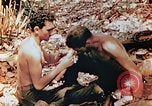
A U.S. marine dresses the wound of a buddy during battle of Saipan in World War II
Two marines are sitting on rocks during battle of Saipan, in World War 2. One has bandages on his right forearm. The other is applying dressing to the wounded marine's right shoulder. The wounded marine holds the bandage in place with his hand, while the other unrolls adhesive tape, and uses it to secure the bandage.
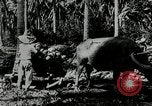
Men harvest coconuts in Philippines.
Coconuts harvested at a field in Philippines. A Filipino man secures coconuts on a cart pulled by a carabao buffalo. Another man gathers coconuts into a pile. Coconut trees in a field. Coconuts are loaded on a boat in a river. Men on boat transport coconuts down a river. Trees in the background.
CRITICALPAST.COM: About Us | Contact Us | FAQs - How to Order | License Agreement | My Account | My Lightboxes | Shopping Cart | Advanced Search | Featured Collections | Website Terms & Conditions | Privacy Policy ©2026 CriticalPast LLC.
License Agreement |
Terms & Conditions |
Privacy Policy
©2026 CriticalPast LLC.