


 Francais
 Deutsch
 Italiano
Refine Your Search
Vietnam-security-police stock footage and images
- Showing 91 to 96 of 6186 results more
more Hide
Hide
U.S. President Lyndon B. Johnson motorcade in Los Angeles, California
U.S. President Lyndon B. Johnson campaigning in Los Angeles, California. The Presidential motorcade proceeding along a freeway towards the city of Los Angeles. In the city streets, President Johnson stands in open car and waves to spectators who greet him from sidewalks. President's motocade moves along under tight security. Police motorcycles escort the President's car. Spectators with the American flag.
Battle of the Ardennes and Battle of the Bulge, in World War II
Film starts showing silhouettes of British tanks on the move, including one with a bulldozer blade. View from Allied warplane as bombs explode on the ground below. In November, 1944, infantry of the First Canadian Army, with Polish and British units fire Bren guns as they advance in Belgium and secure the Scheldt Estuary, to open a shipping route to Antwerp for the Allies. They traverse a river and cross rail lines while advancing. View of destroyed steel bridge across the Maas (Meuse) river with several British troops wading in water nearby. Silhouettes of German prisoners of war marching single file. View from rear of German prisoners walking under guard with hands resting on their heads. British troops running beside the Scheldt river at Antwerp on September 4, 1944, as huge explosions occur in the river behind them. A column of British troops, marching on tree-lined road, enters outskirts of Antwerp, as local people cheer them. Views of the troops being greeted in the city itself. Columns of Belgian refugees are seen returning to their homes. One,injured, is carried by friends in a wooden cart. A contingent of British troops marching in the city. Glimpses of derricks in the Antwerp port and a ship under construction in a shipyard. An animated map shows German counter offensive through Belgium and Luxemburg on September 4, 1944. Refugees leaving again, ahead of the returning German forces. View of a road sign reading: "Bastogne." American military police checking credentials of some refugees as they leave. American soldiers jammed together atop a Sherman tank parked at a checkpoint. After delaying further German advance, through the Ardennes, on September 16th, American troops are forced back and seen leaving , in trucks and Sherman tanks, from Bastogne, past a road leading to Martelange. As weather cleared on September 22nd, a formation of British Hawker Typhoon ground attack aircraft are seen in flight and diving to attack lines of communication with machine gun fire and rockets. Several different views of the aircraft firing and smoke rising from the ground. Animated map of German advance depicts the so-called "Bulge" extending 60 miles into Allied territory. Captured German films show German troops,one carrying a rifle and another a Sig 44 machine gun, as they pass columns of burning Allied trucks, other vehicles and armor. Closeup of German soldier waving to others to follow him, as he runs ahead past burning Allied equipment. Several German soldiers hunker under a knocked out Allied tank, as a German Jagdpanzer 38(t) Hetzer light tank destroyer passes their position. Closeup of German soldier smoking captured American cigarette. German infantry, walk past barrel of destroyed Allied tank. Several gather and smoke American cigarettes. One of them, with a belt of ammunition around his neck, is Hans Tragarsky aka Walter Armbrusch, of German Kampfgruppe Hansen, a battle group formed during the Battle of the Bulge from SS-Panzergrenadierdivision Regiment 2, an infantry regiment of SS Pz Rgt 2 "Das Reich". (This image is well known but his identity is subject to debate.) Glimpse of German officer walking with a soldier at the front, with background engulfed in flames.. Scene shifts to a formation of U.S. Army Air Forces C-47 transport planes seen, in flight, dropping food and ammunition to beleaguered American troops caught in the Battle of the Bulge. Change of scene to German Jagdpanzer IV tank destroyer moving; Panzer IV tanks firing 7.5 cm KwK 37 L/24 guns; and troops riding on a Tiger tank ( Panzerkampfwagen Tiger Ausf. B). German soldiers riding in a streamlined Volkswagen Kübelwagen. German soldier in an open single seat courier car spattered with mud. Close-ups of him smoking a cigar. German soldiers looking at formation of American C-47 aircraft overhead. A U.S. Army Air Corps B-25 bomber in flight. View from Allied bomber dropping bombs that strike ground with many explosions. View from above of a B-24 Liberator bomber in flight. View on ground of shells and bombs exploding in wooded area and low level black flak clouds. Captured 88mm gun being fired by Allied forces. British soldiers in a Landing Vehicle Tracked, cross a stream and climb up a steep bank. View from British "Wasp" flame-throwing Bren-gun carrier, as it fires and resulting inferno of fires. Views from a long distance of other flame-throwers firing across the stream. Closeup view of one firing with fires burning on the opposite shore.
Scattered debris and SPs roping off crash site at March Air Base in California.
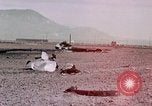
Damage caused to USAF B-52 Stratofortress and to property following crash shortly after take off at March Air Base in California. View of March Air Base and scattered debris. Damaged tail section, tires, motor and engines of a crashed B-52. Personnel stand near debris. One personnel walks through debris. Damaged B-52 in the background. Medics, crewmen and other personnel at crash site. Sps (Security Police) roping off crash site.
Mopping up operations at end of battle for Okinawa in World War II. Numerous Japanese prisoners of war impounded.
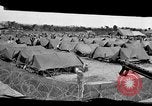
Opening scene shows tents housing more than 1500 Japanese prisoners of war at Kadena, Okinawa during World War 2. The area is surrounded by fencing and, as camera pans, it shows an American soldier overlooking the prison camp as he holds a Browning M1919A6 light machine gun. Another view of the prison compound with warning sign against admittance and another sign reading: "PW inclosure." As narrator refers to "mopping up operations" a jeep carrying more Japanese POWs drives past the signs. Ambulatory Japanese POW entering the prison compound past armed military policeman. View from inside the compound as Japanese POWs enter. A POW being frisked by a U.S. soldier. Closeups of some Japanese prisoners standing behind barbed wire enclosure. American soldier makes notes as he interviews a prisoner. POWs receiving haircuts under a tent in the stockade. Others washing and shaving at an outdoor trough of water. Some seen playing a board game at a tent. POWs in a wrestling contest, surrounded by others watching. Prisoners offloading supplies from a truck and stacking them in their compound. POWs cooking food in large kettles and distributing it to other prisoners. Various views of prisoners in the compound. U.S. medics attending to a wounded POW, administering blood plasma. Numerous Japanese prisoners loosely assembled outdoors. Next, on June 22, 1945, U.S. troops are assembled for a flag raising ceremony. The U.S. flag is raised on a tall flagpole to mark the securing of Okinawa. An unidentified U.S. Army Lieutenant General leads the ceremony, saluting as the colors are raised. (Lieutenant General Simon Bolivar Buckner Jr., Commander, 10th Army that took Okinawa, was killed 4 days earlier, on June 18, 1945.)
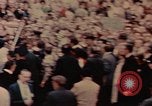
President Richard Nixon and First Lady Patricia at Glacier Park International Airport in Kalispell, Montana
A large welcoming crowd gathered at Glacier Park International airport in Kalispell, Montana, United States. They welcome U.S. President Richard Nixon and First Lady Patricia Nixon during their visit. A number of police officers and security detail are seen at the airport. The President confers with other elected officials present, including Mike Mansfield, the Majority Leader of the Senate, Montana Governor Forrest Anderson, Congressman Dick Shoup, and Congressman John Melcher. A large sign with the label "Kalispell Neon" says "Welcome to the Big Sky Country President Nixon." The President and members of his party proceed toward a waiting military helicopter and board while the crowd looks on.
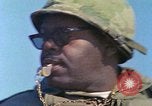
In the U.S. MPs at circulation control points provide river crossing support during war.
A training film in the United States details the role of Combat Military Police of the United States Army in supporting river crossing during war. An MAB (Military Assault Bridge) is emplaced and an armored vehicle rolls over the bridge. MPs direct the traffic. Other roles of MPs showing MPs involved in intelligence reporting on a battlefield, evacuation and control of prisoners. They move forward with equipment gaining advance in enemy area. Additional units of MPs cross the bridge. The MPs direct traffic at circulation control points such as road junctions. MPs with rifles provide security. One MP maintains radio communication. The MPs exchange information at a road junction.
CRITICALPAST.COM: About Us | Contact Us | FAQs - How to Order | License Agreement | My Account | My Lightboxes | Shopping Cart | Advanced Search | Featured Collections | Website Terms & Conditions | Privacy Policy ©2026 CriticalPast LLC.
License Agreement |
Terms & Conditions |
Privacy Policy
©2026 CriticalPast LLC.