


 Francais
 Deutsch
 Italiano
Refine Your Search
Vietnam-security-police stock footage and images
- Showing 1021 to 1026 of 6186 results more
more Hide
Hide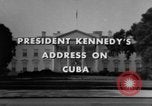
President John F. Kennedy addresses the nation about the missiles in Cuba from his office in the White House, Washington DC.
U.S. President John F. Kennedy addresses the nation during Cuban Missile Crisis. Exterior of the White House. President Kennedy in his office. He speaks about the series of offensive missiles found in Cuba and the range of these missiles. He names the cities that could be covered by medium range missiles and intermediate range missiles and thus are a danger to the western hemisphere. He also talks about Jet bombers capable of nuclear bombing. He refers to the constitution and the charter of the United States. He also discusses his talk with Soviet officials and their refusal to remove the weapons. President Kennedy condemns the nuclear weapons and expresses his concern about the Communist buildup in Cuba as it is dangerous to the United States. He talks about Americans policy to be patient and restrained. He warns that any nuclear attack from Cuba would be regarded as Soviet attack. He talks about an emergency meeting of the UN Security Council for withdrawal of all offensive arms from Cuba under supervision of the United Nations. Kennedy addresses Cuban people and says that they had been betrayed by their leaders. He asks all citizens to be patient

United States Secretary of States Edward Stettinius Junior, meets ambassadors of Britain, Russia and China in Washington D.C.
San Francisco Security conference of representatives of four powers meets in Washington DC prior to the United Nations San Francisco Parley. United States Secretary of States Edward R. Stettinius Jr. meets British ambassador to U.S. Edward Wood (Lord Halifax), Russian ambassador to U.S. Andrei Gromyko, and Chinese ambassador to U.S., Dr. Wei Tao-ming. Assistant Secretary Archibald MacLeish speaks on a microphone. Chinese ambassador speaks. Assistant Secretary of State, Archibald MacLeish, poses and talks on a microphone.
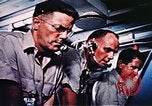
Detonation of liquid thermonuclear device MIKE, the first hydrogen bomb, at Enewetak Atoll, Marshall Islands.
Full-scale thermonuclear test of ultracold liquid deuterium, codenamed Ivy MIKE at Enewetak Atoll in the Pacific Proving Ground in the Marshall Islands (sometimes spelled Eniwetok or Eniewetok). (Left to right) Chief engineering and firing commander, Stan Burris -- later the leader of the Strategic Ballistic Missile development, including Polaris and later editions; retired as CEO of Rockwell Aerospace -- military firing and security commander, Colonel Richard Lunger, and ultracold refrigeration engineering commander for thermonuclear liquid fuel state monitoring, Robert Gibney. The intense nuclear radiation ignited the atmosphere around the device, creating a fireball 4.2 miles across. A remote firing control was created, using a televison tower beam signal to safely trigger the detonation from the USS Estes, approximately 35 miles south/southeast of the detonation. White hot device remnant specks are visible throughout the surface of the fireball. Shockwave from Operation Ivy Mike explosion is seen spreading across the water, then a white mushroom cloud spreading above. View of crew on ship deck observing blast. Device yield: 10.4 megatons.
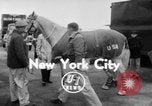
U.S. Olympic horse jumping team members and their horses board an airplane for Stockholm.
Ten horses of the U.S. Olympic horse jumping team are loaded aboard a Pan American World Airways DC-6 Cargo Clipper in New York City. They are bound for Stockholm, Sweden. A trainer is seen leading a horse up a long ramp, into the aircraft cargo hold. Members of the U.S. Olympic Team: Frank Chapot, William Steinkraus (Team Captain), Hugh Wiley, and Warren Woffard. pose in front of the aircraft: View inside the aircraft, as the horses are being secured in their stalls.
An officer talks about the three basic problems to be solved by the Platoon leader in any formations (WW2)
A war film on the 'Battle Formations' The Rifle Platoon depicts the advantages of the different formations during World War II. The U.S. Army Sergeants stand around a desk and talk A Sergeant looks at a wall map. A Rifle Squad officer enters and ask a Sergeant about the people present. Sergeants seated around a table and a model kept on the desk. The officer talks about the battle formations of the platoon. He also talks about why the platoon is led by officers. He explains the battle formation of the platoon. The officer also give details about why and when theses formations are to be used. He talks about the three basic problems to be solved by the Platoon leader in any formation like security, maintenance and direction of control and minimum vulnerability to hostile fire and explains it with a help of the model. The officer explains the Platoon Column formation on the model. The Sergeants listen to him and see the formations made by the platoon leader.
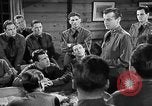
An officer explains different types of platoon formations and its usage and advantages (WW2)
The advantages of the different Platoon formations during World War II. The U.S. Army Sergeants stand around a desk. A Rifle Squad officer talks about the formal formations of the Platoon. He first explains the Platoon Column Formation which is useful at night and during low visibility. Secondly he speaks about the Platoon in Line of Squad Column in which the center is the Base Squad and is useful only when the location of the enemy squad is known. A Sergeant asks a questions and the officer answers. Next is the Platoon in Squad Column formation with center squad back this formation is most useful and widely used. It provides Rifle Squad support and allow use of covered approach terrain further movement in Platoon Column. A Sergeant asks question about the number of squad to be used in the formation. The officer answers. Another sergeant questions him about maintaining contact with security measure. The officer explains this answer with the help of a example.
CRITICALPAST.COM: About Us | Contact Us | FAQs - How to Order | License Agreement | My Account | My Lightboxes | Shopping Cart | Advanced Search | Featured Collections | Website Terms & Conditions | Privacy Policy ©2026 CriticalPast LLC.
License Agreement |
Terms & Conditions |
Privacy Policy
©2026 CriticalPast LLC.