


 Francais
 Deutsch
 Italiano
Refine Your Search
Vietnam-security-police stock footage and images
- Showing 1087 to 1092 of 6186 results more
more Hide
Hide
U.S. Ambassador Joseph Kennedy returns to the U.S. from London, United Kingdom
United States Ambassador to the United Kingdom Joseph Kennedy returns from London, United Kingdom. A Boeing 314 or Clipper flying boat at the New York pier. The Ambassador gets off amidst security personnel and other officials. He is greeted by numerous officials and his family members. He poses with his family for the press.
A USAAF officer trains a new B-17 pilot in internal inspection and safety precautions prior to take off in the United States.
A U.S. Army Air Forces (USAAF) training film titled 'How to fly the B-17. Part I. Ground Operations.' about inspections and safety precautions by a pilot prior to take off. A USAAF officer trains a new pilot beginning his career as a USAAF B-17 Flying Fortress pilot. The instructing officer, trainee pilot and aircraft engineer inspect a USAAF B-17 Flying Fortress. They rotate the propeller blades to inspect engine number 3 and 4. Interior inspection: The three airmen climb into the B-17. Inspection: tail oleo, cylinder, any loose or unanchored parts, ball turret, hand break position, control cables throughout the ship, hand cranks in place, hatch secure, locking dogs in place. The officer instructs the pilot about checking the aircraft's computed loaded weight and CG before each flight, and their effect on the flight. Fire extinguisher check, bomb bay check, emergency bomb release lever check. Cockpit check: fire extinguisher beside the door, all access doors and covers from the cockpit window. The officer and pilot strap into their respective seats to proceed with the check. The officer (acting as the co-pilot) reads out each item from the check list as the pilot conducts the check simultaneously. They complete Form 1A and sign the exceptional release required under special circumstances. Check: radio chart, weather code, Form 1A for loading and passenger list. (World War II period).
People retire from evening entertainment, but trucking activities go on at night in New York City
A film titled 'While The City Sleeps' about the importance of trucking industry for the way of life of a large city like New York City. Automobile traffic on roads at night and neon lights lit up in Times Square, New York City. Neon lights scenes continue, superimposed with other images: People in various clubs and restaurants. People dance. A man plays a trumpet. Hands of a couple overlapped, holding hands. Superimposed images end. View of a bell hop who blows a whistle. A couple enters a taxi cab to go home. A waiter removes a table cloth and a salt shaker from a table. Bell hop takes off his uniform after the day's work. A musician puts a trumpet in a case. Lights are turned off at night. A security guard walks in front of quiet buildings. Trucking activities are shown continuing during the night. Sign for the Port Authority of New York Holland Tunnel entrance. Cars and trucks entering the Holland tunnel. Delivery of fruit, milk, gasoline, newspapers, coal, bread and many other things. Night view of traffic crossing the Queensboro Bridge also called the 59th Street Bridge. Building material is delivered. An Esso gasoline truck delivers fuel to a petrol or service station. Close up view of moving tires on a truck. Stacks of newspapers slide down a chute to a waiting truck. A Canal Coal Company truck delivers coal to a building. The coal trip bed is shown tipping and elevating to dump the coal. Bakery employees load bread into trucks of the Cushman's bakery. A truck dumps sand. Another truck picks up a plant from a nursery. A car carrier truck is shown carrying four new automobiles on a two level flatbed system. View of skyscrapers of Manhattan in early morning after dawn. A hand reaching for an alarm clock to shut it off in the morning. Two feet seen turning off of a bed and into a pair of waiting slippers. Man gets out of his bed.
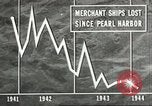
U.S. Coast Guard and maritime authorities assure protection and safety of U.S. ports during World War II
A chart shows the losses of American merchant ships to German submarines diminishing over the course of World War 2. Women walking into the Merchant Marine Council headquarters in Washington DC. Council member officers meeting in their board room. Glimpse of merchant vessels and tugboats. Sign identifies office of the Captain of the Port. Inside, two men discuss movement and anchorage of ships. View of anchor being dropped from a large ship. A small Coast Guard patrol boat moves among anchored ships, checking for possible threats. Closeup of officers aboard the patrol boat with American flag behind them. Sign at office of Port Security Officer. Inside, men update a chart showing ships in port and locations. Coastguardsman patrols cargo area for safety and threats. Cargoes being moved on rail at the port. Explosive cargo and artillery shells are seen in containers. Officer oversees loading of munitions on a ship. Coast Guardsman walking across stacks of military gas cans (Jerrycans) on a barge. Officer and guardsman examine one that appears to be leaking, and remove it.
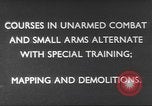
Cadets receive training in hand-to-hand combat, use of small arms, mapping and demolition at a training camp in Cairo, Egypt.
Office of Strategic Services officers on a mission in Cairo, Egypt during World War II. Cadets practice field tactics. Training in hand-to-hand combat, use of small arms, mapping and demolition is given at Security Officer Training Camp. The cadets and an instructor standing beside aircraft. The instructor explains about parachute jumping and commando assault technique. The cadets practice somersaults. The U.S. flag at mast. The cadets play handball. Tents in the camp.
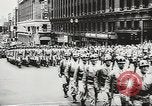
Work and achievements of Harry S. Truman during his first Presidential term in the United States
President Harry S. Truman marches with veteran soldiers of U.S. Army Company D (129th Field Artillery) with whom he served as an officer in World War 1. Wide view of men lined up on White House lawn. Disabled veteran soldiers of World War 2 greet the President. Narrator discusses problem of lack of housing for veterans and their families after World War 2. Aerial view of trailer homes or recreational vehicle (RV) camper units lined up in open space, serving as temporary housing for veterans. Truman sitting at desk while he signs the Veterans Emergency Housing Act of 1946. Views of long lines of new homes being built, and construction workers hammering to build frames of new houses in the United States. During a time of price inflation, scene shows grocer changing price signs on eggs, meats, cheeses to show increasing prices. Truman ata work in his office reviewing paperwork at his desk. Narrator mentions Taft Hartley Labor Act that Truman vetoed. View of car on road with sign on side that reads, "Veto Hartley Taft Slave Labor Bill." President Truman reading at his desk. Close up view of cover page of report entitled "To Secure These Rights. The Report of The President's Committee on Civil Rights. View of Episcopal church Bishop Henry Knox Sherrill seated at a desk. Bishop Sherrill is talking to another man. Narrator states that Truman acted on a civil rights program recommended by Bishop Sherrill, head of the Civil Rights Commission. Car pulling up to portico of White House and view of President Truman shaking hands with visiting President of Mexico, Miguel Alemán. President Truman being presented a sacred Torah by Israeli President Weizmann. Discusses foreign policy matters with Secretary of State George Marshall and comes up with Truman doctrine, Marshall plan and European recovery program. View of Truman signing Economic Cooperation Act of 1948 on April 3, 1948 (of which the Marshall Plan was a part).
CRITICALPAST.COM: About Us | Contact Us | FAQs - How to Order | License Agreement | My Account | My Lightboxes | Shopping Cart | Advanced Search | Featured Collections | Website Terms & Conditions | Privacy Policy ©2026 CriticalPast LLC.
License Agreement |
Terms & Conditions |
Privacy Policy
©2026 CriticalPast LLC.