


 Francais
 Deutsch
 Italiano
Refine Your Search
Vietnam-security-police stock footage and images
- Showing 1297 to 1302 of 6186 results more
more Hide
Hide
Students protest outside the American university against the Turkey-Pakistan defense pact in Beirut, Lebanon.
Lebanese students protest outside the American university in Beirut, Lebanon. They protest against the Turkey-Pakistan defense pact. Police tries to control the situation. One student dies and 29 get injured in police firing. Shows student protestors being beaten by police, and police and officials using high pressure water hoses to disperse demonstrators.
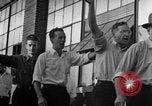
Union-sponsored film about the 1939 Tool and Die Makers Union strike against General Motors in Detroit, Saginaw, and Cleveland.
Union members march beside a building singing about "solidarity." Slate reads "Fleetwood" superimposed on "Detroit." Closeup of flag reading: "Fleetwood Local 15, U.A.W. Detroit." Marcher carries American flag. One carries sign calling for: "Time and a half for overtime, and double time for Sunday and Holidays." Among other signs, one reads: "Equal Pay for Equal Work." Bronze plaque on building reads: "Frederick Coleman and Sons, Inc." Yard filled with striking workers. Trucks sent by General Motors Company (GM), to remove tool and die shops, from a factory, are prevented from moving by the mass of strikers from the unionized Frederick Coleman plant, who refuse to become "Scabs" (strike breakers). Meeting inside their own factory building, Coleman workers promise George F. Addes, Secretary Treasurer of the U.A.W. (Union of Auto Workers) that not a GM tool or die will leave their shop. They pose near auto parts waving their hats. A new slate appears reading: "Fisher" overlaying "Cleveland." A picket line is seen in a Fisher Body Factory yard, guarded by uniformed policemen, including some on horseback. One striker walks to a building identified by a sign as Strike Headquarters. Narrator says he can get a meal there. Inside, a strikers women's auxilliary has set up a Strike Kitchen, where he receives a cup of coffee and converses with a woman of the auxilliary. Next, he is seen reading a Cleveland newspaper with headline: "Police and Pickets clash at Fisher Plant." He is then seen at his home, having supper as his wife reads the newspaper. (Narrator notes that strike has lasted 19 days.) The man and his wife argue about the wisdom of striking. Their little girl runs to her father. The three of them hug and the man then goes to join the picketing. Scene reverts to earlier conversation with the womens' auxilliary person. She sympathizes with the man's concerns. Next, three union auxilliary women visit the man's wife. They try to assuage her fears about the labor strife. (In background, voice of a union auxilliary woman speaks about the Wagner Labor Act.) More views of the Fisher Plant factory yard, with police and strikers struggling. Still photograph of men running as shots ring out. Closeup of hand holding a tear gas shell. Still photograph of police using tear gas to disburse strikers. The women visiting the wife convince her of the soundness of the strike and she joins them as a union auxilliary worker in their Strike Kitchen. View of the film's protagonist man and his wife conversing amicably in their kitchen. Final scene shows the wife with her husband on a picket line holding a sign reading: " Women's Auxilliary Stands Behind Local No. 45 in this Fight." Camera focuses on one striker riding a horse bearing two signs. One points to the front of his horse and reads: "This is the C.I.O end." The other points to the horse's rear and reads: "This is the Company end."
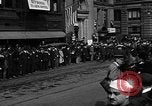
Liberty Loan Drive in New York City during World War I
Fourth Liberty Loan Drive activities in New York City during World War 1. Crowd lines sidewalks to watch as a New York City Policemen's brass band leads a parade along an avenue. A sign on building, above the spectators reads: "Buy Bonds to Arm Armies." A color guard of policemen follows the band, and behind them, a group of mounted policemen moving two-by-two, ahead of a formation of policemen. Scene changes to a street filled with people. Some hold flags and signs. A crowd hangs the Kaiser in effigy outside the Woolworth Building, at 233 Broadway ( between Park Place and Barclay Street in Lower Manhattan, opposite City Hall). Sign on the building reads: "Fight Buy Bonds." Above, a dozen business men watch the events from the window of the Irving National Bank. Gate of the first floor Rathskeller is seen at sidewalk level. Soon, another effigy of the Kaiser is seen swinging from a rope. Both dangle from the third floor of the Woolworth Building. Scene changes to a brass band playing in the street. Workmen are seen on the marquee of a building being renovated. A sailor stands in their midst giving a speech. The workmen applaud. The sailor gives an impassioned call for those below to buy Liberty Bonds. (World War I; World War 1; WWI; WW1)
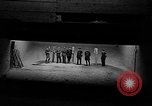
Burial pits in Gestapo torture chambers in Paris, France.
Gestapo torture chambers in Paris, France. Interior of torture chambers of Gestapo (German Secret State Police). French soldier and policemen near boxes. French soldier and policemen hold a cloth. Ropes and blind fold used on victims. A Nazi prisoner. French men with Nazi prisoner look at post. Burial posts. French soldier stands in a burial pit. Policemen stand in the background. (World War II period).
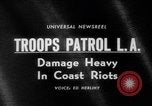
Burning buildings and aftermath of the race riots in the Watts area of Los Angeles, California.
Loss and damage in the city after race riots in the Watts area of Los Angeles, California, during the Civil Rights movement. Night time views of the streets in the largely African American section in Los Angeles. Smoke and flames rise from buildings. Buildings on fire, set by arson during the riots. Interiors and exteriors of the buildings on fire, spanning many city blocks. Policemen arrest two men and lead them away. The devastated areas in the city, and a few buildings which are left intact. Armed National Guard troops in the streets on patrol to prevent further looting and damage. Damaged buildings on either side of the road. The Watts area of the city where a curfew was put into effect. A soldier with a rifle patrols the area. The remains of buildings in the area. Views from a moving vehicle of block after block of gutted and destroyed buildings. A special task force on alert. Policemen come out of a truck and National Guardsmen exit a bus. A helicopter in flight over the area. The police vehicles on the streets, and police in the streets behind makeshift covers for protection.
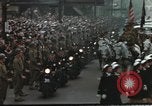
The funeral procession of President Franklin D. Roosevelt moves on the streets of Washington DC
Spectators line sidewalks in Washington,DC, to watch the funeral procession of President Franklin D. Roosevelt. Police motorcycle escort surrounds flag-draped coffin of the President, resting on caisson pulled by team of horses. Color Guard and several closed black limousines are immediately behind. Two open cars, with Secret Service agents on their running boards, are seen next. The closest one carries the Speaker of the House of Representatives, Sam Rayburn, and other officials. A contingent of Women Marines, in dress blues, marches ahead of the casket. Other military units march ahead of them in the distance. Change of scene with brief glimpse of sailors marching along Delaware Avenue, with Union Station in the background. Shift back to the President's casket continuing to move along. Grass and trees line the sides of the street, where spectators fill the sidewalks. Closeup of an open car carrying DC police chief, Edward J. Kelly and other police officials, followed by motorcycle policemen, and the team of horses pulling the caisson with the President's casket. Closeup of closed limousine carrying mourners. Open car carrying House Speaker Rayburn, and others. U.S. Navy Fleet Admiral Ernest King and an officer salute. People in the background.
CRITICALPAST.COM: About Us | Contact Us | FAQs - How to Order | License Agreement | My Account | My Lightboxes | Shopping Cart | Advanced Search | Featured Collections | Website Terms & Conditions | Privacy Policy ©2026 CriticalPast LLC.
License Agreement |
Terms & Conditions |
Privacy Policy
©2026 CriticalPast LLC.