


 Francais
 Deutsch
 Italiano
Refine Your Search
Vietnam-security-police stock footage and images
- Showing 1375 to 1380 of 6186 results more
more Hide
Hide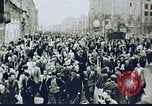
Strikes and demonstrations on 16 and 17 June, 1953 in East Berlin by East German workers.
People on strikes and demonstrations in East Berlin, Germany. Also called the Uprising of 1953 in East Germany. People standing on top of buildings. Buildings and radio tower of RIAS (American Radio Station in Western Sector of Berlin) which was spreading news of the workers general strike. Motorcars pass by. East German demonstrators throw things into fire protesting excessive work schedules. People watch fire. Flames of fire. Sign at the border of East and West Berlin, warning "You are leaving the American Sector." More scenes of the protests in East Berlin, from other news sources. Rioters throw east German police uniforms out of a window toward a crowd. Soviet Russian Soviet army tanks and troops enter the areas of unrest. At TC: 01:48, two protestors are seen sliding an iron pipe into the tread of a tank. East German Leader, Walter Ulbricht at a podium, backed by a huge replica of a white dove, and, elswhere, standing with associates. East German communist organizations, including police, marching in attempts to dispel notions that East Germans are oppressed. Huge poster of German worker rejecting American Marshall Plan, with slogan, "Yankee Go Home." Light tank and armored car parked beside a building. Closeup of soldier gripping machine gun atop a tank. Army trucks and troops in center of a city square. Voice of America commentator broadcasting news of the events from the RIAS station in West Berlin.
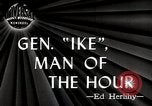
General Eisenhower returning home to Washington, DC after World War II, by way of Paris and London.
With the war ended, General Dwight D. Eisenhower is feted in London, on his way home to America. He is seen stepping into a ceremonial horse-drawn carriage, as throngs of spectators line the sidewalks to watch. Accompanied by British Air Marshal Arthur Tedder, Eisenhower rides in the carriage, escorted by police on white horses. Crowds cheer Ike from the sidewalks as the carriage passes. The carriage stops at the London Guildhall. (A sign reads: "Site of the Guildhall Chapel, 1299-1822.") Inside, Sir Frank Alexander, Lord Mayor of London, is seen making Ike an honorary citizen of London and presenting him a token sword that once belonged to the Duke of Wellington. Outside, the streets are jammed with London well-wishers who applaud and cheer the Supreme Allied Commander as his carriage passes them on the way to Mansion House. At some points, Eisenhower stands and acknowledges the crowds cheers and he sometimes salutes, while seated. Glimpse of spectators jammed side-by-side in the streets. Eisenhower is seen standing on the balcony of Mansion House, flanked by Prime Minister Winston Churchill, in a top hat. The balcony is decorated with British and American flags. Sounds of the cheering crowd can be heard as Ike says: "Whether or not you know it, I am now a Londoner, myself." The crowd cheers. He continues: "I have just as much right to be down in that crowd, yelling, as you have." He goes on to make other remarks about the peaceful state of things. He bids all farewell and he and Churchill turn to enter the building. Scene shifts completely to the Arch of Triumph in Paris, where General Eisenhower is seen ceremoniously laying a wreath at the tomb of the unknown soldier. He steps back to stand beside French General Charles de Gaulle. They and accompanying military officers salute. The memorial flame at the tomb fills the foreground. Next, in a closeup, General de Gaulle is seen decorating Eisenhower with the Medal of Liberation. Glimpse of enthusiastic French citizens cheering as Eisenhower tours the city with de Gaulle, in an open car escorted by police on motorcycles. They proceed along the Champs Elysees, with the Arc de Triomphe in the background. Ike and de Gaulle both stand as they drive along. Closeup from moving vehicle passing close to crowd. Views from rear as the car and escorts move through the spectator-lined streets. Similar views from ahead. Scene shifts to Eisenhower finally arriving in the United States. A pointed arch supports a large American flag above a "Welcome Ike" banner. General Eisenhower steps from an airplane in Washington,DC, where Mrs. Mamie Eisenhower greets him. The two pose for the camera. Next, a motorcade of jeeps travels along Pennsylvania Avenue. The Post Office building is seen on the right and the capitol in the far background. District Commissioners present Ike keys to the City. Views of jeep motorcade proceeding along Pennsylvania Avenue. Eisenhower standing in a jeep acknowledging the crowds. As they reach the capitol, a disabled veteran gives something to Ike. Inside, Eisenhower makes his way to the podium to address a joint session of the Congress. View of Ike addressing the session, with Speaker of the House, Sam Rayburn and president pro tempore of the United States Senate, Kenneth Douglas McKellar, behind him. (The latter was serving as President of the Senate, in the temporary absence of a Vice President, after Harry Truman became President upon the death of Franklin D. Roosevelt.)
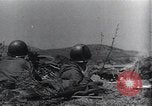
United States Army 187th Airborne Regimental Combat Team returns to Japan from Korea and is welcomed by City of Beppu, Oita
Clip opens with rapid changing scenes: American troops in trench in Korea during the Korean War. American tank on street in Germany. American Ski troops in Alaska. Amphibian assault training in Puerto Rico. Rotating Globe shows: U.S. Army on alert to defend against aggression. Sergeant Stuart introduces episdoe and states that U.S. Army has come to Japan to know their culture and make friends after war and occupation. U.S. Army troops of the 187th Airborne Regimental Combat Team, are seen arriving by railroad train at a train stateion near their base near Beppu,Oita on the island of Kyushu, Japan. U.S. Army soldiers, including white and African American soldiers, exit train cars. They receive a warm welcome from Japanese population. Banner reads:" Welcome Pala Troop comin back from Korea, City of Beppu."[sic] Women holding flowers and families with small children waving American and Japanese flags, welcome them on the train station. A sign over the train station platform reads: "Welcome 187 Para Troop Coming Back From Korea, City of Beppu." The troops stand in formation on the platform while the unit's officers receive the flowers from the women. Japanese men in fraternal uniforms and the general population all join in the welcoming ceremonies. The troops march off the train station under another sign reading: Welcome Home 187 RCT." and march down the main street of Beppu under a swirl of paper confetti. Next scenes are from autumn of 1945, as U.S. soldiers march through streets of Japan during occupation following the end of World War 2. U.S. troops seen marching behind Japanese police to occupy Japan, in 1945, amidst the aftermath of suffering and destruction of the war. The local population standing at road sides and watching with worry and concern. Scenes of postwar destruction in Japan. Rubble of bombed buildings. Scene of simple wooden dwelling shacks and wreckage nearby. A Japanese boy with his baby brother on his back. The baby is crying. Next scene moves again to circa 1950 in streets of a Japanese city, possibly Tokyo, rebuilt and with busy scenes of traffic on streets and commerce. Large outdoor rally with a Communist speaker addressing large crowd of Japanese people who sit and listen. Scenes from a what the narrator describes as a Communist rally in Japan, against America, which turns violent. Protestors running in streets during demonstration, with signboards and police and fire fighters extinguish flames at scene of an overturned, burning car. Flashback again to 1945 or 1946 as U.S. Army soldiers use tractors and heavy equipment to clear and level an area of war rubble and debris during rebuilding efforts after World War 2. Japanese citizens look on, watching the machines at work.
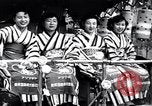
Japanese, United States Army and Americans celebrate anniversary of Yokohama Port which opened in 1859.
Anniversary celebration of Yokohama port, which opened in 1859. Japanese women seated in striped kimonos. A dragon dance in Yokohama’s China Town. Celebration Parade down Isezaki Street, in Yokohama. Dragon floats dance. Musicians march as they play music. U.S. Army participates in celebration. Yokohama locals dressed in costumes ride in parade floats. Japanese women in swimsuits wave from moving float. Military Police personnel ride on top of armored vehicles. A woman wearing a wedding dress dances on top of float. Japanese children wearing paper crowns enjoy the parade. Japanese policemen control the throng. Japanese children watch the various floats. The Big Picture host Sergeant Stuart Queen speaks about friendship of United States with Japan after the end of World War II.
Officers and personnel sitting around a desk and conferring after Detroit riots in United States
Man talks on phone. The man reads from paper as he talks from phone. Man types on a type writer. The man smokes a pipe. Sign over door reads 'Press Room'. Two soldiers stand. Military Police and a soldier talk. Army Military Police on duty in front of an office door.
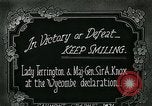
Major-General Sir Alfred Knox declared winner over Lady Terrington, in the 1924 election for MP from Wycombe, England
Defeated Liberal , Vera Florence Annie Woodhouse (Lady Terrington) and Major General Sir Alfred Knox, following announcement of his election as Member of Parliament for Wycombe, in the 1924 general election. Major General Sir Alfred Knox, wearing an outsize boutonniere is seen leaning out window of the Falcon Hotel,High Wycombe, England, as his supporters cheer him from below. Lady Terrington and supporters gathered on portico roof of Red Lion Hotel. She waves to her loyal supporters. Crowds cheering in a square, as Knox and Terrington appear at an open window and shake hands. Bobbies (policemen) escorting Lady Terrington through the crowd. Another contingent of policemen escort Major General Sir A. Knox. The newly elected MP, Major General Knox, smiles for the camera.
CRITICALPAST.COM: About Us | Contact Us | FAQs - How to Order | License Agreement | My Account | My Lightboxes | Shopping Cart | Advanced Search | Featured Collections | Website Terms & Conditions | Privacy Policy ©2026 CriticalPast LLC.
License Agreement |
Terms & Conditions |
Privacy Policy
©2026 CriticalPast LLC.