


 Francais
 Deutsch
 Italiano
Refine Your Search
Vietnam-security-police stock footage and images
- Showing 1417 to 1422 of 6186 results more
more Hide
Hide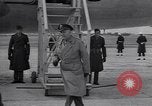
U.S. Army Chief of Staff, General George C. Marshall, arriving at Shanghai China, right after World War II
U.S. Army chief of Staff, General George C. Marshall, steps from his C-54 transport airplane and is met by Lieutenant General Albert C. Wedemeyer, as he arrives in Shanghai, china, right after World War 2. (He has been dispatched to China by President Truman, in attempt to facilitate peace between the the Chinese Nationalists and the Communists.) Marshall, Wedemeyer, and an American diplomat, salute as an honor guard (not seen) presents the colors. Scene shifts to a small motorcade through Shanghai. Chinese police and U.S. Military Police, have set up lines to control large crowd of American service personnel in uniform who gather to greet General Marshall as he enters the Cathay Hotel.
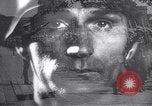
Film juxtaposing German defeat in World War 1, with its defeat in World War II, and comparative postwar impacts.
Film begins stressing the historic aggressive military traditions of Germany. A brief view of thousands of Adolf Hitler's Nazi troopers assembled in dramatic formation at the Nazi party rally grounds in Nuremberg, Germany. Explosion of the Nazi eagle, with swastika symbol, atop the Zeppelintribüne grandstand at Zeppelinfeld in Nuremberg, being blown up by U.S. Army soldiers at the end of World War 2 in Europe. Germans celebrating the armistice ending World War One. German soldiers captured, in unconditional surrender, ending World War Two. Huge open field filled with defeated German soldiers in the second world war. German armies parading through Berlin at the end of World War One. American troops occupying the entire country of Germany after the second world war. A Nazi eagle being destroyed on a German government building at end of the second world war. Old photograph of the German general staff, led by Helmuth von Moltke the Younger, that was still intact, after World War I. In contrast, after World War 2, the entire Nazi military was held and subject to trials at Nuremberg. Großadmiral Erich Raeder seen being taken in custody. Closeup of Field Marshal Wilhelm Keitel. German industry unimpaired by World War I, contrasted with utter destruction in the second world war. American officer coordinating resumed operation of of a postwar plant. View of German diplomats remaining in office after WWI. Proclamation barring Nazi party members from all offices after WWII. German Kaiser Wilhelm II in peaceful exile in Holland after the first world war. A Nazi officer war criminal, is taken in custody by American Military Policemen, and executed by a firing squad. World War 1 did not affect German schools and curriculums. After World War 2 all Nazi doctrines were destroyed. New text books and curriculums were prepared by the Allies for German use. Map shows small area of post World War 1 occupation, in contrast the the entire Germany after WWII. Weimar Republic government, post WWI is contrasted with post World War 2 government by the Allied military powers. British Marshal Bernard Montgomery, American General Dwight D. Eisenhower, Soviet Marshal Zhukov, and French General Charles de Gaulle, are shown. Views of American soldiers interacting with German citizens during their occupation of Germany. Images of Germans: Frederick the Great, Otto von Bismarck, and Kaiser Wilhelm. Views of German farmer sowing seed, postman delivering mail, policemen escorting children. Normal activities resumed in Germany, in areas of culture such as orchestral concerts, etc.
Crowd of ten thousand students demonstrate in support of Hungary's fight against Red domination by Russia, in Rome Italy.
Students in Italy demonstrate in support of Hungary's fight against Soviet domination (during the Hungarian Uprising or Hungarian Revolution of 1956). A crowd of more than ten thousand students carries posters to against communist rule. Riot and violence follows as efforts of the crowd are controlled by police. People fighting and beating. A policeman tries to stop the rallying students from entering the Communist Party headquarters office in Rome.

Commissioner John O'Ryan introduces suspect Richard Hauptmann in kidnapping case of Charles Lindbergh's son, Trenton New Jersey.
Kidnapping case of twenty months old son of aviator Charles Lindbergh, in Trenton New Jersey. Police Commissioner John F. O'Ryan announces in press the arrest of a suspect Berhard Richard Hauptmann, from Bronx, New York in the case. He also displays the ransom money recovered from him. Mayor LaGuardia is seated beside O'Ryan. Subordinates and others working on the case seen behind and beside O'Ryan. Media is present and press men question him. A quick view of Hauptmann. Brief view of intermediary Dr John F. Condon. The arrested suspect's portrait. Crowd in front of the Hauptmann house in Bronx New York at 1279 East 222nd Street, New York, home of Richard Hauptmann. Hauptmann in handcuffs being led away by police.
Garment workers demonstrating, for improved working conditions, encounter resistance in Eastern U.S. cities
Clothing workers in a factory in the United States. Street scene in garment district of Midtown Manhattan, New York City, in 1912. Garment workers, and supporters of their labor rights quest for better pay and shorter hours, pose for a photograph. Workers display many signs expressing their needs, in English, Italian, Russian, Hebrew and other languages. Garment workers, of various specialties, gather in demonstration for better treatment. Employees of the Alfred Benjamins Company refute management's claim that they are satisfied with working conditions. They display a large sign on the sidewalk. Four-sided box signs are also seen (written in Italian and Hebrew). Mounted police move along a street as a foot patrolman arrests a protester. Photograph of lawyer, Fiorello LaGuardia. Garment workers at work in a sweat shop. A large group of young women garment workers marching in a labor rally or demonstration during a strike. Two signs are seen, one reading: "Why are we prohibited from picketing?" and the other, partly hidden, explains why they are striking. A contingent of uniformed policemen with night sticks, stand in front of a building in Baltimore. Smiling women stand carrying signs. One reads: "Our employers are powerful (because) they are organized.We shall be more powerful." Another reads,"We shall fight until we win." Many other signs express similar sentiments. Portrait photograph of 17 year old Ida Brayman, with caption reading: "Who was shot & killed by an Employer Feb. 5th 1913 during the great struggle of the Garment Workers of Rochester (New York)."
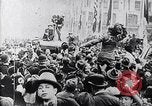
Post World War I political issues in the U.S.A. including Red Scare, anarchists, labor strife, and KKK
A huge crowd on streets of New York City cheering and celebrating victory over Germany in World War I after signing of the Armistice. A cemetery of U.S. soldiers died in World War I. Cross burning and views of hooded Klan members at a Ku Klux Klan (KKK) ceremony, with several uniformed U.S. Army soldiers in foreground, dimly lit (possibly at Stone Mountain Georgia but location not confirmed). Palmer Raid victims: Suspected leftists, left wing, and anarchists seen being led away in a group by police after their homes were raided and searched without search warrants, and some were deported, under program led by U.S. Attorney General A. Mitchell Palmer, during 1919 and 1920. (Second group shown is likely in Paterson, New Jersey; note sign for J.T. Doremus Hardware on building in background.) Palmer Raid arrestees seen behind barbed wire fences where they were held without charges for three months and denied legal representation. Some arrestees being escorted by U.S. soldiers in uniform. Vigilante businessmen and town leaders enforcing 12 hour work days at Steel factories in Pittsburgh Pennsylvania and Gary Indiana. Vigilantes (deputized and armed by local authorities) seen with rifles and shotguns marching down streets enforcing labor demands and countering steel workers on strike. They approach a striking worker on the road side and seize a stick he is holding. They beat a protestor with sticks. Together with police they begin to hit and beat back the protesting crowd of men. Someone fires a gun in the crowd and shooting starts on both sides during fight. An injured or dead steel worker on the ground is lifted up by a man and carried away.
CRITICALPAST.COM: About Us | Contact Us | FAQs - How to Order | License Agreement | My Account | My Lightboxes | Shopping Cart | Advanced Search | Featured Collections | Website Terms & Conditions | Privacy Policy ©2026 CriticalPast LLC.
License Agreement |
Terms & Conditions |
Privacy Policy
©2026 CriticalPast LLC.