


 Francais
 Deutsch
 Italiano
Refine Your Search
Vietnam-security-police stock footage and images
- Showing 1525 to 1530 of 6186 results more
more Hide
Hide
Women discuss domestic violence, man is arrested for violence and counseling session arranged for couples in the United States.
A film about domestic violence against women in the United States. A woman talks of violence she suffered from her husband and complains about the reaction of policemen. A Federal Bureau of Investigation (FBI) agent explains the reason of not sending the accused to jail. Women discuss problems. A man says that he beat his wife after returning from jail. A policeman arrests a man. Man talks on telephone. The man in jail. A Federal Bureau of Investigation (FBI) agent talks about professional counselors. The counselor talks to the couple. Children watch fight between parents.
Bridgetown, Barbados as seen by visitors on a Hamburg-Amerika line steam ship during a cruise.
Life of people in Barbados as seen by passengers visiting on an ocean liner of the Hamburg-American line during a cruise of the South Seas. Boys and girls row boats and dive for coins thrown by passenger aboard a visiting ocean liner anchored in the bay. A small sailboat glides through the group of row boats. . Boys in the boats dive for coins. Group of German tourists motor by, with a Nazi swastika flag mounted at the stern of their boat. The Horatio Nelson Monument in Bridgetown. The native police officers (Bobbies) walk past buildings. Sign for "Henry" street visible. Shops visible including "R.S. Nicholls" and "Collins". A vertical sign "Candy, Cigars, Drugs, Kodaks". Civilians on streets. Cars parked in the background. A police officer on horse back. A cart drawn by a donkey hauling wood. Man walks beside the cart. Sign on cart includes word "yearwood". Another donkey cart with wood and sign includes words, "James Blunt" and "St. Michael". Ships and people at a harbor. Women carrying goods for sale upon large trays on their heads. The Bridgetown Parliament building and clock tower. A view of coral Island, beach and tropical sea of Bath and Conset Bays from the Hackleton's Cliff and St Johns Church. Brief glimpse of Hamburg-American line passengers in a tender, returning to their ship.
German prisoners are searched by officers at a prison camp and are severed food in Britain.
German prisoners of war in Britain during World War II. The prisoners are tagged and they enter a prison camp. A British Military policeman guards them. A military policeman on a guard tower watches the activities of the prisoners. Officers search the prisoners. An officer searches a prisoner. Food kept in huge containers. The prisoners are given spoons and mugs. They are severed with food. The prisoners sit on the ground and eat their food. Special letter form posted on a bulletin broad. A prisoner reads letters.
Records of the Nuremberg Trials are transferred to the International Court of Justice at the Hague, Netherlands
A U.S. Air Force C-54 transport aircraft seen parked at the Amsterdam airport, in Holland. A truck is parked nearby. Men unload 37 packing cases, containing the records of the Nuremberg trials, and place them aboard the truck. Closeup of one case shows it addressed to the International Court at the Hague, Netherlands. Next is a sequences showing a Nazi concentration camp and its infamous "Arbeit Macht Frei," sign over the gate; A sign reading: "Vorsicht Gas.Lebensgefahr. nicht öffnen." (Caution gas. Danger to life. Don't open.") ; Nazi German figures in the dock at the trial, including Hermann Goering, Rudolf Hess, Joachim von Ribbentrop, and Wilhelm Keitel, in front row, and Baldur von Schirach, Fritz Sauckel, and Alfred Jodl, behind them. Closeup of Goering in dark glasses, and Hess. Glimpse of the courtroom. Scene shifts back to the airport, again, where the truck, loaded with the records proceeds under police escort. Street sign points 47 Km toward "Den Haag,"(The Hague). The truck and police escort passes through the gates of the Peace Palace in the Hague (home of the International Court of Justice).
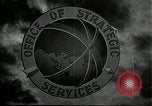
Selected troops, in masks, exit a truck at a OSS secret training camp and receive pins with names on them, United States.
A documentary titled 'OSS Training Group' shows a training program of U.S. hand picked volunteer soldiers in a OSS secret training camp for guerrilla warfare during World War II. A explosion and smoke rises due to explosion. The U.S. troops carrying guns and advance from the smoky area. A soldier attaches a wire and explosion occurs. A training camp. A U.S. military policeman walk towards a truck and salutes. He checks the documents and all the truck to enter the camp. The policeman opens a barricade. The truck enters the camp area and the selected students get down from the truck. The student trainees, all wearing masks to conceal their identity, stand in formation in front of a building and an OSS (Office of Strategic Services) officer instructs them. The students receive pins with names on them. A badge on the uniform of a student. They receive instructions. The students receive necessary supplies.

Johnson addresses Congress on voting rights; Martin Luther King Jr and activists march for civil rights in Selma, Alabama.
United States President Lyndon Baines Johnson seeks end to civil strife in the United States. Exterior view of the dome of the U.S. Capitol Building illuminated at night. Inside view as the President addresses Joint Session of Congress to push a voting rights bill (Voting Rights Act) to end discrimination in voting. Dignitaries and members of the Congress are seated. Next scenes are all from civil rights marches in the U.S. during March, following the March 11 beating death of minister James Reeb. Protestors march on streets all over the country in solidarity with the Selma, Alabama marchers. They carry banners. A banner reads 'We March With Selma'. Another banner says "We Shall Overcome". The people march on streets and carry banners in a Harlem, New York demonstration. The demonstrators gather in large number to pay tribute to Unitarian minister James J. Reeb. Brown Chapel African Methodist Episcopal (A.M.E.) Church (410 Martin Luther King St, Selma, AL 36703, United States) in Selma, Alabama which was a headquarters for the drive for the right to vote. A sign reads 'Brown Chapel'. The people gathered during the campaign. Leader of African American civil rights movement, Dr. Martin Luther King Jr., with other officials. View of protestors in the second Civil Rights march from Selma to Montgomery on March 9, 1965. Martin Luther King Jr marches with the people for Civil Rights. Men take pictures. Martin Luther King with white ministers, African American and white citizens, and civil right workers marching on the street. The police stand blocking the road at the end of the Edmund Pettus Bridge. The marchers stand. Martin Luther King Jr. speaks to a policeman. The marchers kneel on the street and pray. Men take pictures. Martin Luther King Jr with other officials speaks to the marchers. After praying the marchers turn around and go back to Selma. They cross the Edmund Pettus Bridge in Selma, Alabama.
CRITICALPAST.COM: About Us | Contact Us | FAQs - How to Order | License Agreement | My Account | My Lightboxes | Shopping Cart | Advanced Search | Featured Collections | Website Terms & Conditions | Privacy Policy ©2026 CriticalPast LLC.
License Agreement |
Terms & Conditions |
Privacy Policy
©2026 CriticalPast LLC.