


 Francais
 Deutsch
 Italiano
Refine Your Search
Vietnam-security-police stock footage and images
- Showing 2029 to 2034 of 6186 results more
more Hide
Hide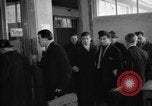
Scenes at a refugee Camp in Germany.
German refugees at a camp in Germany. Men entering a building lobby, show their identification papers. People seated at a desk talk. Families with all their belongings finding their way to assigned quarters in the camp. A sign reads: "Haus E" and "Police Registration" (in German). A woman walks with a baby. Group of refugees stands near a low building. Two children run and play around some dumpsters. Families carrying suitcases board a special bus. A woman serves food to families in a dining hall. Views of several persons seated and eating a meal. Women hanging wash to dry on clothes lines behind their housing. (Note: This might be the Marienfelde refugee transit camp around 1953, showing East Germans fleeing to the West. )

Protests as Allied troops withdraw from Trieste, Mobs storm the American embassy in Belgrade.
Protests in the Balkan Peninsula as Allied troops withdraw from Trieste and it is handed over to Italy. Yugoslavians vow to never give up Trieste as United States and British troops prepare to withdraw. View of Trieste's port, streets and a soldier guarding from behind a barbed wire fence. Sign says "Trsta ne damo". Italians in Zone A of the Free Territory of Trieste. Man in car speaking to a border control officer crossing to Italy. Italian flag and writing "W Trieste Italiana". Italians see the raising of their flag for the first time since 1945. Italians with Italian flags and placards saying "Viva Trieste" and "L'Istria e Italiana" ("Istria (region) is Italian" in English). Mobs raising their fists in front of the United States embassy in Belgrade, storming the embassy following defiant speeches in which Marshall Tito of Yugoslavia threatens to invade Trieste. Yugoslav rioters break into a fight in front of the American embassy. Yugoslav policemen marshal unruly rioters in the street.
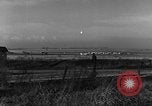
P-47 aircraft take off from a muddy airbase Chievres Belgium to attack German targets in World War II
P-47 aircraft of the U.S. Army Air Forces 365th and 368th Fighter Groups seen at the Chievres Airfield (A-84) in Chièvres Belgium, during World War II. P-47 aircraft take off and land on muddy airfield. Thunderbolt aircraft taking off. Military police directs vehicles across the muddy field. Trees in the background.
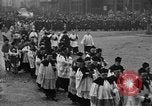
Religious procession to steps of a cathedral in Germany celebrating founding of Weimar Republic
Celebration of the Weimar Republic in Germany, following World War I. A Roman Catholic procession led by clergy, and involving Karl Josef Schulte, Archbishop of Paderborn, moves through the streets of Cologne, Germany, to the steps at the front entrance of Cologne Cathedral. The procession also includes many persons including students in various uniforms, carrying banners. One banner refers to the years 1853 to 1903. Large numbers of persons fill the streets. Policemen on horseback are seen. (Note: It is not clear whether Felix von Hartman or Karl Joseph Schulte is the Bishop in this film. The weather appears to be pleasant, which suggests it might be Hartmann, who fell ill in September and died in November. He was succeeded by Karl Joseph Schulte, Bishop of Paderborn, who formally became Archbishop of Cologne in March, 1920. Historical records describing this film mention "Archbishop Shulpe" with no further information or details. We believe that to be a misspelling of "Schulte".)
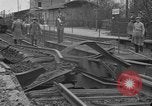
Railroad and train damaged at German station in World War I
People at a German train station examine railroad torn up and twisted, apparently by an explosion (possibly sabotage?), during World War 1. Damage is confined to the railroad, itself, and a train that has been blown over,on its side, nearby . (The station and buildings are undamaged.) Curious onlookers stand around the damaged tracks and many stand on an embankment overlooking the overturned train. Workmen examine the damage to the train. Several policemen appear busy at the road entrance to the train station. One has a bicycle.
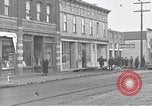
Washington State Governor calls up contingent of the National Guard to maintain order in Centralia, Washington, following Armistice Day riot on November 11th, 1919
Opening scene shows some some people gathered near pieces of debris on the sidewalk outside the Roderick Hotel and a 1-cent to 1 dollar store in Centralia, Washington. This is in the wake of the Armistice Day riot in that city that took place in that city, on November 11, 1919. It involved clashes between members of the The Industrial Workers of the World (IWW) union and members of the American Legion. A man steps out of a shattered and empty store front on the street. The Washington National Guard was called up by Governor Hart to restore order. Company F of the 3rd Infantry, was sent to Centralia by train on the evening of the 11th from Fort Lewis in Tacoma, Washington. Soldiers of that Company are seen assembling and receiving orders from their officer in Centralia. Next, the soldiers begin marching as guards, on the street in front of the local police station. Some pedestrians watch from a sidewalk. A group of local people crowd together to watch something of interest in a building
CRITICALPAST.COM: About Us | Contact Us | FAQs - How to Order | License Agreement | My Account | My Lightboxes | Shopping Cart | Advanced Search | Featured Collections | Website Terms & Conditions | Privacy Policy ©2026 CriticalPast LLC.
License Agreement |
Terms & Conditions |
Privacy Policy
©2026 CriticalPast LLC.