


 Francais
 Deutsch
 Italiano
Refine Your Search
Vietnam-security-police stock footage and images
- Showing 2227 to 2232 of 6186 results more
more Hide
Hide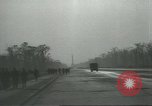
Berlin under Soviet Occupation at end of World War 2
Group of U.S. soldiers wave American flag to stop a U.S. Military Police jeep. A Sergeant gets out of the jeep and greets the GIs. He then gives each of them a carton of cigarettes. Remainder of the scenes show Soviet occupation forces and Berliners subject to Soviet authority. A Soviet woman soldier directing traffic. Russian soldiers pose for pictures in front of the Victory Column in Berlin. View of the golden winged victory statue on top of the column. Three pillars displaying pictures of Stalin and two other Soviet leaders. Soviet soldiers walking near the Brandenburg Gate. Several quiet streets. Elderly German citizens sitting on a bench in front of a granite memorial to Kaiser Wilhelm I. A street filled with destroyed cars, broken buildings and rubble everywhere. Several German citizens struggle to move a laden wooden wagon. A Russian woman soldier directs traffic. Local citizens queue up for water. They read a paper posted with a message from the Supreme Commander of the Armed Forces of the Soviet Union. A line of citizens passing bricks to help with rebuilding.
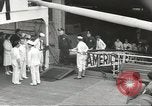
Japanese Nationals and Issei, with families, board the Swedish ocean liner M.S. Gripsholm at Jersey City, New Jersey, for repatriation to Japan, in World War II
Film starts showing the Swedish ocean liner M.S. Gripsholm, docked at Jersey City, New Jersey, in World War 2. Some Ship's officers and crew are on deck and two armed Sailors stand on either side where the ramp meets the ship's deck. Two uniformed policeman come up the boarding ramp carrying a person on a littter. Ship's officer directs them where to take that person. Next, Japanese Nationals and Issei with their families begin boarding. Ship's officer and a sailor direct them where to go. Many boarding have small children. A ship's officer and a sailor carry another person aboard on a litter. A woman alone breezes past the guards. More families with small children board. An ambulatory, disabled , young Japanese woman is helped aboard by a man and a nurse. Two nurses help another woman board. Scene shifts to the pier where U.S. customs officials check baggage being brought aboard the ship and check identifications of passengers who will board. Next, a ship's doctor is seen attending a young girl in the ship's infirmary. He checks her vital signs. Then a Red Cross nurse enters and takes the patient's temperature and pulse rate.
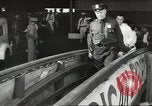
The Swedish ship M.S. Gripsholm boarding persons being repatriated to Japan during World War II
A Boarding ramp is seen extending to the docket Swedish ocean liner, M.S. Gripsholm, from a covered pier at Jersey City, New Jersey, during World War 2. A policeman and a ship's crewman carry a sick man aboard on a litter. At the base of the ramp, Japanese Nationals and Issei stand in group waiting to board. Two armed U.S. sailors guard the ramp. View switches to the Gripsholm's deck where passenger families are happily greeting one another. Many are family and friends who know each other. Camera pans along the ship's deck, where many passengers are seated and others continue to greet one another. View of several passengers seated outdoors, on deck. Two small children squat near the railing to look outside. The Manhattan, New York City skyline is seen in fog, in the background. On the main deck, girl walks with a very small child. Two little girls descend a stairs to a lower deck. Several little boys stand by a railing to look out on the Hudson River. A mother brings a very small child up the gang plank.
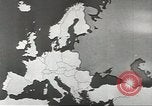
American sends supplies to European countries under Marshall Plan; blockade of Berlin by Soviet Union
American food, machine, tools and other supplies loaded in ships for Europe under Marshall Plan. German citizens in West Berlin Germany busy rebuilding after World War 2 destruction. Men at construction sites and boys and men moving equipment, bricks, steel, lumber, cement, and wheel barrows. Communists demonstrate in Soviet east Berlin. Men and women climbing fences at a building while a crowd pushes forward. Communists blockade Berlin. East German police officers in a human chain move a crowd. A blockaded area dividing the city. Industrial production stopping due to power failures. Closeup of analog power dial moving to zero from a power cut. A light in a factory turning off. Goods piled up idle in train stations, unable to be moved. A blocked border crossing at Helmstedt, and a line of trucks with food supplies at the crossing, stopped and unable to pass. Truck drivers discuss the impasse with a Russian guard.
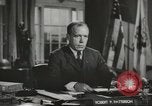
American Undersecretary of War speaks to difficulties facing Allies in confronting Germany and Japan in World War II
Undersecretary of War, Robert Porter Patterson, Sr. speaks about a report from the General staff outlining the needs for combating Germany and Japan in World War 2. He cites Operation Husky, the invasion of Sicily, as an example of what will be needed. He continues to narrate in the background as an animated map appears showing the buildup of supplies and Allied forces in North Africa; Allied air forces flying 60 thousand sorties over Sicily and, the direct amphibious assault using 3,200 vessels. Map also depicts opposing forces of 12 (“unwilling”) Italian Divisions and 3-1/2 German Divisions. View of Allied troops carrying some of their 31 thousand casualties on stretchers from field ambulances. Allied medics attending to the wounded. Some are seen lying on stretchers in a row on the ground near a wall. Interior of a field hospital where surgeons and other medical personnel treat the wounded. Animated map shifts to Europe with Germany at its center, showing , in contrast to Sicily that was only an “outpost,”, the heavily fortified perimeter of Axis controlled areas; the axis industrial might; and the disposition of 300 German Divisions (mostly on the Eastern front) defending the region. Next, the map illustrates Japan’s defended regions in the Pacific Image returns to Undersecretary Patterson i n his office, speaking of the Allied offensives planned for next year (1944), and emphasizing their challenge and difficulty. Scene shifts to General Jonathan Wainwright and his garrison at Corregidor, in the Philippines, surrendering to Japanese forces in 1941. Japanese military camera pans over the Americans being taken prisoner. Other Americans and Filipinos are seen being marched together under guard. Scene shifts to classic views of the Japanese attack on Pearl Harbor, Hawaii, on December 7, 1941. View of Japanese soldiers executing two Chinese civilians in 1937. Dangling bodies of persons hung by Nazis during Operation Barbarossa in Russia, in 1941 A Russian soldier comforts a little girl as he escorts her across a snowy landscape. Time bomb left by German forces retreating from Naples, Italy, in 1943, blows up a Post office building . Views of damage to building and bodies of victims. American Military Police assisting a victim. American soldiers carrying an injured civilian on a litter. Scene shifts to British Foreign Minister, Anthony Eden, Soviet Foreign Minister, Vyacheslav Molotov, and U.S. Secretary of State, Cordell Hull, entering a hall in the Spiridonovka Palace, during the 1943 Moscow Conference in Russia. Close-up of the American, Soviet, and British flags on a table. View of many delegates seated around the table. Close-up of Molotov, Eden, and Hull signing conference document.
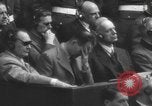
Judgments being rendered in trials of Nazi leaders at Nuremberg, Germany following World War II.
Nazi leaders Hermann Goering, Rudolf Hess, Joachim Von Ribbentrop, Baldur Von Schiarch, Alfred Jodl, Wilhelm Keitel wearing headphones sit in prisoners dock and listen to testimony during Nuremberg trials in Germany. Hess sits with his head lowered, appearing ill. A man comes and speaks to him. Ribbentrop talks to Hess who then leaves the prisoner's dock. Policemen stand at the end of the dock. Men at British and American prosecution tables.
CRITICALPAST.COM: About Us | Contact Us | FAQs - How to Order | License Agreement | My Account | My Lightboxes | Shopping Cart | Advanced Search | Featured Collections | Website Terms & Conditions | Privacy Policy ©2026 CriticalPast LLC.
License Agreement |
Terms & Conditions |
Privacy Policy
©2026 CriticalPast LLC.