


 Francais
 Deutsch
 Italiano
Refine Your Search
Vietnam-security-police stock footage and images
- Showing 2533 to 2538 of 6186 results more
more Hide
Hide
Wilhelm Keitel swears under oath during the Nuremberg trials (WW2)
Indictment of German field marshal and war criminal Wilhelm Keitel during the Nuremberg trials after World War II. A pair of Military Policemen escort Keitel to his seat. A man adjusts the microphone and places a glass of water on Keitel’s podium. Keitel puts on his headphones. Keitel swears under oath in before he sits down. Keitel answers the jury in German. Visitors sitting in the gallery of the Nuremberg Palace of Justice (Fürther Str. 110, 90429 Nürnberg, Germany). General Geoffrey Keyes (Former Commanding General, Seventh United States Army), Commanding General LeRoy Watson, and several Russian military officials watch the tribunal from the gallery. Dr. Otto Nelte, Counsel for Defendant Wilhelm Keitel, interrogates Keitel in German. Keitel provides the court with information about his family background. Court stenographers taking down notes. Nuremberg Trial judges listen to the testimony from Wilhelm Keitel.

German defendants in the prisoner’s dock during the Nuremberg Trials (WW2)
People attend the Nuremberg trials at the Nuremberg Palace of Justice (Fürther Str. 110, 90429 Nürnberg, Germany) after World War II. Spectators, justices, and other staff stand up from their seats and began to leave the courtroom after the session. Some court stenographers stay in their seats and chat among themselves. Military Police personnel group around defendants such as Wilhelm Keitel just prior to the end of the session. Spectators such as United States Secretary of War Kenneth Claiborne Royall watch the tribunal from the gallery. German defense attorneys speak inside the courtroom. Nuremberg trials justices Francis Biddle, John J. Parker, Henri Donnedieu de Vabre, and Robert Falco sit on bench during the proceedings. Camera moves to Nazi defendants Hermann Göring, Rudolf Hess, Joachim von Ribbentrop, Wilhelm Keitel, Karl Dönitz, Erich Raeder, Baldur von Schirach, and Fritz Sauckel are sitting in the prisoner’s dock. The testimony of Joachim von Ribbentrop is heard off-screen.
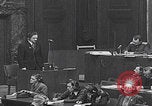
Abraham Sutzkever recounts his experience living in Vilna Ghetto to the tribunal during the Nuremberg trials
Jewish testimony at the Nuremberg trials at the Nuremberg Palace of Justice (Fürther Str. 110, 90429 Nürnberg, Germany) after World War II. Famous Lithuanian Jewish poet and witness Abraham Sutzkever (Avrom Sutzkever) gives his Holocaust testimony to the tribunal. Sutzkever testifies against Franz Murer (also known as the “Butcher of Vilnius”), for murdering his mother Rayne Sutzkever and infant son. He recounts his experience living in Vilna Ghetto for two years before escaping with his wife to join the partisans in Lithuania. Chief Justice Sir Geoffrey Lawrence and Justice Francis Biddle taking down notes at their bench. Justices, court stenographers and other personnel listen to the testimony. A Military Police personnel walks across the room. Justice Lawrence question Sutzkever while the latter is on the witness stand. Sutzkever replies in Russian.
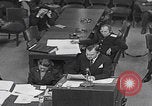
Chief Prosecutor Robert H. Jackson speaks about Nazi organizations during Nuremberg trials
United States Chief Prosecutor Robert H. Jackson continues his speech on the Criminality of Organizations during Day 70 of the Nuremberg Trials. Robert H. Jackson speaks to the tribunal at the Nuremberg Palace of Justice (Fürther Str. 110, 90429 Nürnberg, Germany). Female personnel take down notes beside him. A few guests seated near Jackson listens to his speech. Camera moves to Nazi defendants Hermann Göring, Rudolf Hess, Joachim von Ribbentrop, Wilhelm Keitel, Karl Dönitz, Erich Raeder, Baldur von Schirach, and Fritz Sauckel are sitting in the prisoner’s dock. Military Police personnel surround the defendants. Camera moves back to Jackson speaking to the tribunal. Jackson gives his documents to the secretary beside him before leaving the podium. Jackson speaks about certain Nazi organizations- the paramilitaries SA (Sturmabteilung) and the SS (Schutzstaffel)- were not selected without considerable study by the prosecution and that they were the most vicious in Germany.
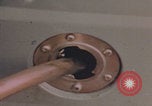
Bank teller gives cash to Iranian man; fuel nozzle filling gas in car
Fuel nozzle filling gas in car. A car filling petrol at a gas station with spiral gas flow indicator moving. A male bank teller counting Iranian rial bills and coins. The bank teller gives cash to a wealthy Iranian man. The elderly man places bills into his money case. Molten metal flowing into a vat. An artisan weaving a traditional Persian rug. The artisan weaves rug with elaborate floral patterns. A policeman directs car traffic in Tehran, Iran.
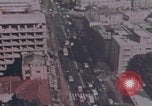
Pre revolution Tehran, Iran shows women in Western fashions, carpet weaving and crafts.
View of downtown Tehran, Iran. Modernist skyscrapers, streets of Tehran are shown. An Iranian policeman directs car traffic. A man runs in the middle of a heavy traffic. Pedestrians cross the road. Iranian women wearing Western fashion such as jeans, miniskirts, and short dresses. An Iranian family walking together. Two women wearing short skirts talk to each other as they walk in the street. A driver gets distracted by women wearing short skirts on the street. He bumps his car into another vehicle in front of him. Two young Iranian boys weave a Persian rug with an artisan. Yarns hang over the loom. A boy weaves the rug by hand. An artisan creates a Persian miniature. Metalworkers create hand tooled metal plates in Iran. A young boy trains alongside two adult metal artisans. Artisans use tools to engrave into metal plates. Persian metal plates and vases on display.
CRITICALPAST.COM: About Us | Contact Us | FAQs - How to Order | License Agreement | My Account | My Lightboxes | Shopping Cart | Advanced Search | Featured Collections | Website Terms & Conditions | Privacy Policy ©2026 CriticalPast LLC.
License Agreement |
Terms & Conditions |
Privacy Policy
©2026 CriticalPast LLC.