


 Francais
 Deutsch
 Italiano
Refine Your Search
Vietnam-security-police stock footage and images
- Showing 433 to 438 of 6186 results more
more Hide
Hide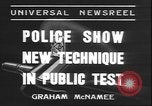
San Francisco policemen march and display new techniques of fighting against the gangsters in San Francisco, California.
Police men show new techniques of dealing with culprits in San Francisco, California. Officials at a ceremony. San Francisco policemen lined up at a field during the ceremony. The policemen pass in review. Officers hold the American flag during the ceremony. Cavalry and infantry units march. Policemen on bikes during the parade. An insignia reads ' San Francisco police '. The police exhibits methods of dealing with culprits. Three men acting as gangsters enter a house. The policemen arrive in a car. They fire pistols at the gangsters. A smoke grenade being used. The police succeeds in getting the gangsters out of the house.
A patrol sergeant inspects military policemen before they leave for town patrolling in the United States (WW2)
A training film 'Military Police Town Patrolling' on functions of military policemen during a town patrolling in the United States during World War II . Soldiers wade ashore. Smoke from firing and bombardment on a battlefield. Soldiers aboard Jeeps and trucks. A military policeman directs traffic. MPs handle prisoners of war. The prisoners are marched. They guard supplies in a supply line. They also patrol captured towns. Buildings along a street side. Vehicles drive past on the street. Men playing on a field. Houses in the background. MPs stand in a line. An officer inspects them. He inspects their uniforms. The officer talks to a military policeman. They march. The MPs are headquartered in a local police station. The MPs enter the police station. Interior of the police station. A desk sergeant at work. The MPs with a criminal. The desk sergeant takes information from him. The criminal is then put behind the bars. The MPs stand in a line at attention in the police station. A patrol sergeant inspects them. He instructs them about town patrol. He says that they should help soldiers whenever they need help and should maintain order and should coordinate with them.
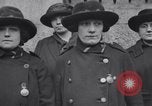
Women join ranks of police reserves in New York City, during World War I.
Closeup of women in the New York City Police reserve, during World War 1. They stand outside the 23rd Police Precinct ("Tenderloin") Station House on West 30th Street, Manhattan, New York City. Their uniforms include round-brimmed hats and overcoats, and they have round badges topped with eagles, pinned to their coats. Next, about 15 are seen, walking two abreast. All wear white gloves and badges, but otherwise, their uniforms are not identical. One supervisor woman walks beside the group, wearing a slightly different badge. Walking casually, a short distance behind the group is a woman (probably Mary Noonan) in the uniform of a captain (with "railroad tracks" insignia on her collar). Scene shifts to a street filled with a traffic mix of horse-drawn and motor vehicles, all staying fairly clear of trolley tracks visible in the center of the road. A police reserve woman stands in the center of the street, directing traffic. Next, a large group of school children is seen standing on a street corner, accompanied by a woman police officer. They begin to cross the street under the watchful eye of another woman reserve police officer, directing traffic in the street. Some adults cross behind the children. (Note: On May 9, 1918, the New York City Police Department announced formation of a new Police Reserve, that would include a women's contingent. This was the idea of Special Deputy Commissioner Rodman Wanamaker, who reasoned, since New York women had received the vote, on November 6th 1917, they should have a role in enforcing the laws. Over 3,000 women were recruited. Their Captain was Mary Noonan. Their duties did not involve direct dealings with criminals. According to the New York Times of May 10, 1918, "If need arose for use of the nightstick or other instrument for curbing crime,the work would be referred to the men members of the force.")
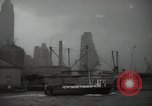
New York City harbor views in upper New York Bay; Manhattan skyscrapers; New York City Police boat activities.
Views of various boats and ship at New York harbor in Upper New York Bay. Good views of New York skyline and skyscraper buildings near the harbor, as seen from a New York City Police boat. Police officers on the police boat. The boat docks and name on back of boat reads, "Police New York City Lieutenant Ronaghan". A small row boat is then put into the water from the larger police boat, and two men board the small boat and row it towards shore. A gathering of onlookers at the docks as the rowboat comes in. Police officers hoist what appears to be a covered stretcher in the air (possible victim?) and load it into a waiting police van or paddy wagon on the dock.
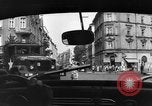
U.S. Military police (MP) direct trucks, tanks, amphibious vehicles at beachhead in Normandy, France, in World War II.
Activities of the U.S. Army Military Police. (Introductory scenes, from 1950 : A U.S. Army truck collides with a VW Beetle automobile in Europe. Local onlookers speak with the man and woman from the car. Local police arrive on scene. U.S. Army Military Police arrive and help resolve the matter with local police. ) U.S. Army Military Police insignia of two crossed flintlock pistols. A Military Policeman at attention. Military Police (MP) directing trucks and amphibious vehicles at a beachhead in Normandy, France, in 1944. U.S. Landing Craft at the beachhead. MPs directing military traffic in Town of Canisy, France.

U.S. Military Police assist soldiers and civilians in Paris, France.
United States Military Police in Paris, France during World War II. Policemen standing in formation on a street. They march in formation. Military Policemen and Parisian Gendarmes work together in front of the La Madeleine Church. Buildings along the sides of the street. The policemen talking to soldiers. A truck arrives. Soldiers getting off the truck and talking to the policemen. The policemen assist them. A young boy who is holding a bag is helped by a policeman while crossing a street.
CRITICALPAST.COM: About Us | Contact Us | FAQs - How to Order | License Agreement | My Account | My Lightboxes | Shopping Cart | Advanced Search | Featured Collections | Website Terms & Conditions | Privacy Policy ©2026 CriticalPast LLC.
License Agreement |
Terms & Conditions |
Privacy Policy
©2026 CriticalPast LLC.