


 Francais
 Deutsch
 Italiano
Refine Your Search
Wac stock footage and images
- Showing 7 to 12 of 117 results more
more Hide
Hide
American soldiers and WACs prepare for the arrival of Vietnamese refugees in the United States at end of Vietnam War.
Operation New Life and Operation New Arrival in the United States at the end of the Vietnam War. A building in a receiving area of Fort Indiantown Gap (FIG) near Jonestown, Pennsylvania. A sign board near the building reads: 'US Army Task Force New Arrivals Receiving Station'. Members of the 401st Personnel Service Company lining up in formation. Troops and Women's Army Corps (WACs) enter the building to prepare for the arrival of Vietnamese refugees. Members being briefed by an officer. Officer explains the use of paper forms. Soldiers and WACs listen. Officer addresses them. Members look at the forms. I believe the date this was shot was in late April we were there to stock all of the building before the refugees arrived. These solders and WACs were flown in from Ft. Carson. That day the fort was nearly a banded maybe 25 regular stationed there until our plane landed. We stocked every barracks with everything from tooth brushes, toilet paper to sheet and blankets. In a couple weeks we changed a ghost town into a town of about 30,000 people. I was in the second platoon front line next to the shortest WACs in the army.
African American WACS of the 6888th Central Postal Directory Battalion march in formation after arrival in Birmingham England.
African American women soldiers of the 6888th Central Postal Directory Battalion, nicknamed “Six Triple Eight", Women's Army Corps (WACS), march in formation on February 15, 1945, during World War 2. Location is Birmingham, England, United Kingdom, at the time of the unit's arrival in Birmingham. A military band of male soldiers precedes the group of marching WACS. The long column of African American WACS, marching 4 deep, is led by commanding officer Major Charity Adams. Close up views of the women marching. WACS in front of the unit carry the American flag in the procession.
African-American WACS pass in review before Major Charity Adams and General John C H Lee during World War II.
During World War 2, African American women soldiers of the Women's Army Corps (WACS) stand in formation at a parade ground in Birmingham, England, United Kingdom, during a formal military review on February 15, 1945. The women are from the 6888th Central Postal Directory Battalion, nicknamed “Six Triple Eight, which had just arrived in Birmingham. The WACS' commanding officer, Major Charity Adams, stands beside General John C.H. Lee. The African-American female soldiers of the WACS march in a column, eight deep, passing by General John CH Lee and Major Charity Adams, who salute the soldiers. Other male officers stand on the review stand behind officers Lee and Adams. Note: Major Charity Adams (Charity Edna Adams; later Charity Adams Earley) was the first African-American woman officer in the WACS, and, at the end of the war, then Lieutenant Colonel Adams was the highest ranking African-American woman in the United States military.
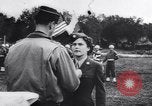
Views of women WAC personnel, and quiz question on Greek goddess Pallas Athene (WW2)
General Mark Wayne Clark greets and pins an award on a woman from the Women's Army Corps or "WAC" during World War II. Ground Infantry quiz question on Greek goddess Pallas Athene, seen on the WAC insignia. Views of WAC women in various jobs and roles during the war, including marching, mail sorting, and radio broadcasting.
U.S. WACs (Women's Army Corps) sightsee on camels in Cairo, Egypt during World War II.
U.S. service women sightsee in Cairo, Egypt during World War II. WACs (Women's Army Corps) sightsee. A sign reads 'Cairo City Police Station'. WACs sightsee the Sphinx of Giza and pyramids. WACs on camels.

The first edition of Stars and Stripes newspaper is printed and distributed to soldiers and WACs in Paris, France.
The first edition of Stars and Stripes newspaper printed in Paris, France during World War II. The first edition of the paper is distributed to U.S. soldiers and Women's Army Corps (WAC). A 'press' jeep distributing the papers. Newspapers loaded in jeeps. The soldiers and WACs reading the papers. Buildings along the sides of a street. Soldiers aboard a jeep giving papers to WACs.