


 Francais
 Deutsch
 Italiano
Refine Your Search
New York United States USA 1961 stock footage and images
- Showing 1 to 6 of 36347 results more
more Hide
Hide
United States President John F Kennedy addresses General Assembly of the United Nations in New York
United States President John F Kennedy addresses General Assembly of the United Nations in New York. View of the United Nations headquarters in New York City. President Kennedy addresses the General Assembly of the United Nations- September 25, 1961. “Every man, woman and child lives under a nuclear sword of Damocles, hanging by the slenderest of threads, capable of being cut at any moment by accident or miscalculation or by madness. The weapons of war must be abolished before they abolish us.” President Kennedy said. Dignitaries arrive in Moscow. Dean Rusk, Secretary of State of the United States, Andrei Gromyko, Soviet Foreign Minister and Alec Douglas Home, British Foreign Minister signs Nuclear Test Ban Treaty in Moscow. Soviet Premier Nikita Khrushchev claps with others on the signing of the Treaty. President John F Kennedy signs Nuclear Test Ban Treaty at White house, Washington DC. Dean Rusk seen with other Senators.
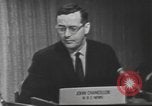
Vice President Nixon and Senator Kennedy debate in the United States over nuclear tests resumed by the Soviet Union.
The fourth presidential election debate held between Democratic nominee Senator John F. Kennedy and Republican nominee U.S. Vice President Richard Nixon in in New York, United States on 21st October 1960. NBC News correspondent John Chancellor asks a question to Senator Kennedy in relation with U.S. relations with the Soviet Union. Correspondent Chancellor asks if Russians have resumed testing of nuclear devices as per news from Atomic Energy Commission of Washington and if the U.S. would resume its own nuclear weapon testing in 1961. Senator Kennedy replies to the question and says that the next President of the United States should make one last effort to secure an agreement on the cessation of nuclear bomb tests. He mentions the Conference for the Reduction and Limitation of Armaments from 1932-1934 held in Geneva, Switzerland. Kennedy says that he believes the effort should be made once more by who so ever is elected the President of the United States. Senator Kennedy says that if they fail in making the effort, the responsibility will be clearly on the Russians and then they'll have to meet their responsibilities for the security of the United States, and they may have to test underground. He says that there may be testing in outer space. Senator Kennedy says that he is most concerned about the whole problem of the spread of atomic weapons. ABC News correspondent Quincy Howe asks the Vice President to comment. Vice President Nixon says that the Soviet Union is filibustering. He says further that the elected president should immediately make a time table to break Soviet filibustering.
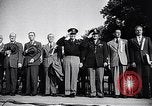
Eisenhower is appointed as the president of Columbia University and Harry S. Truman with him in the United States.
A biographical documentary shows the life of Dwight David Eisenhower who was the President of the United States from 1953 to 1961. Dwight David Eisenhower and officers salute. Others stand near him. Eisenhower with his wife Marie Geneva Doud “Mamie” Eisenhower attend the birth of their granddaughter, Susan Eisenhower. Eisenhower and his wife coos over baby Susan as her mother Barbara holds her. He walks with his wife. Soldiers holding flags salute. Dwight David Eisenhower in a car salutes them. He sits with a woman. In 1948 he is appointed as the President of Columbia University in New York. He walks with other professors. He is being honored and appointed as the president by other personnel. He addresses the students. In Washington: A plane taxis. Dwight David Eisenhower comes out of a car. Cameramen click pictures. Dwight David Eisenhower wearing a hat stands. He enters a building. He opens his coat. He is greeted by U.S. President Harry S. Truman. The United States Capitol building.
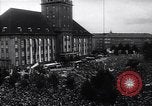
Berlin Crisis: The Western Powers respond to threats from the Soviet Union
Opening scene shows the Rathaus Schöneberg (John-F.-Kennedy-Platz, 10825 Berlin, Germany) where Mayor of Berlin Willy Brandt addresses a large crowd of West Berlin citizens, concerned about the building of the Berlin Wall by the Soviet Union. Many carry placards and signs, including some in English, reading: "We trust Kennedy, Pay any price, Bear any burden, for survival of Liberty" and "Millions behind the Iron Curtain ask for help." Scene shifts to a limousine driving into the center of a crowd. United States Vice President Lyndon B. Johnson steps from the car, accompanied by General Lucius D. Clay, who is seen next, with arm raised, acknowledging the crowd, while standing with Johnson and Brandt, at a podium cluttered with microphones. (Narrator refers to him as "Father of the Airlift.") The next day, British and American soldiers are seen driving in jeeps and trucks and M59 Armored Personnel Carriers, through cheering crowds, as they arrive to reinforce their Berlin garrisons. Closeup of cheering Berliners, waving handkerchiefs. Change of scene shows animated map of Europe illustrating the Westward expansion and growth of Soviet Communist occupation through World War II and the postwar era, concluding with East Berlin, in 1962. The threat to other Nations and regions is also illustrated. Legislators are seen in session in the plenary chamber of the German Bundestag in Bonn. Chancellor Konrad Adenauer is addressing the assembly. He states that Germany does not stand alone in the world. In France, Prime Minister Georges Pompidou addresses the National Assembly, regarding the Berlin Wall. In London, Prime Minister Harold Macmillan addresses Parliament. In the United States, on September 25, 1961, President John F. Kennedy, is addressing the UN General Assembly, in New York, about the dangerous crisis in Berlin. Scenes of the Berlin wall and Checkpoint Charlie. Memorials to persons killed attempting to escape East Berlin, are seen along the wall.
Vice President Nixon and Senator Kennedy debate in the U.S. over a summit conference between the U.S. and the Soviet Union.
The fourth presidential election debate held between Democratic nominee Senator John F. Kennedy and Republican nominee U.S. Vice President Richard Nixon in New York, United States on 21st October 1960. News correspondent John Edwards ask Vice President Nixon about the conditions to be met before meeting Soviet Premier Nikita Khrushchev at Vienna Summit of 1961. Nixon replies that an agenda should be prepared which should delineate those issues on which there is a possibility of some agreement or negotiation. He says that U.S. President should not go to the conference unless they have such an agenda, unless they have some reasonable assurance from Khrushchev that he intends seriously to negotiate on those points. News correspondent Quincy Howe asks Senator Kennedy to comment on the topic. Senator Kennedy says that the U.S. should not go to the summit until there is some reason to believe that a meeting of minds can be obtained on either Berlin, outer space or general disarmament including nuclear testing. He mentions the failure of the conference on May 15th 1960 in Paris, France. He further says it is important that they maintain their determination, that they indicate that they're building their strength, that they are determined to protect their position and that they are determined to protect their commitment.
Life of U.S. President Dwight Eisenhower after World War 2; NATO; Columbia University; U.S. President; advisor to Presidents
Dwight D. Eisenhower during presidency of the Columbia University in 1948. Eisenhower walking at a Columbia University graduation ceremony in New York City and speaking to the group assembled. Two years later, views of Eisenhower as NATO supreme commander in Europe. Eisenhower seated in NATO Conference. Citizens in United States prepare signs and urge Eisenhower to run for President. He salutes a parade in 1952 as he begins a run for the Presidency. Pamphlets and posters read 'we need Eisenhower'. An animated cartoon shows a smiling and marching Uncle Sam with an "Ike for President" jingle song playing. Cartoon shows animated citizens and an elephant supporting Eisenhower. Scenes from Republican National Convention, and Nixon and Eisenhower holding their arms up together. Citizens voting, using ballot boxes, and voting machines. A nun votes. Eisenhower casts his vote. People hold U.S. flags and cheer. Signboards and neon lighting on a building track vote tally and proclaim Eisenhower victory in 1952 presidential election. Eisenhower in Korea after the election. He meets and eats with American troops in the field and studies the war effort. South Koreans wave flags on announcement of truce (cease-fire armistice) in Korean War Eisenhower takes presidential oath of office in Washington DC. He signs document for Civil Rights Act of 1957 (voting right act). View of African American students of the "Little Rock Nine" entering a military station wagon under armed troop escort during integration of Little Rock Central High School in Little Rock Arkansas. U.S. Army troops escort the African American students into school. Exterior view of United Nations building in New York. Eisenhower delivers speech on Atoms For Peace. Winston Churchill of Britain and Nikita Khrushchev of the Soviet Union visit Eisenhower in America. Scenes of John F Kennedy inauguration in 1961. Eisenhower with Kennedy and later with President Johnson. In 1968 address to Republican Convention Eisenhower notes risk of growth of Communism.
CRITICALPAST.COM: About Us | Contact Us | FAQs - How to Order | License Agreement | My Account | My Lightboxes | Shopping Cart | Advanced Search | Featured Collections | Website Terms & Conditions | Privacy Policy ©2026 CriticalPast LLC.
License Agreement |
Terms & Conditions |
Privacy Policy
©2026 CriticalPast LLC.