


 Francais
 Deutsch
 Italiano

Refine Your Search
+"Africa" +1943 stock footage and images
- Showing 1 to 6 of 175 results more
 Hide

King George VI of England visits Allied officers in Algiers, North Africa, on June 12, 1943, during World War II.
Opening scene shows Brigadier General Terence John Tully, U.S. Signal Officer, escorting King George VI of England as they leave a building, during the King's visit to Allied officers in Algiers, North Africa, during World War 2. Next, King George VI is seen in a garden, conversing with an American officer while a British officer stands a rigid attention nearby. He is then seen with General Tully in the midst of a group of British officers. Closeup of the King. Allied officers stand in a line as the King greets them individually. Closeup views of of the King, from behind the line of officers and then from behind the King, as the photographer circles the gathering. Closeup of King George VI and General Tully as they return to the building, first seen in the film. Camera focuses on King George VI as he says farewell to his hosts. He salutes and enters the building.
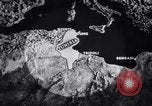
Allied soldiers in North Africa celebrate Christmas in 1942 and assemble for Roosevelt visit in January 1943
Allied Forces in North Africa during Christmas, 1942, during World War 2. Map of Tunisia. Ancient Roman ruins, including the Amphitheater of El Jem. A native plows a field. Children ride mules. Christian Cathedrals in various places. Interiors of a cathedral. At various places Allied soldiers hold Christmas Services outdoors. Camel Corps troops astride their camels. A Christmas service in front of a Curtiss P-40 aircraft displaying an American flag on its right wing and a Christian flag on its left. Scenes of children celebrating Christmas in different parts of the world, including boys throwing snowballs at each other outside a school building in the United States (Lettering above doorway of school reads "Durham Public School", possibly in Durham, NC. Graves of dead soldiers. Religious services held for the allied soldiers. British General Montgomery attends a religious service. Bells ring in churches across the world Sign reads 'A Happy Christmas'. Soldiers carry sacks. Letters brought for soldiers on a jeep. Soldiers run to get their letters. A soldier reads his letter. A soldier wakes up to find a filled stocking hung on his tent. Another soldier opens a parcel. 'Pine Grove USA' and 'Birney Cave Mincoka' written on two signs. Soldiers open parcels. Empty boxes, cups and bottles on a table. Preparation for the Christmas feast. Feathers are plucked from a turkey. Many bottles of rum in a row. Chickens are removed from an airplane. Soldiers in a chow line. A pudding on a plate is put on the table. A bowl of oranges on a table with some WAC (Womens Army Corps) service members. A sign in the background reads 'A Merry Xmas' Soldiers feed their pets. A puppy is fed. A donkey and a pig are fed. A pet monkey grooms a soldier's head. Candy is thrown to the native children. The Red Cross dispenses milk given by soldiers to native children. Soldiers go sightseeing in Egypt and observe an Egyptian magician. The Great Sphinx of Giza with the Pyramid of Khafre in the background as Allied soldiers fall off a camel they are trying to ride. Native people of Morocco in a city market area. Women pass in veils. British Soldiers play Cricket. American soldiers play baseball. A soldier plays a guitar. Another soldier views a magazine with a young woman centerfold picture. Soldiers polish uniform brass and shine shoes to prepare for assembly. Others take baths in tubs outdoors. With all troops assembled, President Roosevelt visits, riding in a jeep (while in the area for the Casablanca Conference). He is accompanied by Lieutenant General Mark Clark and General George Patton, riding in the back of the jeep. Later the President is seen sitting sideways in the jeep, holding his hat over his heart as he passes troops lined along the roadside. Secret Service agents ride behind carrying machine guns. The generals in his jeep salute as they pass the colors. Next, British Prime Minister Churchill is seen greeted by an honor guard of four British soldiers during his time in Casablanca for the Casablanca Conference. He is seen beside a gate labeled "Villa #3" which was the Villa “Mirador in the complex of Villas beside the Anfa Hotel.
United States 1st Infantry Division soldiers fight against the Germans in Africa and later capture Sicily during World War II.
'The fighting first' about the role of United States 1st Infantry Division in various campaigns during World War II. A soldier of United States 1st Infantry Division. Combat boots of soldiers during the civil war and World War I. A map shows the 1st Infantry Division units moving across the Atlantic Ocean towards North Africa for Operation Torch in November, 1942. Soldiers of 1st Infantry Division go to England and loaded onto ships as they move to Africa. U.S. General Terry Allen aboard a ship. Infantry soldiers fire in Oran, Algeria. Aircraft in flight, explosions occur and a convoy of trucks on advance during the battle in Oran. 1st Infantry Division troops as part of US II Corps battle against Nazi General Rommel's armies in Tunisia, North Africa. Battle scenes against German forces in North Africa in a variety of locations, overlaid with this narration: "we damn near flunked out at the Kasserine (Kasserine Pass). But we learned the score and we started to teach Gerry a few things out of our book. We rammed our way back to Gafsa and down Rommel's throat at El Guettar, where we tore up his crack 10th panzer division." In 1943, men of 1st Infantry Division load onto ships and arrive in Sicily. Troops advance into a town in Sicily after capturing it. Damaged houses in a city in Sicily.
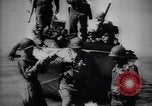
Early life of General George S Patton, and Patton in Africa during World War II.
'The Big Picture' episode narrated by Ronald Reagan depicts the life of U.S. General George S Patton, Jr. Opening scene shows General George S. Patton, Jr. stepping from a landing craft in France, during World War 2. He stands by the side of a road and waves, as elements of his 3rd Army pass in tanks. Patton in a jeep moving with his troops. General Patton pointing with a baton, in North Africa. View of a world globe being circled by a satellite. A baby picture of Patton (called "Georgie"). Patton seen as a boy, fencing, as a cadet at the Virginia Military Institute, and as a cadet at the U.S. Military Academy, West Point. A smiling Patton at West Point. Members of the first football team for soldiers established by Patton. Renault tanks of the 1st Tank Battalion moving with AEF soldiers in World War I. Tank commander George Patton standing in front of a Renault tank. Group picture of American soldiers and tanks, at the Tank School, in Fort Meade, Maryland, after World War I. Closeup of Dwight D. Eisenhower and George S. Patton, in the group. Patton and his wife, Beatrice Banning Ayer, in Old West costumes, for a party, where he displays a pistol in his belt, and in costumes for another party, where they dress as a knight and his lady on horseback. American recruits and draftees being issued uniforms in World War 2. Lieutenant General George S. Patton, Jr. commanding forces for the invasion of North Africa, in November, 1942. U.S. Navy warships fire their guns in advance of an amphibious landing. Landing craft heading toward shore. U.S. troops coming ashore at Casablanca, French Morocco. General Patton accompanied by French officers. Glimpse of U.S. President Franklin D. Roosevelt and British Prime Minister Winston Churchill at their conference in Casablanca in 1943. Patton riding in an armored car with three-star flag displayed. Artillery firing in battle of Tunisia. Lt. Gen. Patton and others observing operations. British General, Sir Harold Alexander, steps from a light airplane to meet with General Patton in North Africa. They converse. General Patton in March 1943 with binoculars observing battle, with Major General Terry Allen on his right, and Brigadier General Theodore Roosevelt Jr. to the right of Allen. They are viewing from a ridge by the village of El Guettar, as allies engage German troops and armor from the 10th Panzer Division. M3 Lee tanks moving in the desert. Knocked out tanks of the German 10th Panzer Division, including German Panzer IV tanks, in the aftermath of the Battle of El Guettar. General Patton coming aboard an American warship, and then standing with an Italian officer and a U.S. Major General. Allied naval bombardment at night. Patton observing though binoculars. Allied warships bombarding Sicily. Allied amphibious forces heading ashore in landing craft. Troops moving ashore. Closeup of troops in a landing craft. Glimpse of Patton in a landing craft. Troops walking across floating dock from a landing ship. U.S. flag flying in sand at beachhead. Landing ships in background. General Patton stepping ashore from small boat, and conversing onshore with a Brigadier General and some troops.
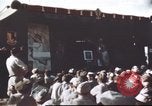
Commander of the 376th Bomb Group Libya, North Africa, briefs air crews for mission against Nazi aircraft production complex, WW2.
U.S. Army Colonel Keith K. Compton, commander of the 376th Bomb Group in Libya, North Africa briefs his Army Air Force aircraft crews for the first Allied bombing mission against the Nazi German ME-109 (Messerschmitt Bf 109) aircraft manufacturing plant south of Vienna at Wiener-Neustadt, Austria, in World War 2. The map that Colonel Compton is using shows the air routes to and from the target. The mission will commence early the next day, on 13 August 1943. An unrelated scene shows U.S. Army and Army Air Force men conversing with an Australian soldier in a summer uniform.
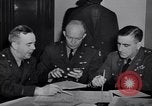
General Dwight D Eisenhower and Allied forces capture North Africa and Sicily, receives the French Legion of Honour medal (WWII)
General Dwight D Eisenhower from the North Africa campaign to the D-Day Normandy landings during World War II. Eisenhower with other military officers in the War Plan Office discusses strategy. A mural covering the west wall of the Eisenhower Museum in Abilene, Kansas. An animated map shows plan to seize key positions in North Africa. Fight in Algiers and Casablanca. Allied troops fire artillery, bombarding a North African coastal town. Troops advancing from beachhead, engage in street fighting with Vichy French troops in Casablanca, Morocco. A flare gun is fired. Unfavorable weather conditions delay the troops advancing towards Tunis and Bizerte. Allied troops fighting at nighttime. Allied soldiers walk through mud, allied military vehicles pass through water on the roads. Troops fire artillery under a canopy, hitting the side of a hill. Thick clouds of smoke cover a hill. U.S. General Omar Bradley and his troops capture Bizerte, Tunisia and the British 1st Army captures Tunis. German and Italian prisoners raise their hands up upon surrender. Animated map shows the surrender of the Axis troops. A ceremony commemorates the victory. North African cavalrymen join the parade. General Eisenhower and Free French Forces General Henri Giraud review a military parade. Henri Giraud bestows to General Eisenhower the French Grand Cross of the Legion of Honor. A mural on a wall of the Eisenhower Museum depicts the Allied invasion of Sicily. Allied troops march into Sicily in 1943.Civilians in the streets to celebrate. A mural on the wall of Eisenhower Museum depicts invasion of Italy. Allied troops land ashore and march into Italy. U.S. General Mark Clark 5th Army at Salerno. A sign reads Napoli. Eisenhower comes out of a tent. U.S. President Roosevelt visits the troops in the combat area with Eisenhower. United States President Roosevelt, British Prime Minister Winston Churchill, and Joseph Stalin in Cairo, Egypt. Another mural on the wall of the Eisenhower Museum. Eisenhower with other officers. Dramatization of German troops guarding and preparing the defenses of Normandy before the Allied landings. Eisenhower reviews training of the troops as they prepare for the invasion of France. Allied troops undergo physical training though obstacle courses. Churchill inspects the troops. Eisenhower reviews the troops on the eve of invasion. Eisenhower speaks to airborne troops wearing blackened camouflage face paint.