


 Francais
 Deutsch
 Italiano
Refine Your Search
+"Africa" +1943 stock footage and images
- Showing 115 to 120 of 175 results more
more Hide
Hide
Film about Allied bombing campaigns against the Axis powers and Japan all over the world during World War II.
Opening scene shows British Avro Manchester bombers lined up on a field in England during World War 2. British air crew board a bomber that taxis out for takeoff. View from inside the aircraft as it lifts off on takeoff and then towards its tail on climb out. Gunner seen manning machine guns as his turret rotates during flight. Formation of Manchester bombers en route to Axis military targets in German occupied France. View from bombardiers position of ground below. The bombardier seen and bombs dropping, as viewed from another bomber in the formation. View from a bomber of railroad yard and an airport with bombs exploding on the ground. Manchester bombers on return flight home over the English Channel. They pass below formation of U.S. B-17 flying Fortresses heading toward France. Close aerial view, from below, of the formation of B-17s overhead. Scene shifts to North Africa, where American Captain Eddie Rickenbacker, famous aviator of World War I, talks pilots of Major General Jimmie Doolittle's Bomber Command. Closeup of General Doolittle smiling outside a tent. A B-17 takes off. An Army cameraman seen inside at a window of the B-17. He is to record an attack on the Sicilian port of Marsala. View from a bomber of bombs exploding along the Port's coast, and of bombs passing the camera as they fall to earth. View from below of a B-17 with battle damage to its left elevator. View from a returning B-17 as it lands at its base in North Africa. Airmen walk around a B-17 that crash landed. One airman walks under part of a bomber tail destroyed by Axis gunfire. Scene shifts to the South Pacific and Allied air attacks against Japanese targets. A formation of B-24 Liberator bombers headed toward the Japanese held island of Nauru. Views of bombs striking the island. Scene shifts again, this time to Attu in the Aleutian Islands. A U.S. Navy PBY Catalina flying boat seen in flight. A task force of U.S. Navy warships in Aleutian waters. American amphibious landing on Attu. Arms and supplies piled up on a beachhead. American forces firing artillery. Infantry search for Japanese soldiers in hiding. Bodies of dead Japanese soldiers. American wounded carried on litters. A formation of B-24 bombers headed toward the Aleutian island of Kiska. Closeups of crew members in a B-24. View of glaciers and volcanic mountains below. A bombardier releasing bombs on a Japanese submarine base and airdrome. view of bombs falling. Formation of B-24s releasing their bombs. A gunner in a B-24 firing at attacking Japanese planes and then firing in a low level strafing attack. A U.S. fighter plane lands back at its base on a water-covered runway, raising waves of water that cover cover it.

Celebrations in the U.S. on the surrender of Italy and the conditions in Sicily leading to the surrender.
The Allied Forces crush the Axis troops in the Mediterranean during World War II. Italy surrenders. Newspapers in the U.S. show headlines of surrender of Italy. People in the streets read the newspapers. In New York the Americans of Italian descent celebrate Italy's surrender. Roll of honor. A child holds an American flag. American and Italian flags side by side. An Allied convoy moves towards North Africa. Allied troops land in North Africa. U.S. General Eisenhower, the Supreme Allied Commander; British General Montgomery, commander 8th Army and Lieutenant General Clark, commander of U.S. 5th Army are shown. U.S. President Franklin D Roosevelt and the British Prime Minister Churchill meet at Casablanca. Prelude to surrender- Allied planes drop bombs on islands off Italy. Allied warships off the coast of Sicily. Fighting off the coast. Sicily is invaded by the Allied troops. Americans land on shore. The U.S. 7th Army and the British 8th Army land on Italy's mainland behind a naval bombardment. The Allied soldiers in the streets. U.S. Army Corporal Salvatore DeMarco, of Italian origin, reunites with his family after having left home at age 15. German troops surrender to the U.S. troops and are sent out of the country in ships.
The U.S. Army Signal Corps Signal Intelligence work during World War II.
The role and contribution of the U.S. Army Signal Corps in combat during World War 2. Soldiers on guard duty in a field. A soldiers talks over a radio receiver at the door of a cabin. An antenna on the cabin roof. Signal Officers intercept enemy transmission by the mean of radio and other electric equipment. Electrical equipment, radios, deciphering equipment, laboratory equipment and parts seen at work in Signal Corps facilities where intercepted enemy communications are analyzed and codes and ciphers are deciphered. Officers skilled in encryption and decryption work to decode enemy codes and messages. They use a microscope to read and write messages in microscopic writing on grains of rice. Signal Intelligence work in North Africa during World War 2. U.S. soldiers on tanks advance over rough terrain. A formation of U.S. B-17 bomber aircraft in flight. Tanks advance with the ground forces. The radio intercept picked up messages from a certain German Division headquarters. A soldier sets radio direction finders on the particular location. Officers receive the information and locate the headquarters on a map. The Allied troops attack the enemy. They hit them with tracers. Artillery and guns are fired. Smoke from fire due to explosions. Soldiers advance in prone positions. They lie low during the night assaults. German soldiers load and fire a mortar. Explosions in a field due to mortar attack. Dead U.S. soldiers and injured U.S. soldiers in foxholes and on the battlefield following mortar attacks. U.S. soldiers help a fellow wounded soldier in a jungle setting.
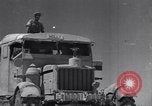
British tank retriever crew comes under fire while retrieving a damaged British tank
British soldiers on tank retriever moving through desert area in North Africa. A soldier standing on the retriever moving through desert followed with a jeep. The tank stops and crewmen start winching up a damaged British tank as another men standing on tank whistles and signals with hands. The damaged British tank is loaded on the retriever. Crewmen take protection as incoming ground and artillery fire begins. As firing stops men resume to load tank. Two soldiers winch the crew in turns as another crewman observes the whole process. Rear part of the tank starts to close and crewmen with different devices work near the wheels. (World War II period).
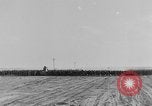
A huge formation of captured German prisoners is herded across the desert by a British 8th Army tank.
A British 8th Army tank leads a huge number of German prisoners of war across the desert of North Africa during World War 2. The German soldiers walk casually but in close formation, with their bedrolls and all their personal equipment. Graves of German soldiers
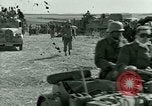
German prisoners move towards stockade area near Michaund and drive their own vehicles at Tunisian Campaign, Tunisia.
German prisoners in Tunisia. The prisoners on their own vehicle move towards stockade area near Michaund during Tunisian Campaign in North Africa. German prisoners on trucks, jeep and motorcycle move toward stockade area near Michaund. German prisoners group drive their own vehicles. Prisoner approaches American for direction. (World War II period).