


 Francais
 Deutsch
 Italiano
Refine Your Search
+"Atlantic Ocean" +1917 stock footage and images
- Showing 1 to 6 of 23 results more
more Hide
Hide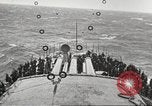
Various scenes of U.S. warships in 1917. British Admiral David Beatty welcomes U.S. Battleship Division Nine to the Grand Fleet.
Scenes of U.S. warships in World War I. Sailors take calisthenics, on deck, aboard Pennsylvania class U.S. battleship underway in Atlantic ocean, as viewed from above her three-gun upper turret. Different time and place: British Admiral David Beatty welcoming officers of the U.S. Ninth Battleship Division upon their arrival to join the Grand Fleet, in 1917, at the Firth of Forth, in Scotland. Admiral Beatty giving a welcome speech to officers and sailors of the Ninth Battleship Division, aboard the USS New York. US destroyer Manley (DD-74) camouflaged in Firth of Forth. Different place and time: Sailors hold on to lines as they watch a U.S. destroyer pass at high speed, and a Battleship following. U.S. warships signal each other using lights and morse code. Battleship passes at high speed.
United States soldiers cross the Atlantic Ocean in Navy transport ships and reach France and England, during World War I.
American soldiers reach France and other European nations crossing the Atlantic Ocean during World War I. Soldiers of American Army march on Fifth Avenue in New York City and then seen boarding troop transport ships bound for France. Thousands of American soldiers crowded onto ships and transported to Europe. U.S. President Woodrow Wilson seen drawing the first draft number for World War 1 draftees in the U.S. military. Vice President Thomas Marshall seen drawing the second draft number. U.S. Navy ships and soldiers aboard during their voyage to Europe. View of a group of women Red Cross nurses on deck of troop carrier ship wearing full body coverall wetsuits or flotation devices. A Navy sailor examines the fit of the wet suit on one woman in the group. YMCA workers posed in a group for the camera aboard ship. Soldiers in chow line receive a meal and eat it below and up on decks. A soldier holds a puppy dog from home and feeds it some of his food. The sailors aboard fire a deck guns and drop depth charges after sighting a torpedo from a German U-boat. A Y-Gun is seen firing TNT depth charges from the centerline deck of a ship to each side. Waves seen crashing over bow of ship in the transport fleet during heavy rough seas. First troops of American soldiers disembark from a transport ship at a harbor in France in June 1917. U.S. soldiers march on streets of Paris. In London, England, American soldiers are seen marching through the streets and the British monarchs and officials including the Queen Mother, King Edward, and Prime Minister Lloyd George review the marching American troops at Buckingham Palace.
American Expeditionary Forces arrive in France by US Navy ships (WW1)
A naval patrol Zeppelin flying over United States Navy ships sailing the Atlantic Ocean during World War 1. United States battleship at sea. American Expeditionary Forces marching after their arrival in France in June 1917. United States soldiers, also known as “doughboys”, marching with the American flag through a town as French locals watch. A man shakes the hand of a passing soldier. United States troops marching in farmland and forested road.

Charles Lindbergh takes off from Roosevelt Field for his famous solo flight from New York to Paris.
People gathered early on a misty morning at Roosevelt Field, Long Island, New York, to watch as Charles Lindbergh attempts to make a solo flight across the Atlantic Ocean in his airplane, The Spirit of St. Louis. The plane starts its takeoff role between groups of spectators, raising dust. The spectators move to get a better view as the plane continues, out of sight in the fog and mist. It is not clear where the plane is, although engine sound has changed. Spectators strain to see it through the mist. Then, some cheers are raised when the crowd realizes that Lindbergh has successfully taken off in his heavily laden airplane. The opening caption refers to Curtiss Field, where the Spirit of St. Louis was test flown and reportedly maintained in Hanger 16. there, from May 12th through the 20th. However, for the Paris flight, the plane was towed a mile to Roosevelt Field where, heavily loaded with fuel, it could take advantage of the longer runway for takeoff. (Note: Both fields were originally part of the old Hempstead Plains Field renamed Hazlehurst Field when taken over by the U.S. Army in 1917. U.S. Geological survey maps of 1918 show three areas named, respectively, Hazelhurst Aviation Field No. 1; Aviation Field No. 2; and Camp Albert L. Mills, abutting it. Field No. 2 was renamed Mitchel Field on July 16, 1918. The eastern part of Field No. 1 was dedicated as Roosevelt Field, on September 24, 1918. After the war, the western part of Field No. 1 became known as Curtiss Field, associated, as it was, with the Curtiss Aeroplane & Motor Company located there.)
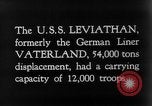
U.S. Navy troop transport operations in New York and New Jersey in World War I
The SS Leviathan, the largest ocean liner afloat, (former German ocean liner Vaterland, seized and renamed by the U.S. Government in 1917, as America entered World War 1). Tug boats assist the three-stacker Leviathan as she enters New York harbor. Tug boats working with another troop ship (two-stacker) in the harbor. Ferry boat in background. A sleek troop transport ship with two slanted stacks and rakish lines, accentuated by camouflage, in a New Jersey harbor.Two Navy troop ships underway with an airplane flying overhead. A column of U.S. Navy troop transport ships underway in the Atlantic ocean. A barrage balloon is seen overhead.
Scenes from WW1 include Woodrow Wilson, Franklin Roosevelt, troop deployment, munitions factory, ship building, WWI battle, and Armistice Day.
A title reading “1917”. An American ship sinks down in the Atlantic Ocean after it was torpedoed by a German U-Boat during World War I. United States President Woodrow Wilson signs the United States declaration of war on Germany. President Woodrow Wilson at work in his desk. A United States soldier blows a trumpet. United States soldiers crowd the deck of a ship sailing to Europe during WWI. The American Expeditionary Forces are waving as the ship sails away from the port. Franklin Roosevelt during World War I. American troops disembark from their ships after arriving in Europe. American women working in military supply factory. Women manufacture bullets using hand drills. A woman assembles munitions. Men building battleships at shipyard assembly line. Allied soldiers running in the battlefield to avoid being hit or bombed by the Germans. Bombs explode in the battlefield in Europe during World War I. Soldiers avoid bombs. A railway gun fires. An biplane falls in smoke after being hit. Explosion from tank in battlefield. Soldier rolls down to a trench. Explosion beside a rolling tank. A German soldier ducks in trench. An Allied soldier fires from a trench. A soldier behind him throws a grenade. Soldier with machine gun ducks from a trench. Tank rolls and fires in battlefield. Black explosion in battlefield. Soldiers run and avoid explosions. German soldiers fire a machine gun and throw grenades. Surrendered German prisoner soldiers march out as prisoners-of-war. American soldiers celebrate Armistice Day. View of the United States flag. Allied soldiers march in victory through ruined city. Americans celebrate Allied victory in World War I, filling with crowds in New York City. Americans hold banner saying, “Germany Surrenders”. Celebrating Americans in New York City, hold American flags and their hats triumphantly after Allied Victory in World War I.