


 Francais
 Deutsch
 Italiano
Refine Your Search
+"Belgium" +1944 stock footage and images
- Showing 1 to 6 of 132 results more
more Hide
Hide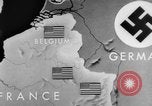
American advance in France and Belgium is stopped by German counterattack in December 1944. U.S. loses 78 thousand troops (WW2)
German forces smash into the U.S. First Army positions along a 45-mile front and advance deep into Luxemburg and Belgium, in Battle of the Bulge during World War II. Animated maps show Germany, France, and Belgium. German Panzer V "Panther" tank with several German soldiers riding on it approaches on road behind a large tree. German tanks, tank destroyers, troops, and artillery in transport on roads and then seen in action against American Army positions. Vehicles of a United States convoy wrecked and burning along road, as German troops advance past the burning vehicles. Fire and smoke rise from U.S. tanks, Jeeps, and trucks. U.S. soldiers captured as prisoner of war are marched on a town road. Frozen dead bodies of U.S. soldiers, victims of the Malmedy massacre, some with hands and feet tied, being placed army truck. Dead bodies of Belgian civilians being placed in large common grave. View of German officer ordering a firing squad to shoot. German troops smoke American cigarettes taken from dead U.S. troops. American troops in retreat and burning and destroying war materiel that could not be brought with them. American defenders firing artillery, including antiaircraft guns fired level, as antitank weapons. Skies streaked with contrails and dogfights between American and German airplanes. American aircraft bombing German positions after weather clears. American troops patrol in snow covered wooded areas. General Eisenhower talks with soldiers. German soldiers advancing. Newspaper headline reads: "Russians Smash Last Nazi Line." Another newspaper headline reads: "40 Jap Ships Sunk." Another reads: "3rd Army Deep in Germany." Narrator cautions against complacency, reminding of 78 thousand American soldiers lost during the Christmas holiday, in 1944. Views of dead U.S. Army soldiers following battles with Germans. Narrator offers closing public service war propaganda message: "If you have a War Job, Stick to it" and " If you Haven't, Get one!"
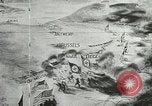
The Battle of the Bulge in Ardennes, Belgium, 1944 (WW2)
Animated map showing disposition of Allied and opposing German forces in Belgium during World War II. Highlighted places include the River Meuse, Bastogne, and Liege. Brief glimpse of German Field Marshal Gerd von Rundstedt, commander of the German Army Command in the West. German troops riding through forest over light snow on a King Tiger II tank. The tank churning up dirt and snow at high speed in another scene. German infantry moving through the forest at dusk. Illustrated map shows national flags delineating battle fronts and the German breakout (Bulge in the line) aiming toward Antwerp Harbor through Liege. Next are series of rapidly changing battle scenes showing American troops in house-to-house combat near houses and stores of towns, moving through smoke and mist, one throwing a hand grenade into an apartment building, helping one another move through buildings, setting off explosives, communicating on a field telephone, moving through burning rubble, and running across snow around industrial buildings. Dramatic camera shakes are seen during some of the nearby explosions. Two U.S. soldiers silhouetted against the snow as place a wounded buddy in a sheltered spot. One places a bandage around the neck of the injured soldier. American medics carrying wounded on litters, across a snowy field containing a several fallen soldiers. One soldier calls for a medic. Corpsmen moving on to a new battlefield. U.S. troops firing machine guns from atop Sherman tanks in a city as infantrymen crouch behind the tanks. Glimpse from inside, of a German soldier firing an Mg34 model machine gun out a building window. Embattled American troops and trucks moving past burning buildings. Closeups of American GIs dashing from building to building and firing from improvised shelter. A bazooka fired out a building window strikes a tank, which is seen burning. Individual soldiers running for shelter as Medical Corpsmen carry the wounded on litter the opposite way. Scene shifts to British forces moving in from further North, through the snow. Glimpse of women and children and aged folks, in Belgium, frightened by the goings on. An old woman holds a small girl who is crying. British infantry advancing into action across a snowy field. A British machine gunner firing from a protected position. U.S. troops entrenched in deep snow. December 24th, clearing weather allowed some Allied air support to aid the troops. Glimpse of aircraft contrails. Formations of Allied aircraft overhead. Aerial view of a formation of British Hawker Typhoon fighter bombers in flight. View from a Boeing B-17 Flying Fortress in flight with others creating thick contrails at high altitude. Pilot and copilot in cockpit of a bomber in flight. American soldiers on the ground watching with binoculars. U.S. Army Air Forces Republic P-47 Thunderbolt overhead, break out of formation and dive to attack German ground targets. American GIs on the ground cheer as they watch. A huge explosion takes place near an American crew manning a heavy gun pointing point blank with zero elevation. American soldiers load rockets into a truck-mounted launcher. Several truck-mounted launchers firing their rocket barrages. U.S. infantry advancing atop tanks, in armored personnel carriers, and on foot. They carry axes, shovels, and similar tools along with their weapons. Army trucks entering a town. The infantry moving through a forest. More troops on vehicles of all kinds moving into a town.
A number of casualties in the year 1944 during World War 2
A large number of casualties as a result of World War II. War continues with artillery fired in Belgium, a ship underway in Atlantic, a wounded in Pacific Theater and a graveyard.
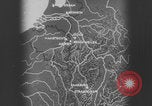
German forces launch a counter offensive after the Allied 1944 invasion at Normandy during World War II
Film shows map of the Ardennes region of Germany and Belgium. In the dark of night, German artillery and rockets are seen being launched against Allied forces in a counter offensive in the Ardennes during World War 2. In daylight, clouds of dark smoke lay across the horizon partially obscuring the rising sun. A German officer signals for artillery to fire, and a heavy gun barrel is seen recoiling as it fires. Shells exploding in the distance. German gunners firing an LeFH 18 howitzer hidden under branches of foliage. Rockets launchers (Nebelwerfers) firing. Explosions in the distance. German troops in trenches. Several views of howitzers firing. American prisoners marching past Dragons Teeth antitank barriers at the Ziegfried line (Western Wall). German soldiers riding on Stug III Ausf. F tank destroyers. A half track (Sd.Kfz.251) passing a line of American prisoners walking in the opposite direction at side of muddy road with their hands over their heads. View from the rear of the U.S. soldiers escorted by German soldiers. German infantry advancing single file along the side of a road. Some carry panzerfaust anti tank weapons. Others carry MG 42 machine guns and belt ammunition. View from rear of the German infantry entering woods. Dead American soldiers lying in a group in bluff overlooking a body of water. American steel helmets scattered on the ground. More views of dead U.S. soldiers.

U.S. and German forces clash at Stavelot, Belgium, during World War II
Opening slate identifies site of World War 2 combat as Stavelot, Belgium, 20 miles from the German frontier. American soldiers of the 30th Infantry Division are seen digging protective field positions. M1917 Browning 30mm machine guns are at their positions. U.S. troops set up 90mm guns along the roads, as fog begins to obscure the area. On 21 December, 1944, Two U.S. soldiers walk across a square in the town of Stavelot where American and German forces clashed on December 20th. Views of destroyed buildings, abandoned Tiger II tank of s.SS.Pz.Abt.101 and Stummel half-track and wreckage. Civilians run for cover into a substantial building as German forces renew an attack on the town. (World War II; WW II; World War 2; World War Two)
P-47 aircraft of the U.S. Army Air Force 368th Fighter Group take off and land at muddy Chievres Airfield in Belgium during World War 2
World War II P-47 aircraft of the United States Army Air Forces (USAAF) take off and land at Chievres Airfield (A-84) in Chièvres Belgium. Airplanes take off from the muddy air base. Trees in the background. Second plane landing has nose art that is difficult to read, but the aircraft serial number 42-76114 (which was piloted by George Swink of the 396th Squadron. Swink's aircraft was downed by flak on 25 December, 1944 and his status after was POW). Various scenes of P-47 Thunderbolts taking off and landing.