


 Francais
 Deutsch
 Italiano
Refine Your Search
+"Belgium" +1944 stock footage and images
- Showing 7 to 12 of 132 results more
more Hide
Hide
U.S. Army Air Forces P-47 aircraft operating in Belgium during World War II
USAAF P-47 Thunderbolt fighter planes operating at Florennes/Juzaine Airfield (A-78), Belgium, during World War 2. Identifiable units include the 411th Fighter Squadron (U9); the 373rd Fighter Group; the 387th Fighter Squadron (B4) and 388th Fighter Squadron (C4) of the 365th Fighter Group. A number of P-47s, (mostly bubble canopy D models) seen taxiing. (The second one's tail number looks like 42-26571, but that aircraft was downed in October 1944. So it is probably 26579.) Crew chiefs ride the wings of most P-47s to guide the pilots during low speed taxi when they would otherwise have to zig-zag to see ahead. Destroyed building silhouetted against the sky.Two flights of four P-38s circle overhead and peel off for landing.View through breached wall of a jeep towing a bomb cart past a parked P-47. Airmen walking across the field. Clear view of 388th Fighter Squadron P-47 taxiing. Another P-47 taxiing past a small damaged building

Villagers of Bande, Belgium, massacred by Nazis on Christmas Eve, in retribution for deaths of three German soldiers, in World War II
A sign identifies the village of Bande, in Belgium, during World War 2. View of snow-covered village rooftops from a distance. Closeup of a cafe in the village. Bodies of 34 young men from the village are seen lying in the cellar of the cafe. All had been executed on Christmas Eve, by a unit of the Nazi SD (Sicherheitsdienst) affiliated with the SS (Schutzstaffel) in retribution for the deaths of three German soldiers killed by Belgian maquis (Resistance fighters) on September 5, 1944. (Bande had been occupied by U.S. forces soon thereafter, but was retaken by German forces in the December Ardennes offensive, setting the stage for the massacre.) British troops that re-occupied the village on January 10th, 1945, are seen removing the bodies from the cellar and placing them on the snow-covered street. Wooden coffins are stacked up at the side of the building. Some closeups of the victims are seen. Scene shifts to a snowy field where the bodies are on the ground and men wrap them in sheets and place them in coffins. Closeup of British soldiers placing cover on a coffin and affixing an identification tag on it. Next, the Village Priest presides over a mass funeral for the victims, as villagers stand along the line of coffins. Women in black grieve over the victims. British soldiers carry the coffins to army trucks.The villagers follow behind the trucks as they proceed to the graveyard for burial. The coffins are placed on the ground at the cemetery.
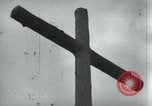
The initial World War II Memorial at Baugnez, Malmedy, Belgium 1945, honoring U.S. POWs executed there by German forces.
The first memorial erected to commemorate U.S.prisoners of war executed by the Nazis during the battle of the bulge (mostly elements of the American 285th Field Artillery Observation Battalion (FAOB), executed by the Kampfgruppe Peiper (part of the 1st SS Panzer Division). This was also known as the Massacre at Baugnez, or the Malmedy Massacre. A wooden cross and a sign reading 'USA - Belgium. To the prisoners of war of overseas who liberated the East districts and were the victims of Nazis cruelty." The wooden cross at the monument to commemorate the massacre of 115 American prisoners at Baugnez on December 17th 1944 during the Battle of Bulge, in World War 2.
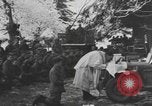
Supplies being dropped from airplanes and gliders landing on a snow covered area in Bastogne, Belgium.
A film depicts the Battle of the Bulge in the area of Bastogne, Belgium by U.S. troops during World War II. Belgian civilians are evacuated from an area. Civilians and soldiers in an area. Guns on a field. U.S. aircraft flying in formation to deliver supplies, ammunition, and food to U.S. Army forces including 101st Airborne Infantry soldiers fighting in the battle of the Bulge. Soldiers watching the airplanes through binoculars. Point of view shot from inside a glider hooked via a tow rope to an aircraft in flight, preparing to cut loose for glide to the ground. Aerial view of the target area. The airplanes in flight overhead. Supplies are being dropped via parachutes. View inside supply aircraft as troops push supplies out of doors. Gliders loaded with supplies and equipment landing in a snow covered area in time for Christmas 1944. Combat in the snow with a night artillery barrage by American soldiers firing at the Germans. U.S. soldiers using flame throwers at night directed at Germans. Dead bodies of German soldiers lying on the snow covered battlefield the next day. German prisoners of war standing under the guard of the U.S. soldiers, some of German prisoners found wearing civilian clothing or wearing pieces of U.S. uniforms. The 101st Airborne Infantry soldiers march in a victory celebration in town. A board reads: "Bastogne Bastion of the Battered Bastards of the 101st."
Early allied victories in Europe during World War II are challenged by German counter attacks in late 1944
Elements of U.S. Army arriving in a town in France, in August, 1944, during World War 2. Local people line the sides of the roads to welcome them. Young French women reach up to American soldiers in the back of an open stake truck and later mingle with them on the ground. Some of them kiss the soldiers. Some American flags are displayed by people in the crowd of well-wishers. One American soldier holds up a souvenir Nazi flag.Large crowds of French people gathered in a square to welcome the Americans. Many display the "V for Victory" sign with their hands. Film fades to a brief glimpse of a fallen soldier, and new slate reads: "Counterattack." Next, U.S. Medical Corpsmen are seen carrying American wounded to ambulances in the field in December, 1944.Several views of medics attending to American wounded soldiers. American infantrymen advancing across a field beside a Pershing T26E3 tank. (Note: It has 6 bogey wheels. Not designated M26 until 1945.) American infantry advancing into area of burning buildings and then into built up part of town, where they take up defensive positions inside a building. A U.S. soldier firing out a building window. Other U.S. soldiers firing from positions behind a wall. One is next to a mortar. Buildings burning and destroyed all around them. Close-up of American soldiers firing M1 Garand rifles from behind the wall. Infantrymen hunkered down behind a stone wall with light snow atop it. An explosion from a hand grenade raises smoke. A medical Corpsman checks a fallen American soldier for sign of life. Next, a Chaplain is seen reading from a small bible or prayer book, as he stoops over the fallen soldier. Fallen and wounded soldiers are carried to a truck, from the battlefield, on stretchers. Scene shifts abruptly to captured German film depicting two junior officers conversing in the field and then to German Field Marshal Erwin Rommel conversing with an artillery assault gun officer. Rommel holds a pair of eyeglasses in his right hand. The gun officer wears binoculars around his neck. A war torn city. German Volkssturm (People's Militia) parading. Some carry panzerfaust anti-tank weapons over their shoulders. A field full of German King Tiger II Ausf. B Heavy Tanks. One being driven out of the field. A German SdKfz 251 halftrack maneuvering in woods. it is covered with foliage for camouflage. German soldier in an open single seat courier car. It and he are spattered with mud. Close-ups of the mud-spattered driver smoking an cigar. German infantry moving across a field and moving along a road, in the mist. German infantry moving along a muddy road near a forest. A German V-1 Buzz bomb seen overhead with engine running. It flames out. Next an explosion and rising smoke is seen inside a town.
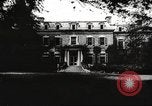
Allied leaders meet in Quebec, Canada and the Germans launch an attack in Bulge, Belgium during World War II.
Allied campaign against the Axis in 1944 during World War II. Exteriors of Dumbarton Oaks in Washington DC. Representatives of the United Nations at a meeting inside the mansion. A railroad train arrives and British Prime Minister Winston Churchill gets off the train in Quebec, Canada for the Quebec Conference. Churchill confers with U.S. President Franklin D. Roosevelt about Allied plans during the war. French FFI or Maquis groups in France. President Roosevelt, seated in front of a large celebrating crowd of people in the U.S., acknowledges them after being reelected President for a third term. People celebrate his victory and hold election victory signs as they cheer. American Civilians (mostly women war production workers) work in war production factories to produce aircraft, tanks and other equipment in the United States. Rows of aircraft engines, cockpits, and gun turrets being produced. On December 16, 1944, German forces launch a major-counter attack through the Ardennes forests, resulting in the "Battle of the Bulge" in Belgium. View of German soldiers and a German Jagdpanzer IV tank destroyer rolling by. German soldiers advance past destroyed Allied tanks and trucks.