


 Francais
 Deutsch
 Italiano
Refine Your Search
+"Berlin Germany" +1943 stock footage and images
- Showing 1 to 6 of 23 results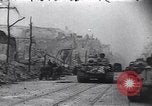
Contrasting views of Berlin, Germany from 1945 to 1943, to 1945 again, during World War II
Soviet Forces battling in Berlin during 1945, in World War 2, employ tanks and heavy machine guns. A Soviet soldier herds two German prisoners from a building. Groups of German soldier prisoners struggle through rubble as they are led from buildings, under guard. Soviet tanks firing as they pass a church building. A Soviet heavy gun being fired point blank on a Berlin street during Battle of Berlin. Buildings on fire. Soviet soldiers firing artillery field pieces. Views of destroyed and damaged German military aircraft on and in hangars of an airfield. Soviet Ilyushin II aircraft land on the airfield. Closeup of distressed German General rubbing his eyes. Flashback in time to 1943, in World War II. Field Marshal Hermann Goering is seen reviewing flyers of a German Luftwaffe (Air Force) unit. A Junkers Ju 52 trimotor aircraft lands and parks on an airfield. Italian leader Benito Mussolini steps from the aircraft after his rescue from imprisonment by the Italian Government at the Hotel Campo Imperatore. He is personally welcomed by Adolf Hitler, who had ordered the mission to rescue him. Change of time, again, to 1945, when Berlin, Germany is attacked by Forces of the Soviet Union. Closeup of a despairing German General. Scenes of utter destruction as Soviet troops batter Berlin, Germany with artillery. Soviet soldier steps down from his tank and gives a Soviet General a handgun, which he pockets and then leads a group of Soviet officers into a building
U.S. shuttle-bombing of German positions and military installations under Operation Frantic during World War II.
Film title slate indicates "Operation Titanic" but it, in fact, depicts "Operation Frantic" with U.S. shuttle bombing operations over Germany from bases in Great Britain, Italy and Russia during World War II. United States Army Air Force B-17 Flying Fortresses in flight. Aerial view of bombers in flight with several aircraft flying in formation leaving behind contrails. View inside bomber aircraft with bombardier preparing to drop bombs. View of bomb bay door opening and closeup of hand near bomb drop switch. Bombs awawy view as bombs are dropped from American aircraft. German defenses are bombed along the invasion coast of France (just prior to D-Day) on June 2, 1944. Aerial views of B-24 and B-17 bombers also in flight bombing German military installations in German-occupied northwestern Europe. Aerial view of a target area. Smoke rising up from bombardment. Two different U.S. Army Air Force B-17 Liberator aircraft are seen falling from the sky toward crashes after being hit by German enemy fire. One of them has smoke trailing from it, and the other is in a free fall. Railroad and marshaling yards are also bombed over Debrecen, Hungary on June 2, 1944, with aircraft continuing on (shuttle bombing) rather than returning to base. United States Army Air Forces B-24 Liberator flying in formation on June 21, 1944. Aerial view as they bomb the Focke-Wulf Fw 190 engine aircraft factory near Basdorf, Germany. German factories are bombed. B-17 aircraft on the same date are seeing in formation and bomb railway stations, freight yards, and factory targets, along with the Nazi German Ministry of War, Ministry of Propaganda, and Gestapo headquarters in Berlin, Germany. Heavy flak bursts seen in the air near the aircraft. Dogfight scenes as several German airplanes are shot down. Machine gunners aboard U.S. bomber aircraft firing at German fighter aircraft and shooting down 43 of them, according to narrator. Aerial view of ball turret rotating below bomber and firing guns at German fighter aircraft. The B-17s and B-24s bombing the targets. Synthetic oil plants and refineries are bombed at Ruhland Germany, east of Leipzig. Planning for the operation was done on December 7, 1943. A document about the operation is typed. Animated map shows Nazi positions and method of shuttle-bombing, allowing American aircraft to bomb from Soviet bases, and allies broadly to bomb German targets from bases in the United Kingdom, Italy, and Soviet Ukraine.
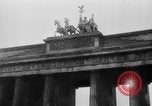
Band heads the parade of German soldiers in front of the Brandenburg Gate in Berlin, Germany.
German soldiers parade in Berlin, Germany. They parade in front of the Brandenburg Gate or Brandenburger Tor (Pariser Platz, 10117 Berlin, Germany). Band heads the parade. Soldiers on horses along with them. (World War II period).
Canadian Lancaster bomber KB-700 night raid bombing Berlin Germany
Participation of Canadian Lancaster bomber aircraft over Berlin Germany in World War II. Lancaster bombers loaded with heavy bombs take off from England for the night time bombing. Scenes from dining hall of Victory Aircraft Plant in Malton Ontario Canada as war production workers workers learn about their "Q for Queenie" (nickname) first KB-700 Lancasters being used to bomb Berlin. Views from inside Lancaster bomber aircraft as crews fly toward Berlin. Internal views of pilots, cockpit, bombardier area, navigator area. Flak and planes evading flak and anti aircraft fire from German ground forces. Views of the impact of bombing along with the explosion sound in background. Bright lights and flashes on ground as bombs impact and fires burn on ground in Berlin, as seen from Canadian Lancaster bomber flying overhead during mission. Radio conversation of pilots and ground men, explosion sound and the victory shouts heard in background.
Athletic events during Berlin Track Meet in Berlin, Germany.
Pole Vault event during Berlin Track Meet in Berlin, Germany. Women run during women's hurdles race. Crowd cheer. Army Officers in stand. Men's race going on.
German soldiers and civilians clear debris and bomb-damaged areas in Berlin, Germany.
German soldiers and civilians clear debris in Berlin, Germany. They repair the bomb-damaged areas. People work outside a wrecked building. They repair a railroad station. Workers repairing and clearing train track area. A German officer talks to two young girls who smile and laugh. People arrive at food stores in the market. They buy various food items and work to carry on everyday business during period of allied bombing. (World War II period).