


 Francais
 Deutsch
 Italiano
Refine Your Search
+"Berlin Germany" +1943 stock footage and images
- Showing 13 to 18 of 23 results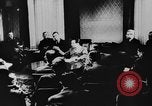
German Chancellor Goebbels confers with air raid council and civil defense measures adopted in Berlin, Germany during WWII.
Adoption of civil defense measures in Berlin, Germany during World War II. German Chancellor and Reich Minister of Public Enlightenment and Propaganda Paul Joseph Goebbels confers with the air raid council. Berlin adopts civil defense measures. People eat at the sidewalk kitchens function. Emergency food arrives. Eggs, meat, and fruit distributed to citizens of Berlin. An officer instructs German soldiers who are then seen clearing debris from streets. Carpenters begin rebuilding work after allied bombing. Welders rebuild rail tracks. View of the damaged buildings. German civilians collect food from a market place.
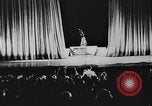
A large crowd of German citizens gathered at a hall to watch the acrobatics show in Berlin Germany.
Acrobatics show in Berlin Germany. A large crowd of German citizens including Berlin bombing victims are seen gathered at a hall. Some of them wear bandages from wounds. The crowd watch the acrobatics performance and applauds. (World War II period).
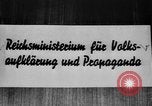
Women and children in trains and buses evacuate Berlin after an Allied attack, Berlin, Germany.
Women and children German citizens evacuate Berlin after air raida in Germany during World War 2. Military officers in a meeting discuss among themselves. Citizens and soldiers work to load furniture, food, and personal items into trucks, buses, and trains. Views of busy streets and railroad train stations as loading takes place Women and children in trains under German military escort, evacuating to safer locations.
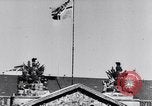
Adolf Hitler and top military leaders pay homage on Heldengedenktag (Day of Commemoration of Heroes) in World War II
German war ensign flying over the Zeughaus (military museum) on Unter den Linden, in Berlin, Germany on Heldengedenktag (Day of Commemoration of Heroes) in World War 2. A military band outside plays the National Anthem, as Adolf Hitler walks out of the building, accompanied by General Paul von Hase, Commandant of Berlin. An honor guard of soldiers presents arms in salute. Hitler and Marshal Hermann Goering (Göring) lead members of the German High Command, including Marshal Wilhelm Keitel; Grand Admiral Karl Doenitz; SS leader Heinrich Himmler; Marshal Fedor von Bock; and Marshal Erhard Milch, as they walk along the street, reviewing troops in formation. Flag bearers dip 30 colors of the old German Kriegsmarine and 30 of the new German army, in salute, as the reviewers pass. Soldiers stand holding a large memorial wreath. Hitler and his entourage turn and walk towards the Neue Wache (New Guard) National War Memorial building. Scene shift to inside the memorial, as the wreath bearers enter, followed by Hitler and the Marshals. The strains of "ich hatt einen kameraden" war song are heard played as a dirge. Soldiers place the wreath, and all present salute. Many more flowers are seen on the memorial floor. View of the memorial black granite block topped by an oak wreath (designed by the sculptor Ludwig Gies) situated under an oculus. It is flanked by two guards. Flowers cover the entire floor in front of it. Meanwhile, outside, on Unter den Linden, all persons simultaneously salute, including military and civilians. As Hitler leaves the memorial building, accompanied by the Marshals, he stops to shake hands and converse with wounded German officers and soldiers in wheel chairs. He greets older veterans of earlier wars. A crowd including many young people hold up placards on poles.
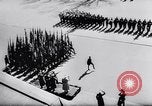
Military parade along Unter den Linden, Berlin, on Heldengedenktag (Day of Commemoration of Heroes) in World War II
German troops march along Unter den Linden, in Berlin, Germany, on Heldengedenktag (Day of Commemoration of Heroes) in World War 2. A military band (unseen) plays. The troops pass a reviewing party in front of the Neue Wache Memorial building, that includes Adolf Hitler, Marshal Hermann Goering; Marshal Wilhelm Keitel; Grand Admiral Karl Doenitz; SS leader Heinrich Himmler; Marshal Fedor von Bock; and Marshal Erhard Milch.
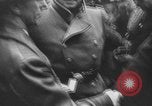
Propaganda Minister Joseph Goebbels awards medals to Berliners who achieved the most against Allied bombers in Germany.
Propaganda Minister Joseph Goebbels meets victims of bombing in Berlin, Germany. He shakes hands with other soldier. People gather to meet him. He award medals to Berliners who achieved the most against Allied bombers. Goebbels talks to a woman. (World War II period).