


 Francais
 Deutsch
 Italiano

Refine Your Search
+"California USA" +1944 stock footage and images
- Showing 7 to 12 of 56 results more
 Hide

Huge crowd of men and women workers leave and enter the shipyard for work at the Kaiser Shipyard in Richmond, California.
The Kaiser Shipyard in Richmond, California. 'Kaiser Co Inc' written on a building. War production workers come out of shipyard premises after a day's work building ships. Huge crowd of men and women workers enter the shipyard for work during World War 2.

United States Army Air Force P-61 Black Widow demonstration: P-61 takes off in Hawthorne, California.
United States Army Air Forces aircraft Black Widow's features are demonstrated in Hawthorne, California. A stationary Northrop P-61 Black Widow aircraft with views of its tail section, wings and engines starting. The Black Widow takes off.

First flight of the Lockheed XP-80A (Prototype of P-80 Shooting Star, America's first operational jet fighter aircraft).
Scenes from first flight of the Lockheed XP-80A, prototype of the P-80 Shooting Star, America's first operational jet fighter aircraft. The aircraft livery (paint job) is dull gray. Unlike the future operational versions, this XP version has no tip tanks. The aircraft piloted by Lockheed test pilot Tony LeVier, is seen flying low over the Muroc Flight Test Base (later Edwards Air Force Base).

A model of the Statue of Liberty is unveiled at the launching of Liberty ship Benjamin Warner in Richmond, California.
Launching of the last Liberty ship in Richmond, California. 'Benjamin Warner' written on a Liberty ship in the Kaiser Richmond Shipyards. A miniature model of the Statue of Liberty is unveiled in the presence of Henry Kaiser. People cheer as the ship is launched.
Construction of Liberty Ships vital to War Effort in World War 2
World War II Liberty Ships that carry war materiel like guns,tanks and planes, in the Marine Shipyard in Sausalito, California, across bay from Richmond California shipyards. View of Vice Admiral Emory Scott Land (retired), speaking about the need for ships, and more ships, for the war effort. Among Liberty ships shown are Billy Mitchell, George Chamberlain, Waslater, Cermak and Charles Summer. Ships with bow numbers 434, 432, and others lined up under construction. View of Senate bill 3500, Merchant Marine Act of 1936 authorizing merchant ship building to support commerce and National Defense. Marine architects and engineers work with blueprints and models to optimize design for fleet of merchantmen that would eventually be called "Liberty Ships." National Posters seen. One shows burly shipyard worker with sledge hammer and reads: "Swing it Brother." Another shows convoy of ships at sea and reads: "You Build ''em. We'll sail 'em." Construction begins. Timbers, plates, anchors , engines, steel blades, and other of the hundred thousand items needed build a ship. Crowds of Shipyard workers leaving after a work shift. A sign on building reads,'It can and will be done', and another, under which workers walk advertises war bonds . Shaping metal with gas torches. Fabricating ribs of steel. Spray painting. A woman welder named Mary Smith, welding with torch. Cutting steel using patterns and torches. Fabricating bulkheads. Riveting. Derricks lift heavy assemblies.
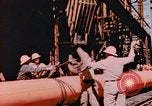
Role of Iron and steel in construction of Liberty Ships. Use of cranes for heavy construction during World War 2.
Building a Liberty Ship in California shipyards (Sausalito or Richmond) during World War II. Raising an 8-ton steel mast from which a ship's boom will extend for loading operations. The gantry crane operator seen in control cabin. A house of steel is built to sit on the deck of an attack transport ship. It is lifted with the help of crane and put into the ship. Several cranes are used to move a 100 ton, 4000 horsepower diesel engine into place in the ship's hold.