


 Francais
 Deutsch
 Italiano
Refine Your Search
+"China" +1937 stock footage and images
- Showing 1 to 6 of 56 results more
more Hide
Hide
The Battle of Shanghai and Chinese history, 1937.
The Battle of Shanghai, September 1937. Japanese planes in flight over Shanghai. Pilots in the cockpit. A hand dials a control to drop bombs on the underlying city. Explosions as bombs hit the target. The citizens flee. A plane drops bombs on a bridge as people are crossing it. The bridge collapses. Citizens in the streets. Vehicles on the streets of Shanghai. People in runner pulled rickshaws. Dead Chinese people on the streets. A cloud of smoke rises over the city. Gate to the Chinese Forbidden City opens to reveal the Temple of Heaven. A Ming Lion statue. A time line shows the advent of different civilizations-- A milestone with 1776 written on it indicates the time when Washington crossed the Delaware River. Another milestone shows 1492. A picture of Columbus's ship. Yet another milestone reads 476. Pictures of ancient Roman Empire. A milestone reads 1440 B.C. A statue of Moses. A milestone reads 1880 B.C. A scene of the pyramids depicts the Egyptian civilization. Another milestone reads 2200 B.C. Shows a road leading to Chinese civilization. . A man carrying two baskets on a pole walks by a statue of Confucius and a horse. Ancient Chinese temple in background. A wall shows Chinese statues of Buddha. An animated map of China. Laborers mining coal in Manchuria. Coal cars filled with coal. In the Gobi desert nomad tribes move with their camel caravan. Himalayan mountains in the Tibet region. Animated map of China shows rivers. Sampans in the Yangtze river. A Chinese farmer plows his field. Chinese soldiers in China. Montage shows the people of China against a crowd of Chinese people.
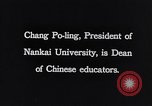
Chinese government leaders in 1937, and Chinese troops and Boy Scouts being reviewed by Chinese officials.
Views of government leaders of the Republic of China in 1937. Chang Po-Ling, President of Nankai University. Po-Ling is seen with a little boy outside a house. Next, General Ho Ying Chin, Minister of War is seen in full military uniform while speaking. Next scene shows Lin Sen, Chairman of the National Government, speaking into a microphone while standing on an outdoor stage. Next scene shows Chiang Kai-Shek and Madame Chiang seated in a garden. Chinese dignitaries including military officers walk down a flight of stairs and approach the camera position. A mass assembly of Chinese Army troops is seen. Next, Chinese Boys Brigade marches by a reviewing stand. Chinese Boy Scouts in uniform march with flags.
U.S. Lieutenant General Daniel Sultan explains Japanese aggression in China and need for troops in India and Burma during WW2
World War II film about the China, Burma, India (CBI) Theater of Operations. A soldier is seen filling out a form seeking information about him and inviting him to write in questions about anything he hadn't learned through normal information channels. Scene shifts to Information and Education Department of the Burma-India Command, where it is being processed by a soldier. Lieutenant General Dan I. Sultan, commander of Burma-India Theater, is seen next, seated at a desk, with wall map of the region behind him. He is appearing in an information film intended to inform troops under his command. He notes that more than half the troops who filled out the information form, asked why American troops were stationed in India and Burma. He refers to the recent recall of General Stillwell and the splitting of CBI into two theaters (China and India/Burma). He states that the purpose is a path toward Japan. An animated map shows China (that narrator notes has been fighting Japan since 1937). Animation shows Japan walling off China from the outside world, by seizing her ports, and then concentrating its grip on the Eastern part of the country. Without access by sea, the allies had only one option to assist China in the fight against Japan. That was to open the Burma Road. Film shifts to scenes of Japanese bombing of Shanghai and Chinese civilians abandoning the city in 1937 during Second Sino-Japanese War. Wounded and injured Chinese fighting fires while tending casualties in an open area. Glimpse of Chinese soldiers near one of their few large artillery pieces. A gun crew manning one of her few antiaircraft guns. Chinese jam road in trek to the unoccupied provinces of the country. Chinese carrying casualties on stretchers, making do without ambulances. Chinese coping in the face of all kinds of shortages. In contrast, well supplied Japanese troops are shown in formation. Japanese troops, military vehicles and equipment are seen. Japanese firing machine guns and heavy artillery against Chinese positions. Japanese armor and long lines of troops engaged against the Chinese, who continue to resist in spite of shortages and hardship. Chinese soldiers without shoes, marching in a column.
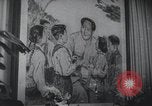
Implementation of the Mao Zedong led economic and social plan titled the 'Great Leap Forward' in Red China.
Postwar living conditions in the People’s Republic of China under the Communist regime of Mao Zedong (Mao Tse-Tung) photographed by Indians visiting the country. The film highlights China's problems of industry, agriculture, and excess population. Advertisements and posters for the Mao Zedong led economic and social plan titled the 'Great Leap Forward' in 1958. Objectives of the plan. Agriculture, industry, and education in China, including brief shot of men, women, and children in classroom, possibly for re-education. Men and women work in factories and plants. A Russian sign reads 'Made in the Soviet Union'. Workers inside a huge automatic automotive plant set up and supplies by the Soviet Union (SU). A steel and iron company rebuilt and enlarged with the aid of Soviet Union. A seamless steel tube mill supplied and erected by the SU. A plant designed, equipped, and built by SU technicians. A bridge over a river. Women work in a high voltage testing laboratory equipped by the East German government. A fully automatic petroleum refinery built by the Japanese. A heavy gilding machine plant started by the Japanese in 1937. Various factories, plants, and industries in China. Rural farmland and irrigation. People work in backyard furnaces, factories, presses, rolling mills and automotive factories. Deserted city streets with few cars. Workers inside an automotive plant. Communist Party of China Chairman Mao Zedong signs a pact with the Premier of the Soviet Union Nikita Khrushchev. Newspaper headlines regarding the disagreements leading to rifts in the China-Soviet relations in 1960. The Soviet Union withdraws technicians and support from China resulting in closure of industries. Statistics highlight China's dropping industrial production in steel, coal, electricity, and petroleum compared to that of USA, Soviet Union, and United Kingdom.
Second Sino-Japanese War
Opening scene shows formation of Japanese Mitsubishi G3M bombers in flight. View of bombardier at bomb sight inside a bomber. Bombs falling from the aircraft, upon the Chinese city of Shanghai, on a day in September, 1937. Ground level view of bomb exploding and Chinese civilians running for cover. A huge explosion throwing earth up. Aerial view of smoke rising from bomb strikes below. More ground views of bombs destroying structures. Chinese people fleeing across a bridge. Cluster of bombs falling from a Japanese airplane. More explosions and destruction. view from a G3M bomber, of others with bombs falling from them. View from above of civilians filling a street as they run for shelter. People on the ground rushing in all directions. Some are in horse-drawn carriages with luggage on top and other in rickshaws, apparently fleeing the city altogether. Bombing victims lying on the ground near destroyed structures. Heavy dark smoke rising from the attacks. Scene shifts to Japanese army officers entering the Yasukuni shrine in Tokyo. Behind them is A Shinto Tori (Gate) and behind that, the monument (statue) of Omura Masujiro. Scene shifts again, to view of the Temple of Heaven, an ancient Imperial Sacrificial Altar in Peking (Beijing) China. Chinese agriculture. Crowds of Chinese people. Stone statue of traditional Chinese lion. Picture of 1851 oil-on-canvas painting by the German American artist Emanuel Gottlieb Leutze, of Washington crossing the Delaware. Drawing of 15th century ship similar to one in Columbus'1492 voyage to America. Drawing of Roman Empire era building. Michelangelo’s statue of Moses. Drawing of ancient Egyptian pyramid and statue. Drawing of Chinese city and environs representing 4 thousand years ago. Extant ancient Chinese shrines and statues. Animated Relief map of China and surrounding countries of U.S.S.R., India,Burma,Thailand, Indo-China, Philippines, and Japan. Animation outlines China Proper. It also shows Manchuria and scenes from there of desolate mountainous land, with miners at work extracting raw materials. Mongolia and Sinkiang are outlined. The Gobi desert is seen with a long camel caravan crossing it. Closeup of nomads transporting animal skins by camel. The last region outlined is Tibet. The ice covered Himalayan mountains are shown. Buddhist monks praying in the courtyard of a shrine in Tibet. The Yellow, Si Kiang, and Yangtze Rivers are shown on the map. Views of Chinese sailing vessels.

Japanese bombers bomb a Chinese cities, including Shanghai, and infantry advance during Second Sino-Japanese War (WW2)
A 1945 film titled 'The Enemy Japan Dream of Empire' details Japanese conquests starting with China during Second Sino-Japanese War in 1937. United States Ambassador to Japan Joseph C. Grew speaks about the ruthless nature of Japanese. Wall maps in the background. Aerial formation of Japanese bombers over a Chinese city, possibly Shanghai, during Second Sino-Japanese War (World War II), 1937. Smoke billows up from bomb bursts. Dead bodies of civilians on bombed streets. View of damaged Palace Hotel in Shanghai. Japanese infantry and horse-drawn munitions carts advance into the city. Car pulls up in front of building in Japan and a guard opens door. Japanese military leaders exit car. View of many tall banners with Japanese rising sun symbol hanging from ceiling. Japanese statesmen and army Generals confer in Japan.