


 Francais
 Deutsch
 Italiano
Refine Your Search
+"China" +1942 stock footage and images
- Showing 1 to 6 of 54 results more
more Hide
Hide
Various scenes of Japanese military activity in China, circa 1938 through 1942
Scenes of Japanese military activities in China, circa 1938 through 1942. Animated map shows thrusts of Japanese military forces at Guangzhou (Canton); Changsha to the North and points West circa 1938. A captured airfield with destroyed and damaged aircraft. A destroyed P-40 with Thunderbird image on its wing. A damaged P-40 parked in the grass displaying painted teeth motif of the Flying Tigers (American Volunteer Group of the Chinese Air Force). A scrap heap of airplane parts, at least one displaying the American star in circle insignia. A tattered map on Bulletin Board showing a logo on part of China. A village near the airfield. Japanese troops board a camouflaged barge to cross a river. A Japanese Ki-27 (Nate) airplane in flight overhead. Column of Japanese troops wending their way along a hillside. Smoke rising from explosions in a port town, with water and hill in background. Bombed out buildings in a town. Japanese infantry and an officer on horseback enter virtually deserted Chinese town. Camouflaged Japanese army vehicles and artillery travel on dusty road. A Ki-27 airplane flies low overhead. Japanese artillerymen set up 120mm gun and rangefinder. Battery of Japanese 120mm guns firing. Wreckage of an American B-25 aircraft. Wreckage of more Allied warplanes. Map showing Formosa; Wenzhou, opposite, on Chinese mainland; and Philippine Islands. Arrows depict Japanese military movements from the Ryukyu Islands. (World War II period).
A 1942-1943 film report to the American public about the progress of World War II in Europe and the Pacific.
Opening slate at start of film reads: "1942--1943 The Turn of the Tide." A column of British armor enters Bengazi, Libya, led by several troops in tankettes. Next seen are a Lee Medium Tank, M3 followed by an infantry tank, a jeep, another infantry tank and another Lee M3 Medium tank. Closeup of local people greeting the troops with upraised hands giving the "V" for victory sign. Another Lee M3 tank passes close by the camera. Black smoke is rising in the background. Scene changes to a half sunken ship near another burning in the harbor. Another view of this from further away above port buildings. Closeup of three smiling British soldiers leaning over a cartoon on a tank, of Winston Churchill (As a bulldog smoking a cigar and wearing a cap with the word "Victory" written on it). A crumpled captured flag with swastika on it. British Field Marshal Bernard Montgomery stands atop a vehicle (unseen) and looks through binoculars. Below, a column of British supply vehicles is making its way along a path in the desert. Two tanks coming toward the camera through sand. Animated map shows Nazi territory being threatened by the Allies from the Mediterranean, the USSR, and the English Channel. Views of Soviet infantry advancing against German forces in the snow of winter on the eastern front. Soviet troops firing updated 76-mm divisional gun model 1902 hidden in woods. Shells exploding in snow-covered field as Soviet BT series tanks advance. Various Soviet artillery firing from fixed gun batteries and from woods. A shell striking in distance. Fallen German soldiers lying on snowy field. Makeshift battlefield crosses marking graves of fallen German soldiers. German steel helmets lined up in the snow. A sign, posted on a birch tree, lists the names and birth dates of 16 German soldiers from the 3rd Panzer Division (3Pz-Pi-BH.39) buried at this site on November 28, 1941. Scene shifts to Joseph Stalin addressing Soviet troops in Red Square, Moscow, Russia. All the soldiers in formation seem to be singing (unheard). Film switches to animated map again. This time delineating the Eastern front being pressed by the USSR, and showing area of the 2nd Soviet winter offensive in 1943. Change of scene from Europe to the War in Asia, against Japan, shows General Douglas MacArthur after arriving by a B-17 bomber at a Pacific island American base. He ascends a steep hill in a jungle area, accompanied by other officers. Closeup of MacArthur. American infantry moving in single file in New Guinea, as a field piece fires a round in the direction they are headed. U.S. artillerymen load shells into a 105mm howitzer gun. A fire burns as mop-up operations begin on New Guinea. An Australian soldier is seen firing a Bren gun in jungles. Other Australian soldiers fire a mortar that explodes, raising earth and dust. More views of shells exploding near Allied soldier advancing. A soldier with fixed bayonet makes a fake charge toward the camera. Views of Japanese prisoners of war guarded in an outdoor compound. Japanese dead soldiers on Guadalcanal. An animated map shows new battle lines in the Pacific, closing in on Japan, with pressure from China, the USSR, and the Pacific islands being captured by the U.S. Arrows are added showing new pressure from American naval fleets and from British and American bombers out of Australia and captured islands.
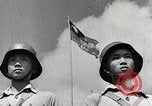
Battle of Changsha in China during the Second Sino-Japanese War (WW2)
Closeup of two Nationalist Chinese soldiers with their flag flying on tall flagpole in background. Next, countless numbers of Chinese soldiers are seen marching along the Great Wall during the Second Sino-Japanese War (World War II). Newspaper article reads: "52,000 Japanese fall at Changsha." Animated map depicts China and environs, with major cities. Areas of Japanese occupation are shown in black. The city of Changsha is highlighted by a circle. Japanese force is shown massing at Yueyang (Yochow), near Dongting Lake (Ting Tung Hu Lake), and advancing on 24 December 1941, toward Changsha. The map shows Chinses forces putting up token resistance and retreating to the East (rather than toward Changsha) and Japanese forces beginning assault on Changsha, New Year’s Day, 1942. Map shows the Chinese forces from the East attacking and cutting the Japanese supply lines. Japanese forces besieging Changsha are forced to retreat under counterattack by the Chinese. A field artillery piece being fired by Chinese forces and explosion and smoke from its shell striking. More field artillery being fired. Japanese forces carrying their Rising Sun flag as they retreat under fire. Chinese infantry firing from a berm A Japanese soldier falls to gunfire. Japanese soldiers retreating across a narrow-improvised bridge across a swamp. Chinese soldier next to a building, firing a Czech ZB vz. 26 light machine gun. Japanese running with horses through a village. Chinese gunner firing Japanese Type 92 machine gun down on Japanese troops retreating across a bridge below. Another Chinese soldier firing a Czech 26 light machine gun, from hill overlooking retreating Japanese troops, below. Victorious Nationalist Chinese troops parading in celebration along a road high above buildings of a town below in background. Men in Khaki pants and white shirts parading. Girls in white dresses, carrying Chinese flags. Soldiers marching (without weapons) celebrating.
Japanese General discusses first American air raid on Tokyo, Japan, in World War II. Captured American fliers in custody
Several blindfolded American fliers are seen being taken from an airplane. They are crew of the 16th B-25 comprising the famous "Doolittle"s Raiders." (Their aircraft was serial number: 40-2268, nicknamed: "Bat Out of Hell." Low on fuel, they were captured after bailing out near Japanese occupied Nangchang City, China, on April 18, 1942.) Captured American pilot, Lieutenant William .G. Farrow, is seen smoking a cigarette, while being escorted by Japanese soldiers, out of a building. With him are members of his crew: co-pilot, Lieutenant Robert L. Hite; Navigator, Lieutenant George Barr; Bombardier, Staff Sergeant, Jacob DeShazer; and Engineer Gunner, Sergeant Harold A. Spatz They pose for a group photograph on the steps, with the officer crew members on the top step and the two enlisted crew members a step below. (Lieutenant Farrow and Sergeant Spatz were executed by the Japanese on Oct. 15, 1942, at Kiangwan Cemetery, Shanghai, China.)
2nd Sino-Japanese war, precursor to World War II in the Pacific. Pearl Harbor attack. Early phase of Pacific conflict between Japan and the U.S.
The film 'Sea power in the Pacific' showing Japanese dominance in China and at start of World War 2. Then it chronicles U.S. efforts to build Navy and fight back on sea and in the air. Opening scene shows Japanese Mitsubishi G3M (Type 96) bombers high overhead, and then closeup in formation. View from bomber of bomb bays open with bombs falling and view from ground of explosions and destruction. Overlay on film says: "China---1931." (This is not correct. The G3M bomber was not yet in service.) This film depicts Japanese attacks during second Sino-Japanese War, commencing 1937, Chinese civilians running to escape Japanese bombing of Singapore. Buildings destroyed and on fire. Next, Japanese troops, carrying the Rising Sun flag, are seen establishing a beachhead in an Amphibious assault. More scenes of Japanese infantry advancing through Singapore, ad it is being destroyed and burned. Soldiers charging along an alleyway, with pagoda in background. Next, Japanese soldiers are seen attacking Nanking, and committing atrocities and killing Chinese during the so-called "Rape of Nanking," in December, 1937. Chinese civilians being summarily shot and dumped into a large open grave after execution. Two Chinese prisoners with hands bound, being executed by rifle fire. Jubilant Japanese troops celebrating their victory. Map shows areas of China occupied during second Sino-Japanese war and the East Indies to the South. View of oil tanks; an open pit tin mine; a native cutting rubber tree bark to collect latex. Flags on map show regions of English, French, and Dutch colonial interest. It also shows Islands to the East, fortified by the Japanese. Cartoon shows Japanese soldier opposed by and American sailor (representing U.S. Sea Power). Next, famous images of the Japanese attack on Pearl Harbor, Hawaii, December 7, 1941, are shown, including the USS Arizona burning and sinking. Hawaii, Midway, Wake, and the Philippines Islands, are highlighted on a map and Japanese control of the Pacific is illustrated. Japanese soldiers are seen displaying a captured American flag. U.S. Lieutenant General Jonathan M. Wainwright is seen surrendering the garrison at Corregidor, on May 6, 1942. View of Japanese General Masahara Homma discussing surrender terms with Wainright. Map shows interlocking web of Japanese fortified bases in Pacific and need for seapower to oppose it. View of American shipyard with hundreds of workers, employed to build ships for the war effort, in World War 2. Views welding, metal fabrication, and other shipbuilding activity. A new ship going down the ways and a woman christening a new ship with splash from bottle of champagne. A new "Liberty Ship," the Richard Bassett, going down the ways at Bethlehem-Fairfield Shipyard Inc. Baltimore, Maryland. Closeup view as the stern of another ship enters the water upon launching. View of it from a distance. Shipyard workers knock supports from under what may be a landing craft, as it is launched. Japanese warships underway in the Pacific and firing their naval guns. Explosions on a shoreline from naval bombardment. Japanese infantry wading ashore during an amphibious assault. Map shows where Japanese forces attempt an amphibious assault on Southern New Guinea, thwarted by the U.S. Navy in the battle of the Coral Sea of May, 1942. In June, 1942, a Japanese attempt against Midway Island, was again checked by the U.S. Navy in the Battle of Midway. View of USS Wasp (CV-7) carrier deck filled with airplanes, including Grumman F4F Wildcats. A Douglas SBD Dauntless dive bomber being cleared for takeoff from the Wasp. Gun camera film showing Japanese airplanes being shot down by pursuing U.S. aircraft.
Japanese aggression in China and various events leading to Japanese attack on U.S. at Pearl Harbor (WW2)
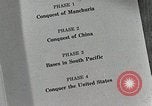
A hand writes check marks beside “Bases in the South Pacific” and “Conquer the United States” on the summary report purporting to reflect phases of Japanese so-called "Tanaka Plan". Animated map shows pressure by German forces in offensive against Soviet Union and illustrates German air war against Britain. Scenes of bombing destruction in Britain, including overturned double-decker bus in ruins of buildings. A Nelson Class British battleship viewed from dead ahead. She is followed by the aircraft carrier HMS Illustrious. The U.S. Capitol building in Washington, DC. American newspaper headline reads: "Navy Bill Passes House." and "Huge Sum Voted for Two Ocean Navy." A line of U.S. Navy battleships underway, led by the USS Mississippi (BB-41). A field full of U.S. M3 Lee tanks moving in formation, as they are overflown by several Douglas B-18 bombers. Assembled Japanese leaders in a forum. Japanese Naval officers in a planning conference. Closeup shows Admirals Shigeyoshi Inoue and Raizō Tanaka pointing at a chart and conversing as other officers look on. Next, bomb bursts and black smoke rises as the attack on Pearl Harbor is underway. The USS West Virginia, USS Tennessee, and the USS Arizona, burning on Battleship row, during the attack. Generalissimo Chiang Kai-Shek with staff officers walks to a waiting car. Forces allied with China, including American troops marching; British troops marching; and Dutch Colonial troops marching (in Batavia, the Capital of the Dutch East Indies). Japanese troops continuing their conquest of China, firing a field piece, and infantry charging. Newspapers announce Japanese advances into Malay Peninsula and Hong Kong. Others cite the Fall of Singapore and the Fall of Corregidor in the Philippines (6 May, 1942). Animated map shows Japanese occupation encompassing Indochina, Thailand, and Burma (with loss of the Burma Road) all of which compounded China's war efforts.