


 Francais
 Deutsch
 Italiano
Refine Your Search
+"China" +1944 stock footage and images
- Showing 67 to 72 of 115 results more
more Hide
Hide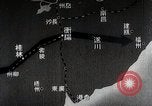
Animated map shows Japanese counter-attack against American forces and views of a deserted airfield in China (WW2)
Animated map shows Japanese counterattack from Changsha and Canton (Guangzhou) against American forces moving towards Fuchow (Fuzhou). View of a deserted airfield near Kweilin (Guilin) where Japanese ousted Americans. Artillery shells. Transporter train passes away. (World War II period).
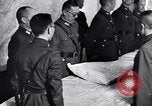
Chinese men, women and children mass migrate to the West in China, as they flee the invading Japanese.
Chinese emigrate to the West as they flee the invading Japanese. Chinese military officers and officials in a meeting. They develop strategies to fight the Japanese invasion. Maps and charts on the table. They confer on territory yield, military strategy and industrial power for production of rifles and guns. An officer talks as he points to a wall map. They decide to move West into the mountains. Chinese men blow up roads, scorch fields, and blow up factories before proceeding westward. Factories in flames. People begin to move towards the West. Men, women and children walk, ride in hand rickshaws. They cross bridges and cities in the process of mass migration. People carry their belongings and machinery. Libraries, schools and houses are dismantled and carted away. Machinery moved in trucks and carts. People wait for a train near a railroad. They board a train bound westward. men dismantle railway tracks to leave no route for the enemy. People seated on railway carriages. Overcrowded boats and barges in a river. Elderly people and children in the boats. People cross a river running through a mountain gorge. People walk on the banks and pull load and boats with ropes. People climb hills and move further into the mountains. (World War II period).
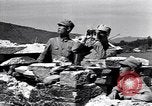
Chinese Nationalist Kuomintang (KMT) forces enter town of Teng-Chung, Yunnan Province, China (WW2)
Nationalist Chinese Kuomintang (KMT) troops attacking Japanese-held Teng-Chung (also Tengchong or Tengchung), a city in Yunnan province, on the Burmese border, during World War II. A Chinese Captain, watches through binoculars, as his infantry leave trenches and advance toward a hilltop fortification. Shells burst near the summit and around the advancing troops, who carry poles and ladders. Upon reaching the outer walls they use the ladders to scale them and enter the fortification. Later, KMT soldiers are seen sheltering against buildings as the town is struck by Japanese shellfire. They run forward. A KMT soldier employs a flame thrower. They run past barricades and burning vehicles, toward a damaged building. Two riflemen take up prone positions, as the soldier with the flame thrower passes in front of them. The infantrymen crawl forward cautiously.
Chinese troops waiting near loading point in Yunnanyi, China.
Chinese troops of the 200th Div, fifth army, waiting in revetment near loading point. Troop soldiers sitting and lying on the ground. Close view of few soldiers. Troops march toward loading point. Soldiers pose holding flag. Close view of soldier with gun. A military transport aircraft C-47 can be seen in background. (World War II period).
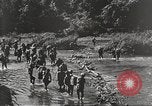
Preparation of parachute supplies to be dropped at observation posts in jungles of the China India Burma Theater.
A film titled 'Aerial supply to Burmese outposts' based on establishing and supplying observation posts of the Allies in jungles of Assam-Burma frontier during World War II. Native workers carry equipment and cross a river followed by U.S. soldiers. Troops reach a camp site and native workers are paid off by a soldier. Shacks are being built by a native labor. U.S. soldiers at camps in forward post bathing and shaving. Once the observation post is set up, the soldiers climb up a lookout post ladder on the top of which a warning system is maintained. Native laborers make baskets at a supply post which will be used as containers for parachute supplies dropped. Ration crates are being brought at an airfield depot from a quarter master depot for shipment. The crates are weighed and the containers are packed with straw. Parachutes are attached and the containers are ready for shipment. The material is taken to a U.S. Army Air Force C-47 Skytrain transport airplane and is loaded aboard. The pilot is briefed at a map which indicates the locations of the camps where the supplies are to be dropped.
A U.S. Army Air Force C-47 Skytrain drops parachute supplies at observation posts in jungles of China India Burma Theater.
A film based on supplying observation posts of the Allies in jungles of Assam-Burma frontier during World War II. U.S. soldiers on a lookout post in trees. U.S. troops wait for the supplies to be dropped by a U.S. Army Air Force C-47 Skytrain airplane. Native people look through binoculars. Signal crew lays a strip of white cloth. A man gives smoke signals. The C-47 lowers the altitude and drops parachute supplies. The airplane circles the area and more containers are released. Crates are gathered by men and supplies are taken to camps. The C-47 repeats the same procedure at the second and the third camp site.