


 Francais
 Deutsch
 Italiano
Refine Your Search
+"China" +1944 stock footage and images
- Showing 73 to 78 of 115 results more
more Hide
Hide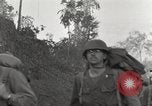
United States 1st Battalion passes along the Ledo Road in the China-Burma-India Theater of World War II.
U.S. 5307th Composite Unit en route to Burma. U.S. 1st Battalion near Hell's Gate lead pack mules over the Ledo Road. Soldiers pass a sign board which reads: 'God be with you', 'Welcome to Borderville' and 'Pangsau pass'. Brigadier General Frank Merrill watches the troops crossing into Burma.

U.S. wartime propaganda film - Japanese people toil in industry and at warfare unified to help Japan win World War II.
United States anti-Japanese propaganda war film about Japan and its people, and its intentions in World War 2. A White actor narrator impersonates a Japanese man, enforcing negative stereotypes and mocking Americans. “You’ve learned that the Japanese do not show their feelings, nor do I have big teeth and thick glasses- how sad to disillusion you” the narrator mocked. Japanese people work to help Japan win war. Japanese people work on a farm. People row in boats on a lake facing Mount Fuji. Snow-capped Mount Fuji. Volcanic explosion. Japanese soldiers seize the United States flag. Japanese flag flying. Sacred fishes in a pool. Soldiers hold Japanese flags as they cheer Banzai in a victory celebration after battle. Modern buildings in a Japanese city. High altitude view of buildings in an area. Bombardment in a city. Destroyed houses, buildings, and rubble on the ground of Japanese cities. United States warplane aircraft fly in formation. Aerial view of a Japanese city. People walk on the street. Vehicles pass on street. Ship 'Argentina Maru' docked at a Japanese harbor. People sow rice seeds on the farm. Narrator (actor impersonating a Japanese person) mocks Americans as being soft. View in an American town of cars parked along the sides of a main street. American 1940's cars. Jockey's Ball banner. People queue at theater box office and in train stations. United States nightclubs, bars, and casinos. United States people at beach. Japanese industry and munitions factories. Ships underway at sea. United States Marines carry a dead soldier on stretcher. United States Marines coming ashore and Japanese soldiers fighting in Pacific islands such as Guadalcanal and Tarawa. Forces of both sides fire guns and artillery. Smoke from bombardment. Ragged Japanese forces surrendering to United States forces. Japan's best forces shown marching in formation and review. Young Japanese soldiers in training. Japanese children study in a school. Burning Japanese city following attack. Japanese citizen refugees flee, a woman crawls across a railroad track. Japanese girls and boys exercise simultaneously outdoors. Japanese soldiers execute two men (possibly in China?). Prisoners held by Japan in forced labor; others executed. Japanese soldier puts his hat on a little girl, other children playing. Remains of a newborn infant wrapped in cloth lying on the street. Forced laborers from Japanese-occupied countries are made to farm rice. Remains of victims of Japanese forces. Heads of decapitated victims lying on the field. United States prisoners emaciated and injured in the Philippines. A United States soldier wipes his tears after losing an arm. Remains of United States troops, Japanese soldiers, and Asia civilians. Japanese soldiers deploy for war at train station. Map showing Japan, China, Manchuria, and Mongolia. A Type 3 Chi-Nu tank rolling up a fortress in China. Soldiers marching on rice fields and climbing rocky cliffs. Japanese soldiers assume prone position, firing rifles.
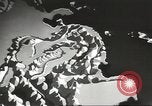
Allied planning for the final invasion of Japan in World War II
Scene opens with a map illustrating one possible Allied path for invasion of Japan. It proceeds from India and Burma to China and thence to Japan. A U.S. B-24 bomber is seen landing at a Far East Air field. Next, the Supreme Allied Commander of South-East Command (SEAC) Admiral Lord Mountbatten, is seen posing with Chinese General Li Zongren (AKA Li Tsung-jen) and other high ranking Chinese officers, and then walking with them. Next are views of U.S. General Joseph Stillwell working with staff as they consult maps. Then, Chinese laborers are seen engaged in construction of a bridge over a riverbed, that is to be part of the "Ledo Road,"traversing Burma and providing a highway from India to Chunking, China. Trucks moving over the already completed segments of the road, carry men and war materiel. One truck passes a local native drawing water from a well using a long counterbalanced pole. At the frontier of the roadbuilding, Chinese soldiers chop their way through dense jungles and battle Japanese forces firing at them. A fallen soldier. Allied soldiers shouting as run into a village engaging Japanese forces. Structures in the village burning and spreading in the area. Scene shifts abruptly to an animated map illustrating what are believed to be the Japanese plan for its last desparate defense. It shows them falling back to highly defensible boundaries encompassing sources of supplies needed to sustain their defense. Aerial views of Manchurian landscape. Japanese officials are seen at their administrative offices in Manchuria. Large numbers of Manchurian workers are seen headed to work near a factory. Others are engaged in open pit mining, where explosives are used to expose and ready ores for extraction. Views inside a Manchurian steel plant supporting the Japanese war effort. Japanese military forces are shown moving by horseback in the area, ostensibly to push further into China and add more protection against potential Allied offensives. Likewise, Japanese warships are shown at sea maneuvering to defensive locations. This is all summed up in a map showing the expected disposition and status of military defensives for Japan's final defense (Fortress Japan). Street traffic on a city street in Japan. A large group of Japanese women in traditional dress, carry banners and quietly bow. View of the Japanese Diet Building (Parliament) and political and Military leaders inside, including Prime Minister Tojo, Hideki.
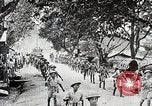
Chinese and American troops battle Japanese forces as they proceed along the Ledo road in the China-Burma-India theater of operations in World War II
On Christmas Eve, 1943,during World War 2, the Chinese 38th and 22nd Divisions are seen marching along a road toward North Burma. A regiment of Merrill's Marauders is seen joining the march from India through Burma. (Narrator says they will engage the Japanese 18th Division.) Along the line of march a road sign reads,"Shinbwiyang, Mile 110." Numerous views of troops struggling through jungles and natural obstacles. They employ pack animals that sometimes had difficulty in rough terrain. Animated map shows the route from Ledo, Assam, India, to the places of Chinese and American engagement with Japanese forces, in the Hukawng Valley. U.S. troops are seen moving under fire from Japanese enemy during active combat and returning fire with rifles, Browning M 1917, and M 1919 machine guns. Some of Merrill's Marauders wear standard M1 steel combat helmets, while others wear older M1917A1 "Kelly" helmets. One is seen firing a Bren gun with top-mounted curved box magazine. Others fire mortars. Chinese troops seen firing small artillery pieces. M3A3 Stuart light tanks of the joint Chinese-American 1st Provisional Tank Group (1st PTG) are seen with infantry walking behind them. Next, Allied casualties on litters are seen being placed in an ambulance. Numerous wounded are seen on the ground. Chinese troops carry a wounded on a litter. Views of Japanese soldiers being burned out of their hiding places by Chinese troops. Numerous views of dead Japanese soldiers. Scene shifts to air support by U.S. Army Air transport command providing aerial resupply from C-47 transport aircraft. C-47 aircraft seen flying over jungles. Monitors at a headquarters location are seen charting the changing positions of the Allied troops on the ground. View in a warehouse where air drop ready supplies are stored. Numerous views of supplies of all kinds being readied for air drop, including mail for the troops. Shipments being loaded aboard a transport airplane. C-47 airplane taxiing out after loading. Troops on the ground in radio contact with a transport plane. A long sequence ensues showing aerial resupply air drops from C-47 transport planes. After that, medical personnel are seen on the ground providing care to seriously wounded under difficult circumstances. Closeup of a surgeon tending to a patient. Many wounded seen on the ground awaiting attention and others in tents. A wounded on litters are transferred from an ambulance to an airplane. A woman nurse with other medics transferring patients. View inside an airplane set up for air evacuation. A nurse gives a wounded patient some water to drink. At a location unreachable by larger transport airplanes, a wounded soldier is placed aboard a single engine Stinson L-5 Sentinel liaison airplane which is then seen taking off and flying away. Animated map shows progress of Chinese troops on the Ledo road.
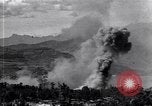
The Salween Campaign against Japanese forces in Yunnan Province, during World War II
The Nationalist Chinese Salween Campaign against Japanese forces in Western Yunnan Province, during World War 2. Kuomintang (KMT) Chinese Air Force airplanes drop bombs on Japanese positions in valley near Salween River. U.S.Army Air Forces C-47 aircraft of the Air Transport Command's India-China Wing, airdrop military supplies to elements of the KMT army. U.S. military advisors (plus two pet dogs) help the Chinese to retrieve the airdropped supplies. They load mortar tubes and munitions on the shoulders of Chinese soldiers, who are also seen fastening loads on the backs of mules. The Chinese troops transport the supplies up winding mountainous paths into a destroyed town.
USAAF XX Bomber Command B-29s attack Japanese positions on Formosa in World War II
U.S. Army Air Forces XX Bomber Command Operations during World War 2. A Boeing B-29-10-BW Superfortress, number 42-6347, named "King Size," of the 462nd Bombardment Group, 769th Bombardment Squadron. It is seen here, at their forward operating base on Kiunglai Airfield, China. Tents are seen near the flight line. Numerous bombs are lined up on the ground ready to be loaded aboard the bomber. A B-29 taking off at nightfall. A formation of B-29s in flight. Bombs being dropped over Japanese installations at Hatto, Formosa (aka Taiwan). View of B-29 landing after the mission. (Note. Formosa was a Japanese colonial territory from 1895 to 1945.)