


 Francais
 Deutsch
 Italiano
Refine Your Search
+"England" +1944 stock footage and images
- Showing 301 to 306 of 413 results more
more Hide
Hide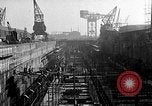
Construction of concrete caisson for use in building "mulberry" harbor for ships supplying Allies in Normandy invasion
Construction of a concrete Caisson at Portsmouth harbor in England. These wartime project "Phoenix" caissons, were to be used to form instant breakwaters for the invasion Harbors (code-named "Mulberry" harbors). Men work at the construction site with cranes in background. A man on the deck of a ship, with a pair of binoculars around his neck. (World War II period).
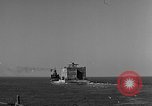
Concrete caisson being towed in English waters, off Portsmouth, during world War 2
A wartime project "Phoenix" concrete caisson being towed in water off Portsmouth harbor in England. British military personnel aboard the caisson. The caisson is identified as "A 30" indicating it is destined to be part of an artificial harbor (code-named "Mulberry") at Omaha beach in the Normandy invasion of World War II. An antiaircraft gun is mounted on a platform at the top of the caisson. Royal engineers turn valves to allow water to enter interior chambers of the caisson, where the water level rises to 23 feet. British troops take up positions on the superstructure of the caisson.
U.S. soldiers aboard a Landing Ship Tank and aboard a LCI(L) preparing for the invasion of France in World War II
American troops preparing for the invasion of Europe during World War 2. United States Army soldiers on board an LST (Landing Ship Tank) docked in England, three days before D-Day. (Slate month is wrong.) Soldiers eat C rations on the deck of LST. They rinse their mess kits in hot water. Several soldiers assigned kitchen police duties wear helmets displaying "KP." Soldiers sit along gunwales of Landing Craft Infantry LCI(L) number 88. (This craft is one of five that will land on Omaha Beach on D-Day, as part of Assault Group O-1, Commanded overall by Captain Fritzche, U.S. Coast Guard. The LCI(L) 88 belongs to Flotilla 10, and is commanded by Lt. Henry K. Rigg, USCGR)
Four U.S. Coast Guardsmen share cigarettes and showoff their weird haircuts, three days before D-Day in World War II
United States forces preparing for the invasion of Normandy, France, during World War 2. Four United States Coast Guardsmen sit cross-legged and smoke cigarettes, on board a landing craft docked in England, three days before D-Day. A life raft in the background. They simultaneously take off their hats and lower their heads to reveal radical haircuts that collectively spell "HELL."
U.S. troops preparing for invasion of France in World War II. Coast Guardsmen explain operation of 20mm gun
U.S. Army troops preparing, three days before the invasion of Normandy, France during World War II. Several Army soldiers watch as several Coast Guardsmen explain operation of 20mm antiaircraft gun aboard a Landing Craft Infantry LCI(L), docked at a pier in England.
USS Bayfield (APA-33) loading equipment and troops during preparations for the invasion of Normandy during World War 2.
USS Bayfield (APA-33) anchored off Plymouth England to load troops and equipment of the 8th Infantry Regiment (U.S. 4th Infantry Division) and the 87th Chemical Battalion. Cargo net being lowered into a Higgins Boat, LCVP ( Landing Craft Vehicle Personnel) alongside. Crew on the boat secure cargo in net. Several crew aboard the ship look over the rail of the ship. The cargo net being hoisted aboard the ship. Another Higgins boat arriving filled with combat troops. U.S. sailors remove the cargo net and unload two wheeled carts holding ordnance. One of the ship's landing craft can be seen on deck, bearing the number PA33-25. Crewmen work on cargo nets. One uses a wooden taper pin. Ttroops of the 87th Chemical Battalion begin boarding, carrying their special equipment. Coast Guard officer on deck . Several British vessels are seen in the water. Low hills in background.