


 Francais
 Deutsch
 Italiano
Refine Your Search
+"England United Kingdom" +1944 stock footage and images
- Showing 1 to 6 of 193 results more
more Hide
Hide
Ground and air crew of Allied aircraft work to bomb German held territory in France and Netherlands in Spring of 1944 during World War 2.
Allies bomb Nazi targets in France and Netherlands during World War II. An animated map shows France and Germany. Allied squadrons move towards the bombers. Martin B-26 Marauder aircraft taxi and take off from a British airfield in England, United Kingdom. Interior cockpit view of a B-26 A pilot in the cockpit as he puts on a steel combat helmet and wears a steel jacket. A formation of bombers drops bombs on a Nazi German controlled airfield in Holland. Ground crew watches as a bomber comes in for landing. An aircraft sends off flares shortly before landing, indicating to ground crews that there are wounded soldiers on board. The bomber lands on its belly. Ground crew moves towards the bomber. A row of bombers. Crew members work on the bomber. Multiple shots of more bomber aircraft as they take off (some shots from the side, and some with the aircraft approaching the camera position). View of bombs attached to the bomber with bomb bay open. Bombs away view as bomb clusters are released through open aircraft bomb bay doors. Bombs dropped on Nazi installations in France. Aerial view of explosions on the ground.
Montage of scenes related to role of 101st and 82nd Airborne Divisions and 9th Troop Carrier Command before D-day, World War II
U.S. soldiers wade ashore at Omaha Fox Green Beach on D-Day, from landing craft of USS Samuel Chase (APA 25). during the Invasion of France. Preparations for invasion underway in an idyllic village in England, United Kingdom on June 5, 1944. U.S. Army Air Force C-47 aircraft towing a Waco CG-4 glider over shelters made of wooden shipping containers. "Shanty Town" written atop one tall structure. Glider being pulled out a shipping container. Soldiers moving into empty shipping container. Glimpse of their homemade barrack. Soldiers eating a meal inside a shipping container shelter. Soldiers at barber shop. German defenses of the Atlantic Wall on the French coast. German Army gun crews drilling. German rail gun. Animated map of German fortifications of the Atlantic Wall. Allied officers, including U.S. Major General Lewis Hyde Brereton, Commander, 9th Air Force and British Air Marshal Arthur Coningham, Commander, 2nd Tactical Air Force, in D-day planning. Airborne troops board buses and arrive at restricted airfields. Troops playing musical instruments in jazz band; exercising on field; and playing volleyball. Paratroopers reading mail. Airmen painting invasion stripes for D-day on C-47 aircraft. French francs issued to paratroopers. Soldiers sharpen knives and bayonets. Chaplains conduct religious services. General Dwight D. Eisenhower visiting 101st Airborne troopers. Airborne Pathfinders. Paratroopers march to C-47s, and put on parachute packs. Troopers of the 101st Airborne, 506th Parachute Infantry Regiment, Headquarters Company Demolition Section ("Filthy 13") in their Mohawk Indian haircuts. Clarence Ware puts war paint on Charles Plaudo, using still-wet paint from their C-47's D-day stripes. Heavily laden paratrooper help one another board airplanes. Pathfinder C-47s taking off at dusk, followed by all others, on June 5, 1944. formations of C-47s. Closeup of several planes. Paratroopers exiting C-47s. Formation of towed gliders. Gliders landing in field. Troops from gliders engaging in fire fights. Naval gun barrage.

Robot bomb damage in England; launching sites and wide gauge tracks for transporting bombs in Cherbourg, France (WWII)
U.S. Army 9th Air Force North American P-51 Mustang fighters in flight and tracking a V-1 Flying bomb to shoot it down over Southern England, United Kingdom, during World War II. Crowds inspect damage caused by V1 flying bombs and V2 rockets, also known as “robot bombs.” A crater formed by a German robot bomb. A U.S. Army soldier collects fragments while inspecting the bottom of the bomb crater. British and American soldiers and British civilians inspect the damage. Aerial and ground views of an unfinished German V-1 and V-2 launch site on the Cherbourg Peninsula in Normandy, France after its capture by Allied forces. The main rocket ramp is seen on the launch site. A crane at the unfinished launch site. A concrete strip under construction. An unfinished section at the Cherbourg rocket launch site. The rich concrete mixture used in the construction of the massive installation is reinforced by lattice-type steel rods (half inch thick woven in squares). Unfinished and destroyed platforms from 29 rocket launch installations made by German forces at Cherbourg before the Normandy landings. Large solid underground structures intended as showrooms for shells and equipment. Unfinished or damaged narrow-gauge railroad used for supplies and construction. Carts are seen on the railroad. Netting laced with metal leaves to prevent fading is used for camouflage. A soldier arranges green coverings outside a bunker. A man stands on a crater. Wide gauge tracks to bring bombs to the platform. Some parts of the installation are bombed by Allied bombers.
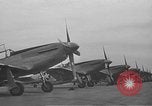
P-51 Mustangs and B-17 Flying Fortress planes attack German aircraft plants during World War II.
U.S. Army Air Force bombers attack Germany during World War II. View of U.S. P-51 Mustang aircraft in flight line at U.S. Air Base in England, United Kingdom. Aerial views of a formation of B-17 Flying Fortress planes and P-51 aircraft in flight over Germany. Bombs fall on German aircraft plants. Ruins of German aircraft plants after facing the bombings. Scene changes to show German war production workers building new Focke-Wulf aircraft (e.g., Fw 190) at production factory in Germany.
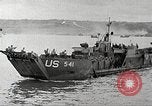
German prisoners of war leave Normandy en route to the U.S.A. , via England, in World War II
German prisoners of war in Normandy, during World War 2. LCI(L) 541 is seen departing from Omaha beach, filled with German prisoners of war. Scene shifts to a pier in England, United Kingdom, where the German soldiers and officers are boarding an American Coast Guard troop ship, for transport to Prisoner of War centers in the United States. Aerial view of an ocean liner, converted to a troop ship, underway. Views of German POWs on a ship's deck.
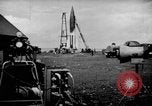
Launch of German V-2 rockets; a V-2 explodes in the launching pit at Peenemunde, Usedom island, Germany; V-2 destruction in England
Launching of German V2 rockets (guided missiles) from Peenemunde, Usedom island, Germany, during World War 2. German V-2 in launching position, technicians and equipment in area are preparing to launch the missile. Two civilian technicians and a uniformed German military officer walk across launch area toward V-2 rocket. Workers and technicians gathered around the V-2 base. The missile about to be launched. Smoke emitted from the exhaust section. Launching of V-2. Launching pit at Peenemunde showing a V-2 prior to launching. Rocket engine starts, rocket begins to rise slightly, and then the V2 rocket topples over and explodes in the launching pit. Another scene showing the successful launching of a German V-2 guided ballistic missile. Brief view of a street in England showing results of a V-2 impact on surrounding buildings. Scene of devastation and rubble from V-2 rocket explosion. Two British boys hand a chair to one another across rubble. Another V-2 impact site in England, United Kingdom, showing a row of houses with one or two completely destroyed a rocket.