


 Francais
 Deutsch
 Italiano

Refine Your Search
+"England United Kingdom" +1944 stock footage and images
- Showing 7 to 12 of 198 results more
 Hide
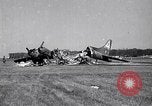
Wreckage of crashed B-17 aircraft at an Air Force base in England.
Remains of B-17, tail number 42-37789, which crashed during a post -maintenance test flight on April 24, 1944, at Grafton Underwood Airfield in Northampshire, England. The Aircraft belonged to the 544 Bomb Squadron of the 384th Bomb Group and was flown by Lieutenant Colonel Alfred Nuttall, who survived the crash and went on to lead a number of bombing missions thereafter. The aircraft was destroyed by fire that ensued after the crash. Firefighting foam residue can be seen covering the wreckage. This scene was filmed on April 29, 1944, five days after the crash. (World War II period).
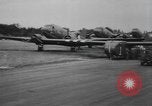
U.S. Paratroopers preparing, and then departing from England, to airdrop over Normandy during World War II
An airfield in England, filled with Waco CG-4A Gliders and their C-47 tow planes, in readiness for the invasion of Normandy, France, in World War 2. U.S. Army Air Forces intelligence officer briefing C-47 and Glider pilots and crews about conditions expected in the drop zones of Normandy before D-Day in World War 2. Brigadier General James Gavin,Commander of the 82nd Airborne Division, giving a final briefing to his paratroopers. A military chaplain holding final religious services for troops. General Dwight D. Eisenhower, visiting paratroopers of the 101st Airborne Division, as they prepare to depart on the night of June 5, 1944. U.S.Army paratroopers boarding their C-47 aircraft to depart for Normandy on June 5, 1944. Several are seen tying parapacks of heavy equipment to the aircraft for separate release. Paratroopers of 101st Airborne Division, loading equipment aboard a CG-4A Glider, and getting final briefing from their pilot. Other 101st Airborne troopers don personal equipment on the ramp near their C-47 airplane, which displays paint-striped wings and fuselage. Jumpmaster makes final check of his troopers. The paratroopers boarding their aircraft with heavy loads of equipment. C-47 aircraft take off towing their gliders.
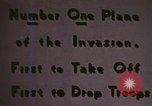
The first U.S. C-47 aircraft (and its crew) to drop Pathfinder Paratroopers on D-day eve in World War II.
U.S. Army Air Forces C-47aircraft , number 42-93098, of the 9th Troop Carrier Command Pathfinder Group, and its crew. This is the first aircraft and crew to drop American paratroopers (pathfinders) over France during the Allied invasion, in World War 2. The aircraft taxis on a British airfield. Crew of the aircraft are seen in front of it, including pilot, Lieutenant Colonel Joel Crouch, Copilot, Captain Vito Pedone, Navigator, Captain William Culp, Radio Operator, Harold Coonrod, along with two crew chiefs. Crew members shake hands and board the aircraft. Colonel Crouch waves from the cockpit of the C-47 (but has not started engines). Major J.L. Sweetman boards another aircraft. Colonel Crouche's C-47 taxis to where the Pathfinders will load up. View of Control Tower at RAF North Witham, with ambulance parked outside it. Three hours before takeoff.Colonel Crouch, is seen on a path near the airfield, with a Pathfinder Captain and Lieutenant, who will be aboard his aircraft and be the first to jump into France. They kid around. The Pathfinder officers note that Colonel Crouch wears paratroop wings. Later, two Pathfinders, of the 101st Airborne Division , with camouflaged faces and American flag insignia on their right shoulders, step from woods and pose momentarily. Pathfinder Paratroopers line up to board C-47 aircraft as Lt. Col. Crouch rides a scooter at the airfield. Aircrews and Pathfinders pose for photographs before taking off. The lead aircraft, number 42-93098, with Lieutenant Colonel Crouch at the controls, takes off from RAF Station North Witham at 9:54 PM, on June 5, 1944. to begin the invasion of France. (Note: This C-47 was shot down on September 18, 1944, during Operation Market Garden, and crash landed on Haamstede Airbase, Netherlands. Although shot at by German troops on the ground, pilot, Maj Joseph A. Beck, and Navigator Lt. Vincent J. Paterno, survived as prisoners of war. Copilot Capt Fred O. Lorimer and another crew member were fatally shot.)
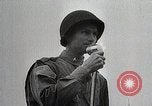
U.S. Paratroopers of 82nd and 101st Airborne divisions preparing to depart England the day before D-day in World War II
Film begins showing Brigadier General James M. Gavin, Commander of the Force A (parachute) contingent of the 82nd Airborne Division, standing on the hood of a jeep, at an airfield, to brief his paratroopers as they prepare for the D-Day invasion, during World War 2. A C-47 transport plane taxis behind the assembled group of troopers. Barbed wire is strung in the foreground. Paratroopers are issued French currency before departure. Some gamble with it using dice. Troops are seen playing volleyball on a field surrounded by trees. On an airfield, one trooper hits ground balls with a soft ball and several others field it. Some other troopers sit in grass next to the ramp, assembling wooden containers for airdrop. Two Army Air Forces mechanics fasten a tow bar on the nose wheel of a British-built Horsa Mk.II glider. They then tow it with a tug. View from above of Horsa gliders and C-47 tow airplanes, all in D-Day paint stripes, lined up on an airfield ramp. Paratrooper tent camp is viewed from above. Then, General Dwight D. Eisenhower and other senior officers are seen visiting paratroopers of the 101st Airborne Division, at the camp, on June 5, 1944, as they prepare to board their aircraft. Famous closeup of General Eisenhower speaking to a tall paratrooper who has his face camouflaged with grease paint.View looking down, as Eisenhower circulates among the troopers. Closeup of him conversing with another one directly.
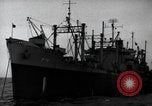
Exercise Fabius I, U.S. amphibious forces prepare for the invasion of Normandy in World War II.
U.S. military preparations for the invasion of France in 1944 during World War 2. Footage focuses on transport ships and landing craft practice amphibious operations with American troops of the 16th Infantry Regiment. Film begins showing closeup of the American transport ship, USS Anne Arundel (AP-76) anchored off shore at Slapton Sands, England. A landing ship (LCI-590) passes by her and several Higgins boats maneuver in waters nearby. Stern view of the Anne Arundel from an LCI. Closeup of an LCI pulling up next to the transport ship. Next, troops of the 16th Infantry Regiment are seen descending rope net from the transport ship and boarding the LCI. Closeup from the LCI of the troops reaching the deck of the LCI and walking forward. The number on the LCI is "88." Several views from different angles of the troops descending the rope net from the transport ship. View of the USS Anne Arundel with Higgins boats moving all around her. Closeup of LCI moving away from a transport ship. More views of troops descending from a transport ship to a Landing Craft Infantry. View from an LCI headed for the beach, where many troops have already landed. The LCI continues and beaches. Troops and various exercise markers are seen in the background Troops leave the LCI via her side ramps and join many others already ashore.
American troops in England, rehearse for the amphibious invasion of Normandy, France during World War II.
American troops rehearse amphibious landings at Slapton Sands, England in January, 1944, before the invasion of Normandy, France, in World War 2. American soldiers descend from a troop transport ship and board a Landing Craft Tank (LCT 504) that takes them toward the beach. A group of Higgins Boats is seen maneuvering in the water. Their troop transport ship is seen further offshore. Next, a Higgins Boat full of soldiers is silhouetted against the sky and the sun shining on the water. Closeup of Coast Guardsman at the tiller of the boat. Scene changes to a view from the beach as a Higgins Boat, from Transport ship, USS Samuel Chase (APA-26) hits the beach, drops its front door ramp, and soldiers rush ashore. Complete change of scene shows American troops, carrying full battle gear, coming up a gang plank to a large established port terminal, where they go up another gangplank to board a large transport ship.