


 Francais
 Deutsch
 Italiano
Refine Your Search
+"England United Kingdom" +1944 stock footage and images
- Showing 103 to 108 of 193 results more
more Hide
Hide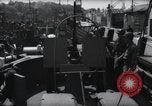
U.S. soldiers talk with Coast Guard gun crew about their 20 mm antiaircraft gun, aboard LCI(L) docked in England before D-Day
A U.S. Coast Guard gun crew near a 20 mm antiaircraft gun aboard a Landing Craft Infantry LCI(L) docked at Weymouth, England, 3 days before D-Day. U.S. troops ask questions about the gun. (World War II period).
U.S. Military Chaplain (Roman Catholic) conducts mass on pier in Weymouth harbor, England, 3 days before D-Day
U.S. troops and Coast Guardsmen assemble for religious service on a pier in the port of Weymouth, England, three days before the invasion of Normandy, France, in World War 2. A Roman Catholic Military Chaplain conducts the mass. Landing Craft Infantry LCI(L) numbers 89 and 93 are tied up at the dock in the background. (These craft are part of LCI(L) Floltilla 10, operated by the United States Coast Guard.) A small dog stands at the feet of the Chaplain, as he conducts the mass. The service finishes as the Chaplain administers the sacrament of Holy Communion (Eucharist) to the troops. In concluding scenes, U.S. Landing Craft Infantry are seen underway from England, to join Assault Groups for the invasion of Normandy, France. One of the craft is seen to be Number 87 and another number 495.
Views from Landing Craft Infantry LCI(L) number 88, as she departs England for the invasion of Normandy, France in World War II
View toward stern of Landing Craft Infantry LCI(L) 88 as she pulls away from the wharf at Weymouth, England, to join an amphibious assault Group destined for Omaha Beach, Normandy, France, in World War 2. Other LCI(L)s seen preparing, or underway, include numbers 488, 493, 497, and 498. Number 88, from which these scenes were recorded, belongs to Flotilla 10, part of an Assault Group operated by the U.S. Coast Guard, and is commanded by Lt. Henry K. Rigg, USCGR
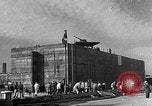
Tugs pull floating concrete caisson at Portsmouth harbor, England
Testing of concrete Mulberry Caisson at Portsmouth harbor in England. A warehouse and a Caisson at the dock. Sailors and Chief )Project Officers ( CPOs) work on hausers, climb ladder and secure cable hausers. A tug tows the Caisson from the dock. These structures had the code name Phoenix
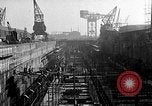
Construction of concrete caisson for use in building "mulberry" harbor for ships supplying Allies in Normandy invasion
Construction of a concrete Caisson at Portsmouth harbor in England. These wartime project "Phoenix" caissons, were to be used to form instant breakwaters for the invasion Harbors (code-named "Mulberry" harbors). Men work at the construction site with cranes in background. A man on the deck of a ship, with a pair of binoculars around his neck. (World War II period).
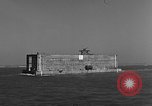
Tugboat tows a concrete caisson in coastal waters of England
A concrete caisson being towed by a tugboat off Portsmouth in England. This is one of the wartime project "Phoenix" caissons to be used in building instant harbors (code-named "Mulberry harbors") for Allied ships supporting the Normandy invasion in World War II. A truck can be seen on the caisson, as well as an antiaircraft gun mounted on a platform at the top of the caisson.