


 Francais
 Deutsch
 Italiano

Refine Your Search
+"England United Kingdom" +1944 stock footage and images
- Showing 151 to 156 of 198 results more
 Hide

Political advisors of the Jewish Agency for Palestine in a meeting in London during the Zionist Movement of World War II.
The Zionist Movement in England during World War II. The exterior of Jewish Agency for Palestine. People enter and leave the building. Inscription in Hebrew on a board in the Agency. The inscription reads 'Zionist Organization'. Political advisors of the Jewish Agency for Palestine in a meeting. Doctor Waismann, Mrs Dugdale (niece of the Lord Balfour), J Linton, Berl Locker, Professor Brodetsky and Professor Namier in a meeting preceded by Doctor Chaineizmann. Dignitaries converse with each other at the table. Doctor Weizmann shows position of Jewish settlement on the map of Palestine.
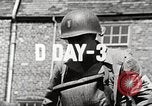
U.S. troops are ferried from Weymouth England, to transport ships in preparation for Normandy invasion in World War II
U.S. army troops board LCVPs (Landing Craft, Vehicle, Personnel) at pier in Weymouth, England, to be ferried out to transport ships anchored offshore, in preparation for the D-Day invasion of Normandy, France, during World War 2. Several large Landing Craft Infantry are seen tied up at the docks, including LCI(L) numbers 84 and 49. Views of Higgins Boats (LCVPs) heading out. Markings on one identify it as belonging to the Attack Transport ship USS Charles Carroll (APA-28). The Higgins Boats come alongside the USS Charles Carroll and troops of the U.S. 29th Infantry Division board her.

Men, women and children in the underground shelters built to protect them against German attack, in London during World War II.
A film on the underground shelters in London against German attack by rocket buzz bomb ( V-1 flying bomb during World War II). British men, women and children evacuated to the underground shelters built to protect the people against German attack. The canteen in the shelter or bunker. Women drinking from cups. People in the canteen taking food. Men behind counters. A woman with a child. A doctor in an underground shelter attending to a child, mindful of infectious disease risk among the people in close quarters. People sleeping on beds in the shelter. A group of children singing with a boy playing the accordion. A woman feeding her child from a bottle.
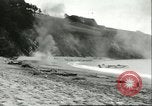
British and American troops practice amphibious assaults at a beach near Dartmouth, England
Allied troops practice amphibious landing at Blackpool Sands, a beach near Dartmouth, Devon, England during World War II. Smoke on the beach. Landing Craft Vehicles (LCVs) beached at the coast. British and American soldiers on the beach. Allied officers watch amphibious landing practice. A radio operator with equipment. A pole mounted loudspeaker is dug in on the beach as the operator observes the advancing troops. American soldiers with helmets and packs pour out of LCV boats and advance across the beach. Some soldiers hit the ground as shells explode near the beach. The soldiers advance on the beach. They crawl.
American troops practice amphibious assault landings near Dartmouth, England, during World War II.
Allied troops practice amphibious landings at Blackpool Sands beach, close to Slapton Sands, near Dartmouth, England, during World War 2. Landing craft underway at sea head beachwards. The craft arrive at the beach and American soldiers debark. Another group of landing craft arrive at the beach. U.S. troops near the landing craft. Ships underway at sea.
U.S. Army Rangers board British landing craft in Weymouth, England during World War II
Pre-invasion activities of United States Army Rangers (2nd Battalion) in Weymouth, England during World War 2. The Rangers eating doughnuts (donuts) and drinking coffee. They march along Weymouth Esplanade to an embarkation area. Royal Hotel Weymouth and St. John's Church seen in the background. They are checked as they move past the pier. The rangers get into British Landing Craft Assault (LCA) at the pier. (The officer seen with a white bar on front of his M1 helmet, is First Lieutenant Robert T. Edlin, who was the first American soldier to board a Landing craft at Weymouth for the Invasion of Europe.) LCAs underway at harbor en route to a transport. An LCA filled with troops.