


 Francais
 Deutsch
 Italiano

Refine Your Search
+"England United Kingdom" +1944 stock footage and images
- Showing 187 to 192 of 198 results more
 Hide
Stockpiles of Allied invasion materials at various supply depots in England during World War 2, including at Burtonwood, England.
Stockpiles of Pierced Steel Planking (PSP), also called Marsden matting at Burtonwood supply and repair depot, the largest depot in the world during WW2. Dozens of tractors, trucks, and other military vehicles parked in neat rows. Assorted rolls of metal meshes, platforms, wiring, and cable. A crane in action lifting supplies, teams of men working to organize, stock, and inspect the materials. Numerous shots of men at work, supplies such as fuel barrels, small boats, and tractors. Aircraft including American and British gliders, P-47 Thunderbolt, A-20 Havoc, P-38 Lightning, B-17 Flying Fortress, and B-26 Marauder. Engineering equipment at a British depot in Thatcham, England. Additional scenes of men at work in the depots.
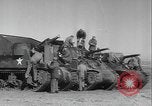
Armored vehicles undergo waterproofing and testing in Bideford, England.
U.S. Army soldiers waterproof U.S. tanks and military vehicles by hand during World War 2. Close up shots of men applying putty to seal the vehicles. Tanks with deep wading exhaust trunks, also called "breathers," are tested and driven in water. The wading snorkels are released off the back of an M4 Sherman tank and M10 tank destroyer as the tanks begin to drive on land.

War correspondents approach the docks on the South England coast, preparing for D-Day invasion in World War II
War correspondents covering World War 2, prepare for the D-Day Invasion. U.S. soldiers in military jeeps, ready to be boarded onto Landing Crafts, approach the dock area in South England. Soldiers on the road. Bars on the jeep bumpers designed to cut wires put up across the roads by Germans. A war correspondent sits with baggage on the road. A dog nearby. An American and a British soldier man a Control Post. They check a correspondent's baggage and bedding. Wes Hanes seated on the baggage. Pete Carroll of Boston, photographer for the Associated Press, smokes a cigarette. Behind him is a sign for the Salmon Leap Public House. They eat K-rations. Hanes on the riverside with a small castle in the background seen through the arch under the bridge. Pete Carroll stepping on stones near the river bank after washing his hands in the river.

U.S. forces loading on ships in England for the invasion of Normandy in World War II
A man with a pair of binoculars observes something in background while on board a United States ship in Portland Head, England. A half track vehicle being loaded on a landing barge. Soldiers and sailors on deck of a landing barge. Three American soldiers clean weapons aboard a landing craft at the pier. Truck is raised to the deck by elevator. M4 High speed tractor with soldiers atop pulls a 90mm Anti-aircraft gun on the dock and boards the landing ship, tank. Sailors and others are seen seated at the bow of the vessel.

American troops in Falmouth England before D-Day during World War II.
U.S. troops in England during World War 2. American soldier refuels a military truck from a jerry can. . Soldiers loaded in truck. American soldiers loaded in United States Army trucks traveling in a convoy. Soldiers proceed on foot as they move past buildings in Falmouth moor. Two school children watch them. One GI has a small dog on a rope leash. Soldiers lined up with British shops in the background. One shows sign "OXO" in window (OXO stock cubes are popular English food product.) Red Cross volunteers serve doughnuts and candy bars to soldiers.

General Eisenhower and British Prime Minister Churchill review 101st Airborne Division troops in England during World War II.
U.S. 101st Airborne Division in England during World War 2. Paratroopers marching on Welford airfield, Berkshire, England, then home of the U.S. 435th Troop Carrier Group. They march past gliders parked with their rear doors open. Tail of a WACO CG-4A Glider is seen with serial number 277396. A band plays. An olive drab staff car arrives on the airfield. U.S. Army General Dwight D Eisenhower and British Prime Minister Winston Churchill alight from the car. They review 101st Airborne Division troops with its Commander, U.S. Army Brigadier General Maxwell D. Taylor. Churchill, Eisenhower, and Taylor review the troops by walking amongst them. Prime Minister Winston Churchill shakes hands with Brigadier General Don Pratt, Assistant Division Commander of the 101st Airborne Division (who was later killed on D-Day in the Normandy Landings). As the reviewing party proceeds, they pass the guidon of 321st Glider Artillery Headquarters, displaying crossed cannons. Churchill pauses momentarily, as he passes a British paratrooper in formation with the 101st Airborne.