


 Francais
 Deutsch
 Italiano
Refine Your Search
+"English Channel" +1943 stock footage and images
- Showing 1 to 6 of 13 results more
more Hide
Hide
A 1942-1943 film report to the American public about the progress of World War II in Europe and the Pacific.
Opening slate at start of film reads: "1942--1943 The Turn of the Tide." A column of British armor enters Bengazi, Libya, led by several troops in tankettes. Next seen are a Lee Medium Tank, M3 followed by an infantry tank, a jeep, another infantry tank and another Lee M3 Medium tank. Closeup of local people greeting the troops with upraised hands giving the "V" for victory sign. Another Lee M3 tank passes close by the camera. Black smoke is rising in the background. Scene changes to a half sunken ship near another burning in the harbor. Another view of this from further away above port buildings. Closeup of three smiling British soldiers leaning over a cartoon on a tank, of Winston Churchill (As a bulldog smoking a cigar and wearing a cap with the word "Victory" written on it). A crumpled captured flag with swastika on it. British Field Marshal Bernard Montgomery stands atop a vehicle (unseen) and looks through binoculars. Below, a column of British supply vehicles is making its way along a path in the desert. Two tanks coming toward the camera through sand. Animated map shows Nazi territory being threatened by the Allies from the Mediterranean, the USSR, and the English Channel. Views of Soviet infantry advancing against German forces in the snow of winter on the eastern front. Soviet troops firing updated 76-mm divisional gun model 1902 hidden in woods. Shells exploding in snow-covered field as Soviet BT series tanks advance. Various Soviet artillery firing from fixed gun batteries and from woods. A shell striking in distance. Fallen German soldiers lying on snowy field. Makeshift battlefield crosses marking graves of fallen German soldiers. German steel helmets lined up in the snow. A sign, posted on a birch tree, lists the names and birth dates of 16 German soldiers from the 3rd Panzer Division (3Pz-Pi-BH.39) buried at this site on November 28, 1941. Scene shifts to Joseph Stalin addressing Soviet troops in Red Square, Moscow, Russia. All the soldiers in formation seem to be singing (unheard). Film switches to animated map again. This time delineating the Eastern front being pressed by the USSR, and showing area of the 2nd Soviet winter offensive in 1943. Change of scene from Europe to the War in Asia, against Japan, shows General Douglas MacArthur after arriving by a B-17 bomber at a Pacific island American base. He ascends a steep hill in a jungle area, accompanied by other officers. Closeup of MacArthur. American infantry moving in single file in New Guinea, as a field piece fires a round in the direction they are headed. U.S. artillerymen load shells into a 105mm howitzer gun. A fire burns as mop-up operations begin on New Guinea. An Australian soldier is seen firing a Bren gun in jungles. Other Australian soldiers fire a mortar that explodes, raising earth and dust. More views of shells exploding near Allied soldier advancing. A soldier with fixed bayonet makes a fake charge toward the camera. Views of Japanese prisoners of war guarded in an outdoor compound. Japanese dead soldiers on Guadalcanal. An animated map shows new battle lines in the Pacific, closing in on Japan, with pressure from China, the USSR, and the Pacific islands being captured by the U.S. Arrows are added showing new pressure from American naval fleets and from British and American bombers out of Australia and captured islands.
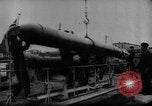
German minesweeper patrols in English Channel and allied bombers shot down during World War II.
Germans shoot down Allied planes in the Atlantic Ocean. A German minesweeper patrols the English Channel. Ship underway at rough sea. Water washes over the deck of the vessel. Men aboard a German ship. Allied bombers in flight. German antiaircraft guns fire at bombers and shoot them down. Bombers crash into the sea.
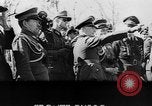
Japanese and Turkish military missions tour Eastern Front at German invitation, in World War II
Opening scene shows German Field Marshal Wilhelm Keitel gesturing as he hosts members of a Japanese military mission and a Turkish military delegation (headed by Colonel General Cemil Cahit Toydemir). At Adolf Hitler's invitation, they are on a tour of the Eastern front and English channel coasts between June 25th and July 7th, 1943, during World War 2. Here, they are seen inspecting German positions and witnessing firepower demonstration on the Russian Front near Kharkov (also Kharkiv) just south of Kursk. They observe a German artillery gun crew as they demonstrate rapid firing of their field piece. Shells explode raising black smoke. Closeup of a senior Japanese military official. Turkish and Japanese delegation visitors board two small open train cars driven by German soldiers on motorcycles adapted for the purpose. Following a pause, the scene shifts to the visiting officers inspecting German armor, including a small armored personnel carrier; a Tiger Tank of Pz.Abt.503; and other armored vehicles. They watch a Tiger tank moving along a muddy berm rotating its turret and 88mm gun as it moves. Another tank races past the camera at high speed, raising clouds of dust. A German gun crew, in a trench, fires an MG 42 heavy machine gun. They look up and camera focuses on formations of German JU 87 Stuka dive bombers flying overhead. Visiting officer peers through a periscopic viewing device, as Large explosion occurs in the field. German, Japanese, and Turkish officers converse as a huge plume of smoke rises in the background, capturing their attention.
WW2 German defensive preparations on French coast; Allied invasion scenes; Allied bombing over Germany
Slave laborers digging during the construction of the Atlantic Wall in World War II. German engineers oversee the construction. Men working around a large gun turret. Nazi German fortifications, bunkers, and artillery posts along coasts facing the Atlantic Ocean in Europe. The 380 mm gun at the Todt Battery near Cape Gris-Nez, Pas de Calais, France. 40.6 cm SK C/34 gun “Battery Lindemann” (German unit MKB 6 / MAA 244) as part of the Dover Strait coastal guns. German emplacements and troops marching along Normandy in France. A German soldier uses binoculars to watch the English Channel. Adolf Hitler and a Nazi German general. Adolf Hitler greets Benito Mussolini as the latter exits a plane in Vichy France. Allied leaders Winston Churchill, Franklin Roosevelt, Joseph Stalin, and General George C. Marshall at the Tehran Conference in 1943 during World War 2. Armies from various European countries march and prepare themselves for war against Germany. Supreme Commander General Eisenhower and other Allied generals during a meeting. Fleet of ships in sea ready to land in Normandy on D-Day. Navy and coastal command aircraft drop bombs on Nazi German submarines. Anti-aircraft guns fire at Nazi bombers. Docks damaged by German bombing receive aid from Allied countries. Cranes and hooks lower relief supplies, medicines and warfare material at dock. Warships loaded with artillery and warplanes lowered in ships by hoists. A locomotive train is being lowered from a ship. A military band plays music in a dock. Soldiers move towards the ships. British and Royal Canadian and Australian bombers at their base take off for bombing on Nazi bases at night. A soldier directs a bomber taxiing in runway. Aerial views of British bomber aircraft bombing targets in Germany at night, with immense explosions.
Joseph Stalin, Franklin Roosevelt and Winston Churchill at Tehran conference; also Yugoslavian and French resistance fighters.
General Secretary of the Communist Party Joseph Stalin, President Franklin D Roosevelt of the U.S. and Prime Minister Winston Churchill of the UK seated on porch of Soviet Embassy building in Tehran, Iran, 28 November 1943, during World War 2. Scene shifts to group of Yugoslav Partisans and closeup of their leader, Marshal Tito, at their mountain headquarters. Yugoslavian Marshal Tito smoking a pipe while standing on the porch of his headquarters with American Office of Strategic Services (OSS) Officer, Army Major Linn M. Farish, U.S. Liaison to the Partisans, and British Brigadier General Fitzroy Maclean, Winston Churchill's special envoy to the Yugoslavia leader. Next scene shows French resistance fighters with their flag on a mountaineer's pick. It reads,""Vaincre ou Mourir"" and displays a cross of Lorraine. Closeups of French resistance fighters at attention and also relaxed, smiling, and singing. Scenes of various such groups joining in the June 6, 1944 Allied invasion at Normandy, France. Aerial glimpse of D-day task force crossing the English Channel. Animated map shows Germany being attacked by Russian forces from the East, by the other allies from Britain in the West and from Italy, in the South. Allied forces moving across a pontoon bridge and engaging German forces in France. A U.S. M3 Gun Motor Carriage firing its 75mm gun. American troops firing machine guns, carrying wounded on stretchers and using flame throwers. Troops, including ambulatory wounded moving under enemy fire. Paratroopers of the 101st Airborne Division in France. One carries a wounded buddy. American troops firing a variety of artillery from under camouflage netting. French underground forces engaged in Paris. Closeup of one wearing a French Adrian helmet firing a rifle. Another throws a grenade out an apartment window. An American tank moving under the base of the Eiffel Tower as French Resistance fighters run across the area. French citizens celebrating the liberation of Paris. View from an American jeep as French people cheer. Closeups of French people. A bombed out bridge. A battlefield cemetery. Destruction and death in the wake of combat. Fallen French civilians lying on pavement. A U.S. tank slowly driving through a masonry wall. Soviet forces advancing through destroyed buildings. Chinese troops marching along the Great Wall. British troops on parade in tropics. Asian ally troops marching. Huge formation of marching U.S. soldiers. United Nations flags in the breeze.
Allied troops aboard ships and gliders head for Normandy, France for the D-day invasion during World War II.
Allied invasion of Normandy, France during World War II. U.S. General Joseph McNarney, Deputy Chief of Staff at a desk as he outlines the importance of June 6, 1944 the day Allied forces attacked the Germans in Normandy. He speaks about the decision to knock down the Nazis first and then the Japanese during the World War. He says that the invasion of Normandy was planned in November 1943. He also states how General Dwight D. Eisenhower, Supreme Commander of the Allied forces in Europe, planned and executed the invasion. He also speaks about how the U.S. Army Air Forces and the Royal Air Forces aircraft bombarded the coasts of Normandy prior to the D Day invasion. Past events show American soldiers getting onto landing crafts in England as they leave for the invasion. The soldiers aboard the ships in the English Channel. The soldiers read the Bible and comics, sleep and cook aboard the ships. On June 5th , 1944 the ships head towards Normandy for the invasion. In England gliders carrying paratroopers take off from an airfield to bombard the German positions in Normandy. British soldiers receive ration and work on motorbikes. TNT (trinitrotoluene) charges being prepared by soldiers tasked with demolition duties. British soldiers check their guns and other weapons prior to the invasion. Jeep and artillery being loaded onto aircraft.